About Polyscias elegans (C.Moore & F.Muell.) Harms
Growth Habit
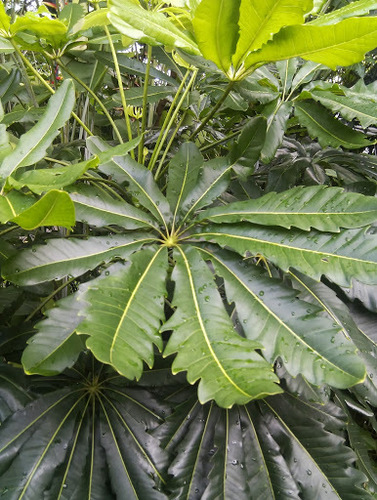
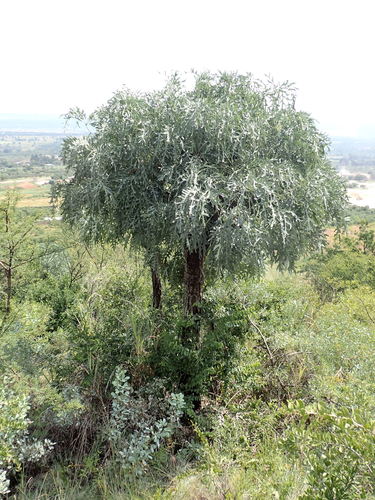
Polyscias elegans is a fast-growing, medium-sized tree that forms an attractive palm-like or umbrella-shaped crown.
Mature Tree Size
Mature trees reach up to 30 meters in height, with a trunk diameter of up to 75 cm.
Trunk Characteristics
The trunk is mostly straight, cylindrical, and unbuttressed.
Bark Texture
Young trees have smooth bark, while larger trees develop fissured, scaly, rough bark.
Leaf Arrangement
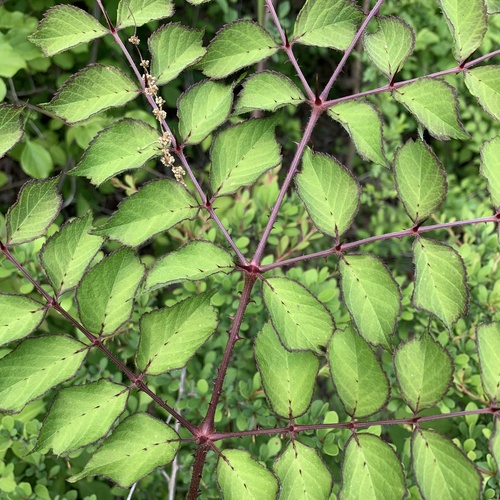
Its leaves are large, and can be pinnate or bi-pinnate, with almost opposite leaflets that often grow in groups of three.
Leaflet Dimensions & Shape
Leaflets are ovate in shape with a pointed tip, measuring 5 to 13 cm in length.
Leaf Venation
Leaf veins are noticeable on both sides of the leaflet, and net veins are visible on the underside.
Flower Characteristics & Bloom Period
Purple flowers grow on a terminal panicle, arranged in a series of racemes, and typically bloom from February to April, though flowering can occur at other times of year.
Fruit Appearance & Size
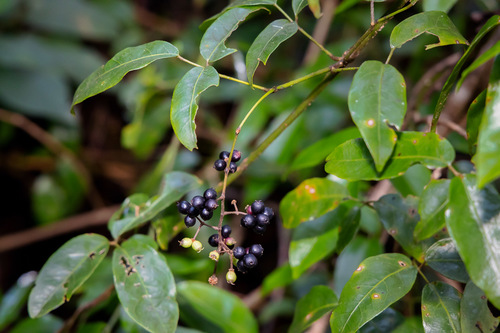
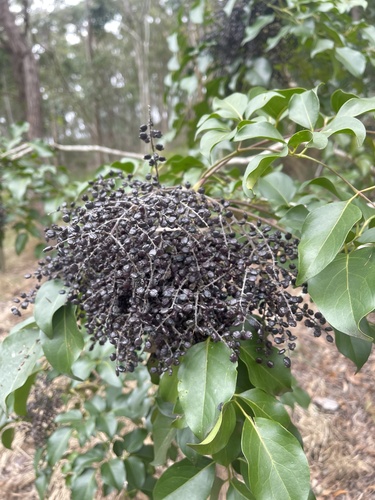
The fruit is a drupe, coloured brown or purplish black, and measures 5 to 7 mm across.
Seed Structure
The drupe contains two cells, each holding one 5 mm long seed.
Seed Viability
Seeds remain fertile for regeneration after being passed in the droppings of the pied currawong.
Fruit Dispersal Agents
The fruit is eaten by a wide variety of bird species, including the brown cuckoo dove, Australasian figbird, green catbird, Lewin's honeyeater, olive-backed oriole, pied currawong, paradise riflebird, rose crowned fruit dove, silvereye, superb fruit dove, topknot pigeon, and wompoo fruit dove.