About Pogoniulus pusillus (Dumont, 1805)
Scientific Naming and Size
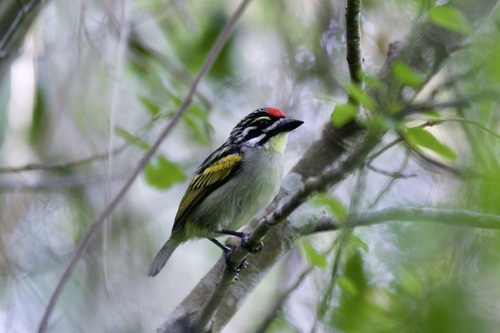
The southern red-fronted tinkerbird, with the scientific name Pogoniulus pusillus (Dumont, 1805), measures 9–10.5 cm (3.5–4.1 in) in length.
General Body Morphology
It is a plump bird, characterized by a short neck, large head, and short tail.
Upperparts Plumage
Adult individuals have black upper parts that are heavily streaked with yellow and white, plus a golden wing patch.
Head Markings
The head has a bold black and white pattern, with a red spot on the forecrown.
Underparts Plumage
The bird's underparts and rump are lemon yellow.
Age and Sex Plumage Differences
Males and females look similar to each other, but young birds do not have the red forehead marking.
Distinction from Yellow-fronted Tinkerbird
This species can be told apart from the yellow-fronted tinkerbird by the color of its forehead spot, the presence of a golden wing patch, and its generally darker overall appearance.
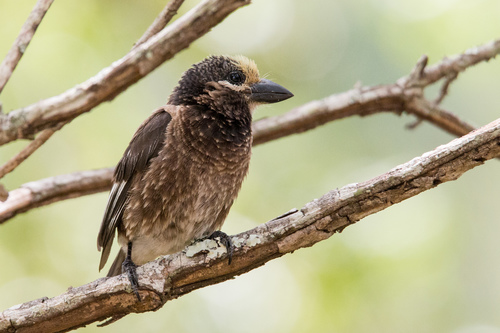
Distinction from Red-fronted Barbet
It is often mixed up with the red-fronted barbet, but it is noticeably smaller than that species, has a black moustache, a less thick bill, and does not have a broad yellow superciliary stripe.
Vocalization Characteristics
The call of the red-fronted tinkerbird is a fast repeated tink-tink-tink-tink, repeated at around 101 times per minute, and it is very similar to the call of the yellow-fronted tinkerbird.
Barbet Perching Behavior
Many barbet species perch in exposed, prominent locations.
Tinkerbird Singing Behavior
However, unlike their larger relatives, smaller tinkerbirds sing from hidden cover, and are more often heard than seen.