About Pogogyne nudiuscula A.Gray
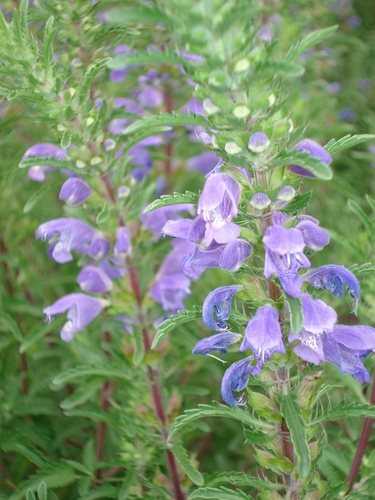
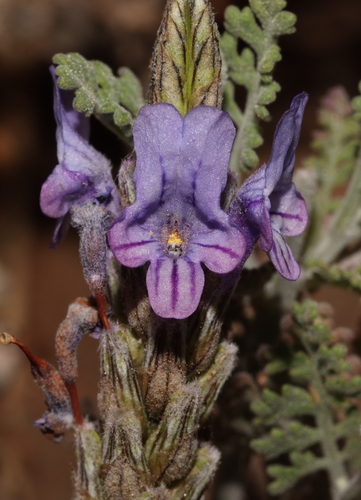
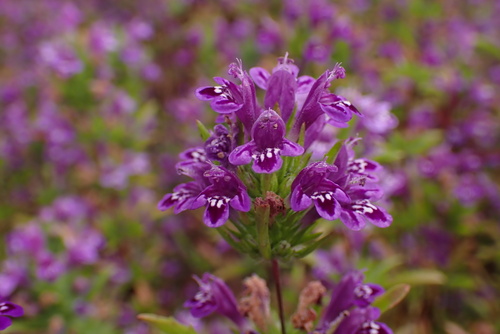
Pogogyne nudiuscula A.Gray, commonly known as Otay mesa mint, is a rare flowering plant in the mint family. It is native to southern San Diego County, California, where it is only found on Otay Mesa near the border with Baja California. While it has been recorded on land south of the Mexican border, these occurrences are probably extirpated. Today, the species is only confirmed to exist at seven vernal pool complexes just north of the border, and it is a federally listed endangered species of the United States. This annual herb grows an erect stem between 9 and 30 cm (3.5 to 11.8 inches) tall. Its foliage is strongly aromatic, and is covered in a very thin layer of straight, bristle-like hairs, or may be completely hairless. Its inflorescence is 10 to 20 mm (0.39 to 0.79 inches) wide, made up of interrupted clusters of opposite cymes. The bracts are green with sharp, pointed tips. Flowers have a 3 to 5 mm (0.12 to 0.20 inch) long tube, and a bell-shaped corolla 11 to 14 mm (0.43 to 0.55 inches) long; the corolla is purple. This species flowers from March to June. Pogogyne nudiuscula grows in coastal mesa vernal pools at elevations of 100 to 250 m (330 to 820 ft) on Otay Mesa, in southern San Diego County, California. It formerly occurred in vernal pools in extreme northwestern Baja California, Mexico, near Tijuana Airport, but these populations are likely extirpated. The plant faces many threats tied to the loss and destruction of its rare vernal pool habitat. These threats include urban development, trash dumping and pollution, damage from vehicles, fire, grazing, and changes to local hydrology.