About Podarcis pityusensis (Boscá, 1883)
Nomenclature
This species is the Ibiza wall lizard, with the scientific name Podarcis pityusensis (Boscá, 1883).
Snout-to-Vent Length
It reaches a maximum snout-to-vent length of 7 cm (3 in), though most full-grown adults are slightly smaller than this maximum.
Tail Length
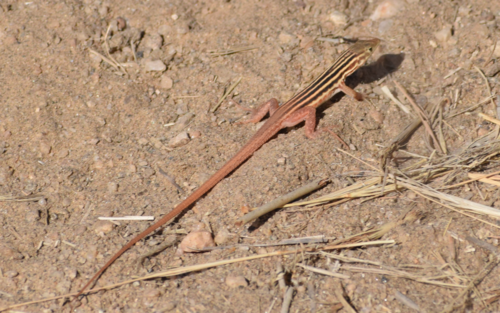
Its tail is roughly twice the length of its body.
Body Build and Scales
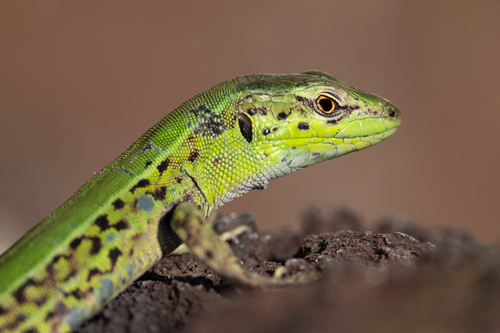
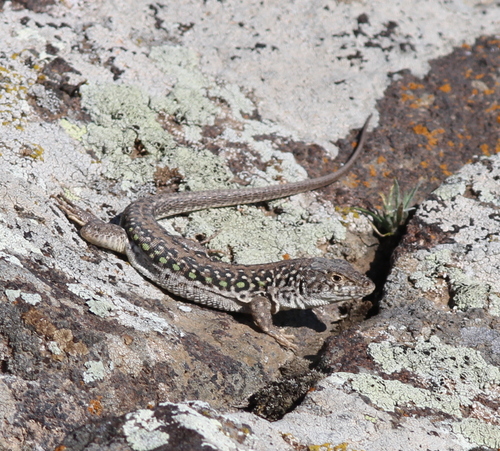
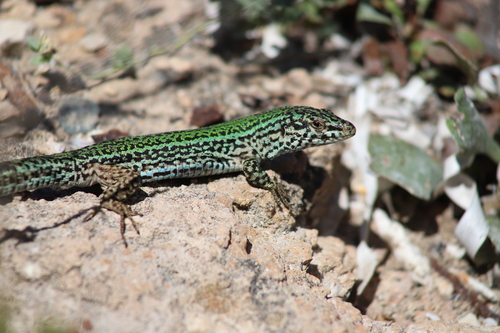
It has a robust build, with a short head, rounded body, and relatively coarse, slightly keeled scales.
Dorsal Coloration
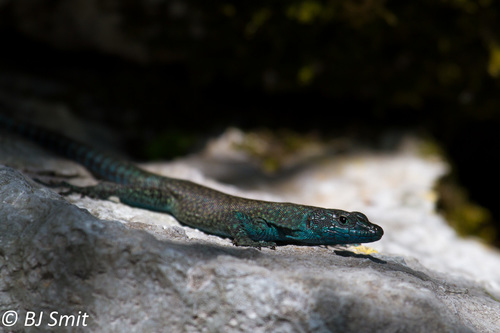
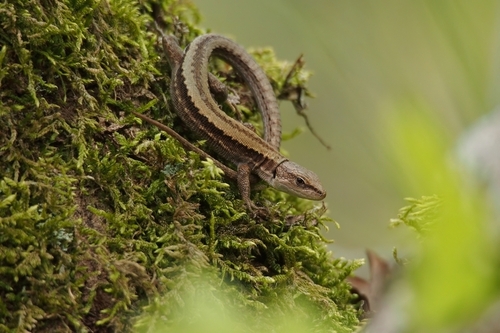
Its dorsal surface is usually green, but can also be grey or brownish.
Dorsal Markings
It typically has a clearly defined pale dorso-lateral stripe, and may have a row of dark spots or a dark line running along its spine.
Ventral Coloration and Markings
Its underside can be white, cream, grey, orange, or pink; the throat, and sometimes the belly, may have darker blotches.
Native Range
The Ibiza wall lizard is native to Ibiza, Formentera, and the surrounding rocky islets of the Balearic Islands.
Introduced Range
It has been introduced to Muella de Palma in Mallorca, Barcelona (where it was once thought to have died out, before being re-discovered in 2007 per Bruekers, 2007), the town of Aleria in southern Spain, and the island of Gaztelugatxe in northern Spain.
Altitude Range
It occurs at altitudes up to 475 m (1,558 ft) above sea level.
General Habitat Preference
It mostly lives in vegetated areas, particularly those associated with human activity.
Common Habitats
It can be found in gardens, pasture, and arable land, as well as on rocks, especially near the coast.
Islet Habitat Abundance
On some small islets, it can be very abundant, and lives almost entirely on rock.