About Podarcis carbonelli Perez Mellado, 1981
Size and Sexual Dimorphism
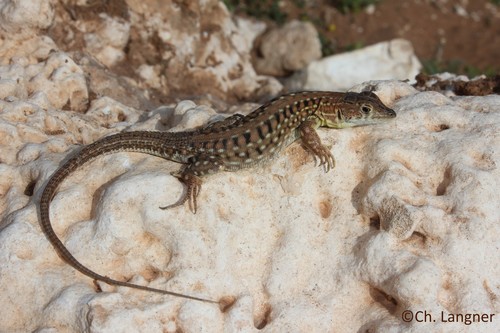
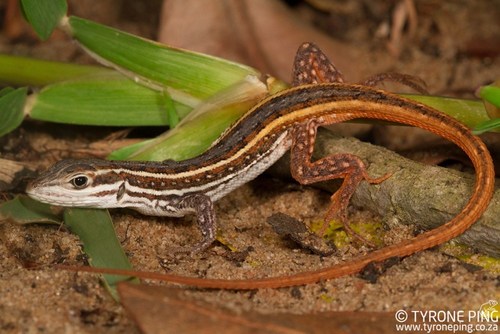
Carbonell's wall lizard (Podarcis carbonelli Perez Mellado, 1981) reaches a snout-to-vent length of 6.5 cm (2.6 in), with a tail roughly twice the length of the body. In some locations, females are typically slightly larger than males.
Dorsal Coloration
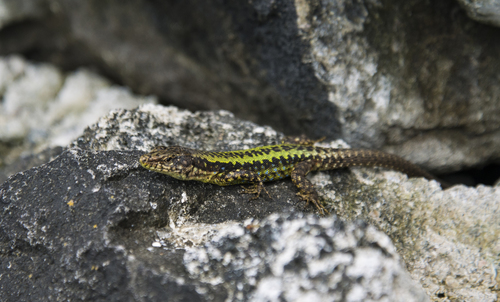
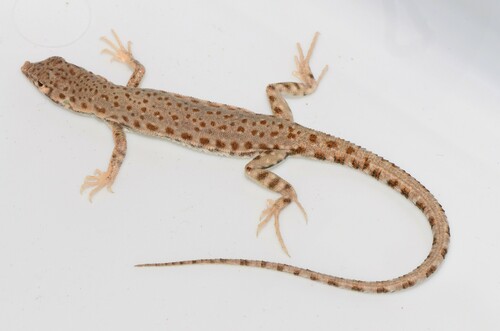
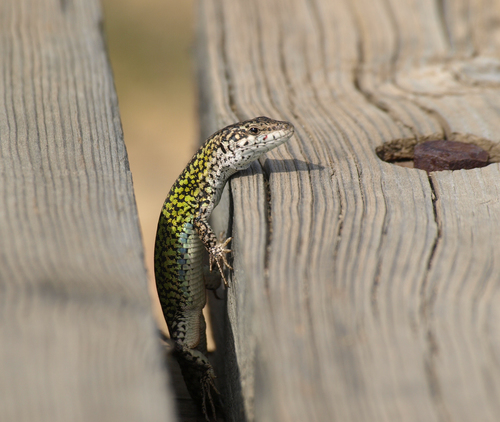
Its dorsal surface is most often grey or brown, though it can sometimes be green, especially in males, and is covered in numerous speckles arranged in rows of dark markings.
Flank Coloration
The flanks may also have a slight greenish tint, with dark reticulated markings.
Ventral Coloration
The underparts are whitish, and small blue spots often occur along the edge of the belly.
Distinction from Other Iberian Wall Lizards
This species differs from all other Iberian wall lizards by usually having greenish flanks but no green on the back.
Comparison to Bocage's Wall Lizard
It is very similar in appearance to the closely related Bocage's wall lizard, but Bocage's wall lizard generally has more clearly defined markings, a yellow, orange or pink belly, and lacks both green flanks and blue outer ventral scales.
Native Range
Carbonell's wall lizard is native to Portugal and Spain.
Population Distribution
Its range is made up of a number of isolated populations in western and central Portugal, an additional population in Coto Doñana in southwestern Spain, and a distinct subspecies located on the Berlenga Islands off the coast of Portugal.
Coastal Habitat
It is specialized for Mediterranean climates with cool to warm summers, and has stable populations along the Atlantic coast, where it occupies sand dunes with very little vegetation.
Inland Habitat and Population Trend
In contrast, the remaining inland populations in the mountainous western Sistema Central, where the species occurs up to an elevation of 1,200 m (3,937 ft), appear to be declining rapidly, an effect that is likely caused by global warming.
Reproductive Mode
Podarcis carbonelli is oviparous.
Clutch Characteristics
In central Portugal, one clutch of two eggs is usually laid each year, while on the Berlengas Islands, multiple clutches of up to four eggs are laid.
Egg Incubation Period
Eggs take between ten and fifteen weeks to hatch.