About Pluvialis fulva (J.F.Gmelin, 1789)
Scientific Name
Scientific name: Pluvialis fulva (J.F.Gmelin, 1789).
Adult Body Size
Description: Adult Pacific golden plovers are around 25 cm (9.8 in) long, with an average wingspan of 61 cm (24 in).
When fat-free at their lightest, these birds weigh approximately 135 g (4.8 oz).
Pre-Migration Weight Gain
Birds begin putting on weight in March, and reach around 200 g (7.1 oz) just before departing for their Arctic breeding grounds.
Breeding Male Plumage
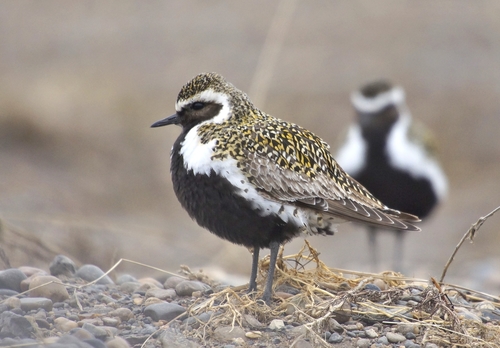
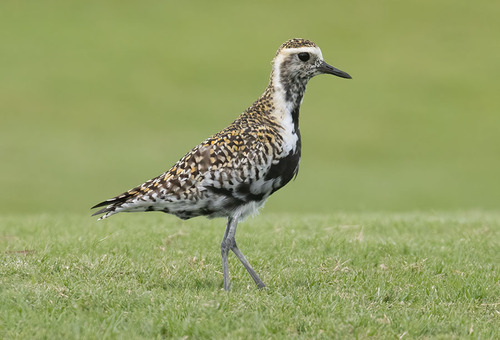
In breeding plumage, males have gold and black spotting on the crown, back, and wings.
Their face and neck are black with a white border, their breast is black, and their rump is dark.
They have a black bill, and legs that range from gray to black.
Breeding Female Plumage
Females have similar patterning, but their black breast is mottled and less distinct.
Nonbreeding Plumage
In nonbreeding plumage, males and females look identical.
The characteristic white-bordered black of the breeding face and breast is replaced with dark brown, gray, and yellowish patterning, paired with lighter underparts.
Plumage Molt Timing
Molt into breeding plumage begins in March and April, before migration starts.
Molt into nonbreeding plumage begins in the Arctic while birds are incubating eggs.
Hatchling Appearance
Downy hatchlings have gold and black spotting on the head and back, with whitish yellow underparts.
Their legs and feet are already adult-sized when they hatch.
Similar Species
This species is similar to two other plovers: the European golden plover (Pluvialis apricaria) and the American golden plover (Pluvialis dominica).
Pacific golden plovers are more similar to American golden plovers, and the two were once considered a single species called the lesser golden plover.
Compared to American golden plovers, Pacific golden plovers are slimmer, have longer legs, and usually have more yellow coloring on the back.
Species Classification
Distribution and habitat: The Pacific golden plover is a migratory shorebird.
Breeding Range and Timing
It breeds from May through July in Alaska and Siberia.
Nonbreeding Range
It migrates south to Asia, Australasia, and Pacific islands in August and September, and remains in these nonbreeding areas until April or May.
It is a rare vagrant to western Europe.
General Habitat Preferences
Although it is classified as a shorebird, it feeds mostly inland, and prefers open areas with short vegetation.
Breeding Habitat
During the breeding season, Arctic tundra provides it with insects and berries for food, as well as effective camouflage to avoid predators.
Hawaiian Local Name and Adaptation
In Hawaii, this species is known locally as kōlea, and has adapted remarkably well to human presence and human-altered environments, including backyards, parks, cemeteries, rooftops, pastures, and golf courses.
Site Fidelity
Kōlea are site-faithful, meaning each bird returns to and defends the same territory year after year.
This consistent return has led people to take special interest in observing the comings and goings of individual kōlea.
Human-Kōlea Interactions
Some observers name and feed their returning birds, and some individuals become quite tame around their regular caretakers.
Recorded Longevity
The oldest recorded kōlea lived to at least 21 years and 3 months; its exact age was unknown when it was banded.
Citizen Science Project
Kōlea are the focus of a Hawaii Audubon Society citizen science project called Kōlea Count, hosted at www.koleacount.org.
Geolocator Research Methods
The species' annual return to the same territory allows scientists in Hawaiʻi to attach tiny light level geolocator devices to the birds, and retrieve the devices the following year from the same location.
Alaska-Hawaii Migration Findings
Research using these devices has shown that the birds make the 3,000 mile (4,800 km) nonstop flight between Alaska and Hawaiʻi in 3 to 4 days.
Pre-Migration Flocking and Flight Altitude
Pacific golden plovers gather in flocks a few days before starting northward migration, and fly at altitudes ranging from around 3,000 ft (910 m) up to 16,000 ft (4,900 m).
Non-Migratory Individuals
A small number of birds do not migrate; these are most often first-year individuals, older birds, injured individuals, or birds that have not built up enough fat reserves to complete the journey.
Foraging Habitats
Food and feeding: This species forages on tundra, mowed grass, beaches, and tidal flats.
Diet Composition
It eats nearly any crawling prey, including insects, spiders, mollusks, crustaceans, and small reptiles, and also consumes berries, leaves, and seeds.
Foraging Behavior
Its foraging pattern follows a repeated run-stop-peck rhythm.
Most wintering birds feed alone within an established territory.
Non-territorial birds feed in loose groups.