About Plestiodon anthracinus Baird, 1849
Taxonomy and Common Name
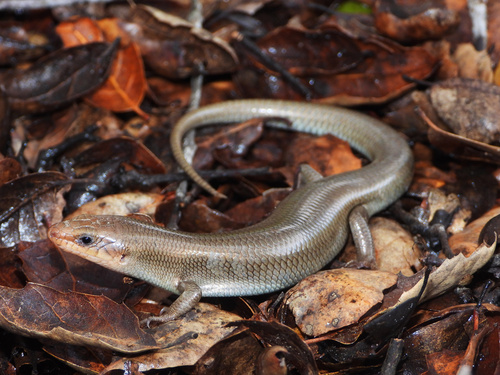
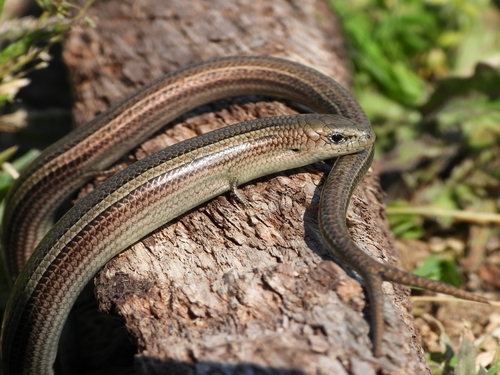
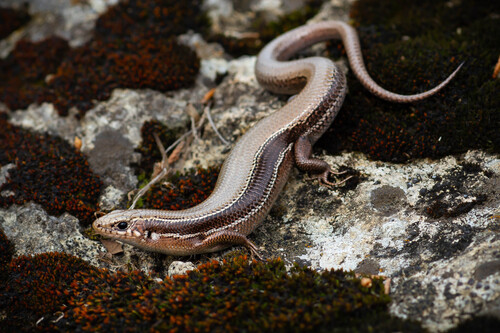
Plestiodon anthracinus Baird, 1849, commonly called the coal skink, is a mid-sized lizard with short, well-developed legs.
Limb Characteristics
In most specimens, the limbs overlap when held against the body; this is not the case for gravid females.
Size Measurements
Adult coal skinks reach a total length of 13–18 cm (5.1–7.1 in), with a maximum snout-to-vent length (SVL) of 7 cm (2.8 in).
Dorsal and Caudal Striping
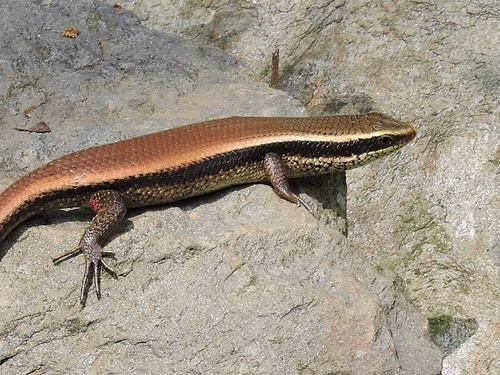
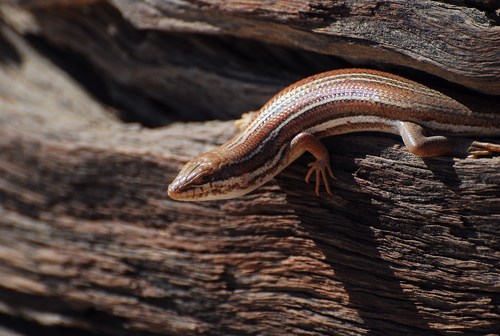
This is a four-lined skink, with light stripes that extend onto the tail.
Lateral and Head Markings
It has a broad dark lateral stripe that is 4–4.5 scales wide, and no light lines on the top of the head.
Dorsolateral Stripe Scale Position
The dorsolateral light stripe sits on the edges of the 3rd and 4th scale rows, counted from the midline of the back.
Scale Morphology
One postmental scale is present.
Breeding Season Male Coloration
During the spring breeding season, male coal skinks have reddish sides of the head, at least in some parts of the species' range.
Preferred Habitat Types
Coal skinks prefer habitats in more humid areas of wooded hillsides, where there is abundant leaf litter or loose stones. They may also occupy areas around springs, rocky bluffs overlooking creek valleys, and other mesic sites.
Predator Escape Behavior
When pursued, coal skinks take refuge in shallow water, moving to the bottom and hiding under stones or debris.
Subspecies Distribution
Two subspecies are recognized: the northern coal skink, which occurs in western New York, central Pennsylvania, and isolated colonies in the Appalachians; and the southern coal skink, which is found on the eastern Gulf coast from the Florida panhandle to Louisiana, as well as west of the Mississippi from eastern Kansas and central Missouri to eastern Texas and northern Louisiana.
Intermingled Subspecies Populations
Scattered intermingled populations of both subspecies occur in Alabama and Georgia.
Natural Threats
Natural threats to this species include various small mammals, snakes, and larger lizard species.
Anthropogenic Threats
Human activity also threatens the coal skink through habitat loss and degradation, which impacts many reptile species.
Reproduction Timing and Clutch Size
Coal skinks mate in spring or early summer, and lay clutches of 8 or 9 eggs.
Egg Dimensions
Eggs are typically around 10–11 mm in length.
Courtship Behavior
During courtship, the male first investigates and recognizes a potential female mate using pheromonal cues.
Incubation Period and Hatchling Size
Young coal skinks hatch after four to five weeks, and measure about 5 cm (2.0 in) long at hatching.
Hatchling Tail Coloration
Hatchlings have blue tails.
Subspecies Hatchling Pattern Differences
Northern coal skink hatchlings have stripes matching those of adults, while young southern coal skinks have black bodies with at most faint traces of stripes.