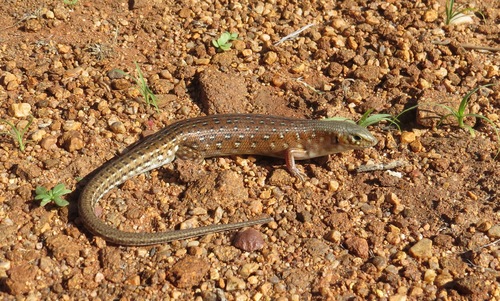
About Corucia zebrata Gray, 1855
Nomenclature
The Solomon Islands skink, with scientific name Corucia zebrata Gray, 1855, also goes by common names including prehensile-tailed skink, monkey-tailed skink, giant skink, zebra skink, and monkey skink.
Endemism and Size
It is an arboreal skink species endemic to the Solomon Islands archipelago, and is the largest known living skink species.
Diet
This skink is fully herbivorous, feeding on a variety of fruits and vegetation including the pothos plant.
Social Structure
It is one of the few reptile species that lives in a social group called a circulus. Both males and females are territorial, and often act hostile to individuals that are not part of their family group.
Genus Classification
Corucia is a monotypic genus, meaning it contains only this single species.
Subspecies Taxonomy
However, in 1997, researchers identified two subspecies: the common monkey-tailed skink (Corucia zebrata zebrata) and the northern monkey-tailed skink (Corucia zebrata alfredschmidti). One key difference between the two is that the northern subspecies is smaller, has darker eyes, and has a black sclera.
Primary Threat
This species faces serious threats to its survival from extensive logging.
Additional Population Threats
Consumption as food by indigenous Solomon Islanders and overharvesting for the pet trade have also negatively impacted wild populations.
Conservation Protections
Today, exports of this species from the Solomon Islands are restricted, and the species is protected under CITES Appendix II.
Overall Native Range
The Solomon Islands skink is native to Papua New Guinea and the Solomon Islands archipelago, an island group in the southwestern Pacific Ocean.
Common Subspecies Distribution
The common subspecies C. z. zebrata lives on the islands of Choiseul, New Georgia, Santa Isabel, Guadalcanal, Nggela, Malaita, Makira, Ugi, and Owaraha.
Northern Subspecies Distribution
The northern subspecies C. z. alfredschmidti is found on Bougainville, Buka, and the Shortland Islands; Bougainville and Buka are geographically part of the Solomon Islands archipelago, but are politically part of Papua New Guinea.
Arboreal Habitat Preference
Both subspecies are strictly arboreal, and typically inhabit the upper canopy of forested areas across their range. Adult skinks usually establish a territory within the canopy of a single tree.
Host Tree Preference
They are commonly found in strangler fig trees (Ficus sp.) when the epiphytic growth of their food plants is present there.
Modified Habitat Tolerance
They can also be found in trees in semi-cleared areas and cultivated food gardens, as long as their required food plants grow there.
Communal Group Trait
As noted earlier, the Solomon Islands skink is one of the few reptiles that lives in a communal social group called a circulus.
Reproductive Method
It reproduces via viviparous matrotrophy: the female develops a placenta to nourish her young, which are born after a 6 to 8 month gestation. This reproductive trait is rare among reptiles.
Newborn Size
Newborn skinks are large relative to their mother. Northern subspecies newborns are roughly 29 centimeters (11 inches) long and weigh 80 grams (0.18 pounds), while common subspecies newborns are 30 centimeters (12 inches) long and weigh 175 grams (0.386 pounds).
Newborn Size Comparison
Dr. Kevin Wright, former curator of reptiles at the Philadelphia Zoo, compared this size proportion to "a human mother giving birth to a six year-old".
Litter Size
Almost all pregnancies produce a single offspring, but twins are born occasionally, and herpetologist Bert Langerwerf has documented at least one case of triplets.
Juvenile Group Protection
Newborn skinks stay within their circulus for 6 to 12 months, and are protected not just by their own parents, but also by other unrelated adult skinks in the group.
Juvenile Dispersal
Juveniles typically leave to form new family groups around one year of age, sometimes even earlier. Some individuals have been recorded staying in their original group through multiple births without being expelled.
Parental Protective Behavior
Females display fierce protective behavior around the time of birth; while protective behavior toward young is rare in reptiles, this behavior lasts for a shorter time than similar protective behavior seen in most mammals.