About Penstemon rostriflorus Kellogg
Nomenclature and General Growth Form
Penstemon rostriflorus Kellogg, commonly called beak-flowered penstemon or beaked penstemon, resembles a small shrub, with stems that are woody near the base and bear many leaves.
Stem Height
Stems grow between 24 and 100 centimeters (9.5 to 39.5 inches) tall, and are usually taller than 30 centimeters (12 inches).
Stem Hairiness
Stems may be hairless or lightly hairy; some individuals are hairless near the base and covered in glandular hairs toward their ends.
Leaf Attachment
Almost all of its leaves attach directly to the stems, and are more numerous on the lower woody sections of the plant.
Basal and Lower Stem Leaf Size
The few basal leaves and lower stem leaves are 2 to 5.2 centimeters (0.8 to 2.0 inches) long, 3 to 11 millimeters wide, and end in a sharply angled point.
Basal and Lower Stem Leaf Shape
These leaves are oblanceolate, shaped like a reversed spear head with the widest portion above the midpoint, and have a tapered base that nearly forms a leaf stalk.
Upper Stem Leaf Size
Upper stem leaves share the same minimum length as lower leaves, but can reach up to 7 centimeters (2.8 inches) long and 2 to 14 millimeters wide.
Upper Stem Leaf Shape
Upper leaves are lanceolate, shaped like a spear head with the widest section closer to the base, to nearly grass-blade shaped, with their base attaching directly to the stem.
Inflorescence Size
The upper section of the stem forms an branched inflorescence called a thyrse that measures 3 to 28 centimeters (1.2 to 11.0 inches) long, and is usually more than 6 centimeters (2.4 inches) long.
Inflorescence Flower Grouping
This inflorescence holds three to twelve groups of flowers.
Lower Inflorescence Flower Arrangement
In the lower part of the inflorescence, flowers grow on longer branches, with two to five flowers per branch.
Upper Inflorescence Flower Arrangement
Higher up the inflorescence, flowers occur singly on shorter branches.
Flower Bud Color
Unopened flower buds are green-yellow with red tips.
Flower External Appearance
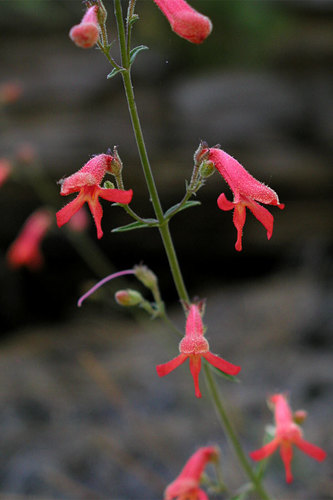
This species produces bright scarlet flowers, with projecting beak-like lobes at the top that are notched near their ends.
Flower Tube Interior
The inside of the flower tube is yellowish or orangish, and lacks floral guide lines.
Flower Length
Full flower length ranges from 2.2 to 3.3 centimeters.
Staminode Characteristics
The staminode is 1.4 to 1.6 centimeters long and extends out from the opening of the flower.
Fruit Characteristics
The fruit is a capsule 7 to 10 millimeters long and 4 to 5 millimeters wide.
Native Distribution Range
Beaked penstemon is native to the southwestern United States and Baja California, northwestern Mexico.
Baja California Distribution
In Baja California, it grows in the Sierra de Juárez mountain range, and may also grow in the northern Sierra de San Pedro Mártir.
California Distribution
Within California, it grows on the eastern side of the Sierra Nevada, and extends south into the Transverse Ranges, the Peninsular Ranges, and the San Jacinto Mountains.
Nevada Utah Arizona Distribution
In Nevada and Utah, it is found in the southern half of each state, and in the northern part of Arizona.
New Mexico Distribution
In New Mexico, it has only been recorded in two widely separated western counties: San Juan and Catron.
Colorado Distribution
In Colorado, the species is known from three southwestern counties: Dolores, Montezuma, and La Plata.
Elevation Range
It occurs at elevations from 1,200 to 3,200 meters (3,900 to 10,500 feet).
Habitat Vegetation Communities
It grows alongside sagebrush steppes, pinyon–juniper woodlands, Gamble oak scrublands, ponderosa pine forests, and mountain mahogany shrublands.
Habitat Substrate
It is often associated with sandstone outcrops and dry, sandy or rocky soils.
Baja California Habitat Specifics
In Baja California, it almost always grows in partial shade on wooded slopes and at the edges of meadows.
Cultivation Value
Beaked penstemon has a long history of cultivation, and is valued by gardeners for its moderate size, which is noticeably shorter than the related red-flowered Penstemon barbatus (golden-beard penstemon), as well as its long flowering period that runs from early to late summer.
Cultivation Soil and Hardiness
It tolerates a wide range of soils, including clay, loam, and sandy soil, and is hardy in USDA Zones 4b to 8.
Propagation Requirements
It is grown from seed, which requires 45 days of cold-moist stratification.
Garden Longevity
It is a long-lived plant when grown in garden conditions.