About Plantago maritima L.
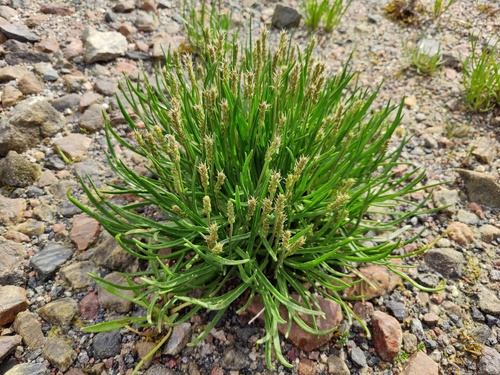
Plantago maritima L. is a herbaceous perennial plant that grows a dense rosette of sessile leaves (leaves without petioles). Each leaf is linear, 2–22 cm (0.8–8.7 in) long and less than 1 cm (0.4 in) broad. It has a thick, fleshy texture, an acute apex, and a smooth or distantly toothed margin, with three to five visible veins. Small greenish-brown flowers with brown stamens grow in a dense spike 0.5–10 cm (0.2–3.9 in) long, held at the top of a stem that reaches 3–20 cm (1.2–7.9 in) tall. Across most of its range, this species is strictly coastal, and grows in sandy soils. In some areas, it can also be found in alpine habitats along mountain streams. Aspects of this species' physiology and metabolism have been studied, with specific documented research on how its metabolism changes when exposed to elevated atmospheric carbon dioxide concentrations. Similar to samphires, the leaves of Plantago maritima L. are harvested to be eaten either raw or cooked. Its seeds are also eaten raw or cooked, and can be ground into flour.