About Plantago major L.
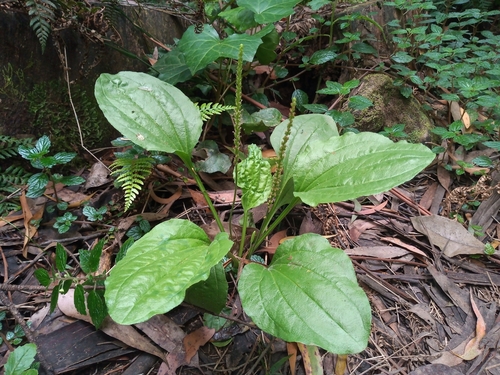
Plantago major L. is a herbaceous perennial plant that grows a rosette of leaves. The rosette is typically 15–30 centimetres (6–12 inches) in diameter, and can exceptionally reach 70 centimetres (28 inches). Each leaf is oval-shaped, normally 5–20 cm (2–8 in) long and 4–9 cm (1+1⁄2–3+1⁄2 in) broad, rarely growing as large as 30 cm (12 in) long and 17 cm (7 in) broad. Leaves have an acute apex, a smooth margin, and a distinct petiole that is almost as long as the leaf blade itself. Five to nine conspicuous veins run the full length of each leaf. Small greenish-brown flowers with purple stamens are produced in a dense spike 5–15 cm (2–6 in) long. The spike sits atop a stem that is normally 13–15 cm (5–6 in) tall, and rarely reaches 70 cm (28 in) tall. Plantago major is wind-pollinated, and propagates primarily by seeds that are held on the long, narrow spikes that rise well above the plant's foliage. A single plant can produce up to 20,000 very small, oval-shaped seeds that have a bitter taste. The species is native to most of Europe, and northern and central Asia, but has become widely naturalized in many other regions across the world. It grows in lawns, fields, along roadsides, and in other areas disturbed by human activity, and grows particularly well in compacted or disturbed soils. It is believed to be one of the first plant species to reach North America after European colonization. It was reportedly brought to the Americas by Puritan colonizers, and some Native American peoples gave it the common name "white man's footprint", because it thrived in the disturbed and damaged ecosystems around European settlements. Its ability to survive frequent trampling and colonize compacted soils makes it useful for soil rehabilitation: its roots break up hardpan surfaces, while simultaneously holding soil together to prevent erosion. Plantago major seeds are a common contaminant in cereal grain and other crop seeds, and this has contributed to its current worldwide distribution. The mature plant contains pliable, tough fibres that can be used to make small cords, fishing line, sutures, or braiding in survival situations. Some cultivars are planted as ornamental plants in gardens, including 'Rubrifolia' with purple leaves, and 'Variegata' with variegated leaves. Young, tender leaves are edible as a salad green, but they quickly become tough and fibrous as they age. Older leaves can be cooked and added to stews. The seeds are very small, which makes them tedious to gather, but they can be ground into a flour substitute or extender. Plantago major contains phytochemicals including allantoin, aucubin, ursolic acid, flavonoids, and asperuloside. Plantain extract has been studied for its potential health effects. In folk medicine, plantain leaves were commonly used to make skin poultices for wounds, sores, or insect stings. The root was used to treat fever and respiratory infections.