About Pittosporum bicolor Hook.
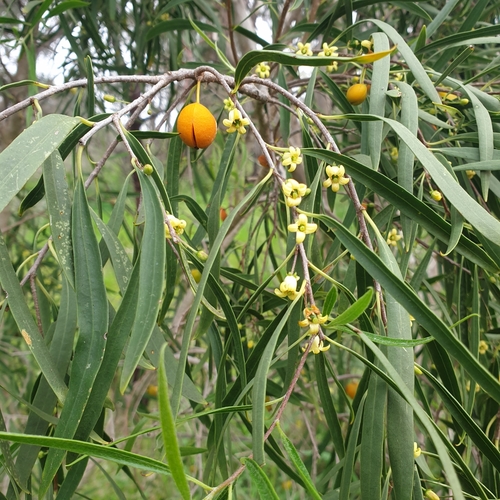
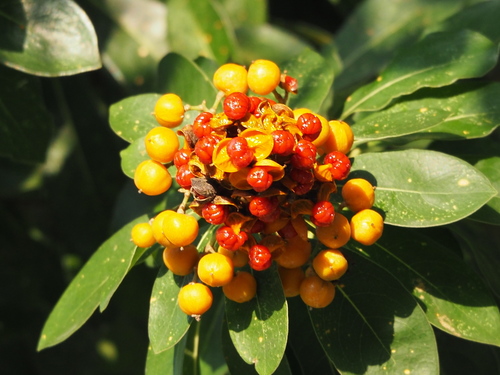
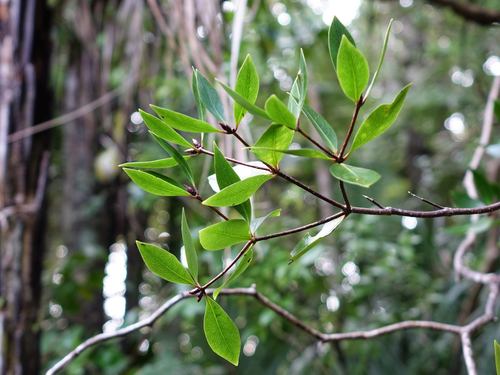
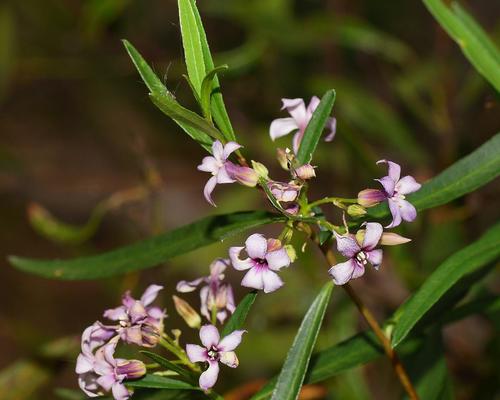
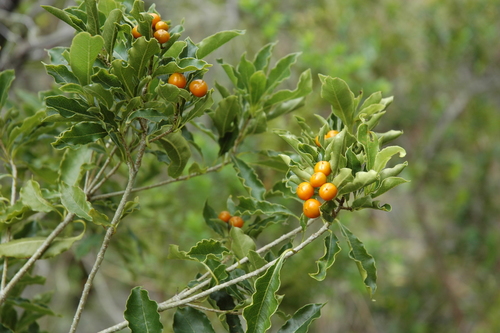
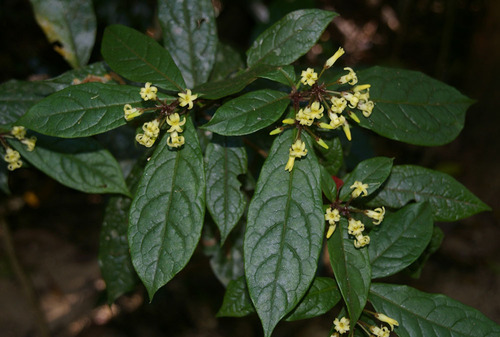
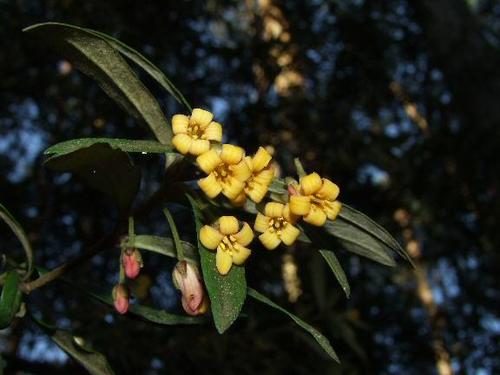
Pittosporum bicolor Hook. has narrow leaves that range in shape from lanceolate to slightly ovate. Leaves are typically 2–8 cm long and 5–18 mm wide, with margins that are either flat or distinctly recurved, and an apex that is obtuse to subacute. Leaves are arranged alternately along the stem. As the species name bicolor suggests, its most distinctive feature is the contrasting color of the two leaf surfaces: the adaxial (upper) surface is glossy dark green, while the abaxial (lower) surface ranges from light green to silver-grey. The abaxial surface is densely covered in fine white hairs, and the adaxial surface occasionally has a sparse coating of fine white hairs as well. Flowering takes place in spring. The attractive flowers usually grow at stem nodes, and may be solitary, terminal, or borne in small groups. Flowers are bell-shaped. The perianth has 5 sepals that are 5–6 mm long, curve slightly inward at the apex, and have fine white hairs on their lower surface. The 5 petals are 8–11 mm long and noticeably recurved; petal color on the outside ranges from dark burgundy red to yellow, and is typically lighter on the inner surface. Each flower usually contains 5 stamens and a single pistil, with a superior ovary that is densely covered in fine hairs. Flowers grow on long, hair-covered pedicels. The fruit is a globose woody capsule, covered in fine white hairs, that changes color from orange to brown as it matures. When mature, the capsule splits in half to expose rows of 8–20 sticky red or orange seeds. Conspicuous dark valves are visible on the inner face of an open mature capsule. The bark ranges in color from grey to light brown; lower on the trunk, it is smooth and somewhat scaly, while higher up it is rougher and papery. The plant grows in a conical shape, and typically reaches 2–10 metres in height, though it may occasionally grow taller. Pittosporum bicolor is found across all of Tasmania and the Bass Strait Islands. In New South Wales and Victoria, it is loosely restricted to the southeasternmost parts of both states. It grows as a shrub or small tree in gullies and the shrub understorey of wet sclerophyll forests, and is tolerant of shaded conditions. It prefers to grow in moist, well-drained soils, and does not usually occur at altitudes higher than 1,000 metres above sea level. It is not uncommon for this species to grow as an epiphyte on soft tree fern species such as Dicksonia antarctica, which may be an adaptation to prevent seedlings from being eaten by browsing mammals. P. bicolor is a relatively inconspicuous plant, so it is not widely cultivated. However, its attractive, strongly scented flowers make it appealing to some gardeners. It prefers well-draining soil, grows well in a sunny position, and also thrives in sheltered or shaded locations. While it can survive in dry soils, it prefers moist or damp soils similar to those found in its natural habitat. It tolerates heavy pruning well. It can be propagated from either seed or cuttings. Ripe seeds can be collected and planted directly, and germinate easily. Cuttings should be taken from semi hardwood, and must include a heel at the base of the cutting. Propagation by seed is usually more successful than propagation by cuttings, but care should be taken when planting seeds because species in this genus hybridize easily.