About Pinus torreyana Parry ex Carrière
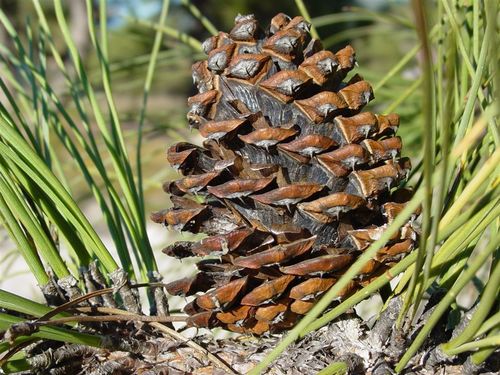
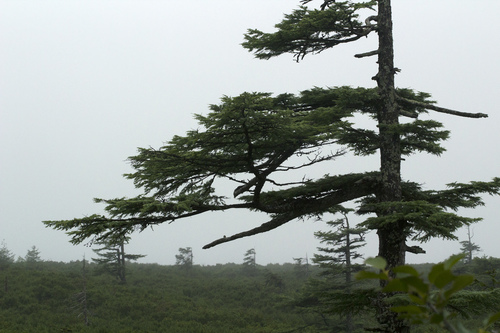
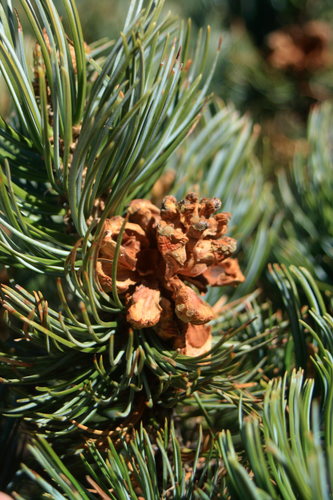
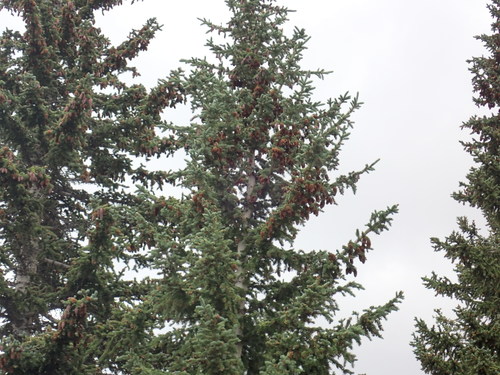
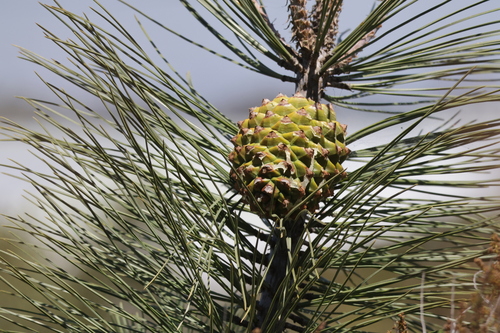
Pinus torreyana Parry ex Carrière, commonly known as Torrey pine, is a broad, open-crowned pine tree. In the wild, it grows 8–17 meters (26–56 ft) tall. Its leaves, called needles, are 25–30 centimeters (9.8–11.8 in) long, and are grouped five to a cluster. Like all pines, Torrey pine needles form clusters called fascicles, with each species having a set number of needles per fascicle; Torrey pines always have five needles per fascicle. Its cones are stout and heavy, typically 8–15 cm (3.1–5.9 in) in both length and width. The cones contain large, hard-shelled but edible pine nuts. Like all pines, Torrey pines produce strobili: structures that function like flowers but resemble small cones. Male Torrey pine strobili look like yellow buds, while female strobili look like small red cones. Torrey pines are sometimes affected by witch's broom, also called "gorilla's nest", which is an unusually dense cluster of needles that resembles a bird's nest, caused by disease or other factors. This species has two recognized subspecies or varieties, which are distinguished by physical characteristics and may also differ in their terpenoid profiles, including compounds such as beta-phellandrene, limonene, and cineole. The current wild population of Pinus torreyana is restricted to a narrow strip along the Southern California coast in San Diego. A second population of the variety Pinus torreyana var. insularis grows in two groves on Santa Rosa Island, one of California's Channel Islands off the coast of Santa Barbara. The species' current range along the semi-arid coasts of San Diego and Santa Rosa Island, where annual rainfall is less than 15 inches, is likely a relict of a much more extensive distribution that existed during the Ice Age. Coastal fog in spring and summer along these coasts adds enough moisture to supplement the region's fairly low winter rainfall, allowing the species to survive in its wild habitat. The native habitat of Pinus torreyana is coastal sage scrub plant community. It grows slowly in dry, sandy soil, and has an extensive root system. A tiny seedling can quickly grow a taproot down 60 centimeters (24 in) to seek moisture and nutrients, while the roots of a mature tree can extend as far as 75 meters (246 ft). Exposed trees battered by coastal winds often twist into sculptural shapes resembling large bonsai, and rarely grow taller than 12 m (39 ft). Its seeds are eaten by birds and rodents. Like most pine species, Torrey pine seeds have an attached wing, but in this species the wing is papery, breaks off easily, and is entirely non-functional. Because of this, the tree is completely reliant on animals to disperse its seeds. On the mainland, the California scrub jay (Aphelocoma californica) is the most important species for seed dispersal. Scrub jays, and possibly also squirrels, are thought to spread Torrey pines into adjacent parklands from residential gardens around San Diego. The caterpillars of the moth Gloveria arizonensis have been confirmed to feed on this tree in the wild. Subjecting Torrey pine seeds to moist cold, a process called stratification, encourages germination. Historically, the Kumeyaay Native American tribe ate the pine nuts of this species. Although Torrey pine is considered endangered in the wild, it is often planted as an ornamental tree around San Diego, in coastal and inland southern California, and even in California's Central Valley. One tree planted in a San Diego suburb in the 1940s or 1950s has grown tall, straight, and to a large size of 108 feet (33 m). According to Shipley Nature Center, cultivated Torrey pines can reach 148 ft (45 m) in height. As of 2020, the tree is sold by at least ten different plant nurseries across California.