About Pinus sylvestris L.
Pinus sylvestris L., the Scots pine, is an ancient evergreen coniferous tree. A fossil seed cone of Pinus montana fossilis, sent by Naturmuseum Senckenberg to the Swedish Museum of Natural History, has been dated to the late Pliocene epoch (Reuverian stage, around 2.6 million years ago). Its great longevity may be tied to its genetics: during the haploid stage of the Scots pine’s life cycle, its genes experience stronger negative selection, which makes the selective removal of alleles carrying potentially harmful mutations effective via efficient natural selection. Mature modern trees can grow up to 35 metres (115 feet) tall with a trunk diameter of 1 metre (3 ft 3 in); on highly productive sites, exceptional specimens can reach over 45 m (148 ft) tall and 1.7 m (5+1⁄2 ft) in trunk diameter. The tallest recorded specimen is a 210-year-old tree growing in Estonia that stands 46.6 m (153 ft) tall. Its typical lifespan ranges from 150 to 300 years, while the oldest recorded specimens in Lapland, Northern Finland are over 760 years old.
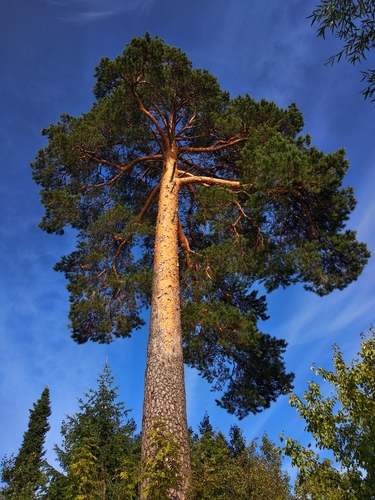
Young Scots pine bark is thick, flaky and orange-red; mature bark becomes scaly and gray-brown, and the upper portion of the trunk sometimes retains the younger orange-red bark. Mature trees have a distinct growth habit: a long, bare, straight trunk topped by a rounded or flat-topped cluster of foliage. Shoots are light brown, with a spirally arranged scale-like pattern. On mature trees, the leaves (needles) are glaucous blue-green, often darkening to dark yellow-green in winter. They are 2.5–5 centimetres (1–2 inches) long and 1–2 millimetres (1⁄32–3⁄32 in) broad, produced in fascicles of two with a persistent gray 5–10 mm (1⁄4–3⁄8 in) basal sheath. On vigorous young trees, needles can reach twice this length, and occasionally grow in fascicles of three or four on the tips of strong shoots. Needles persist for 2–4 years in warmer climates, and up to nine years in subarctic regions. Seedlings up to one year old produce juvenile leaves: these are single (not paired), 2–3 cm (3⁄4–1+1⁄4 in) long, flattened, with a serrated margin.
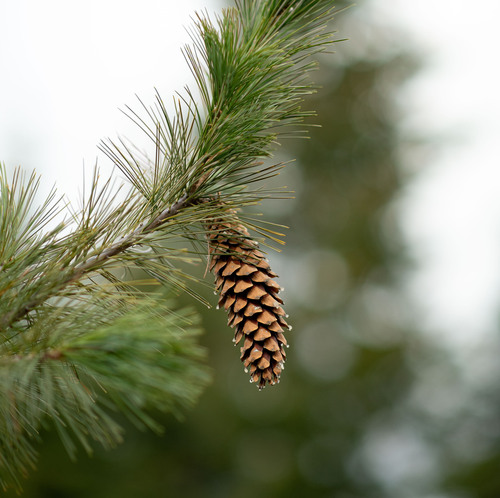
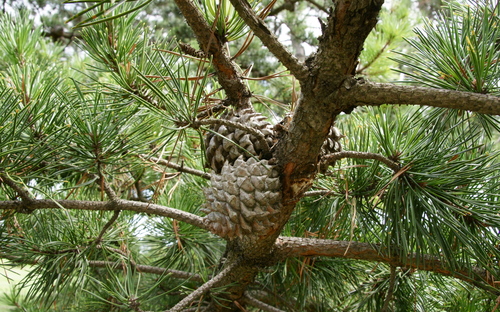
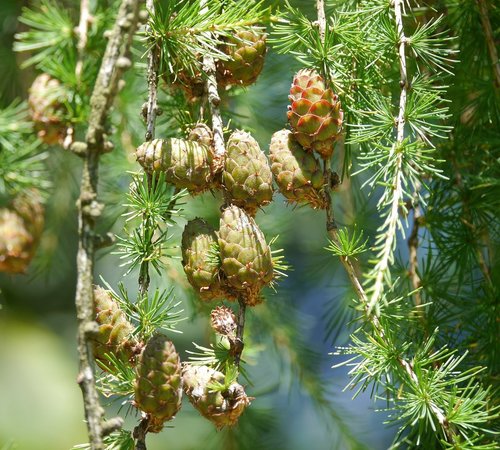
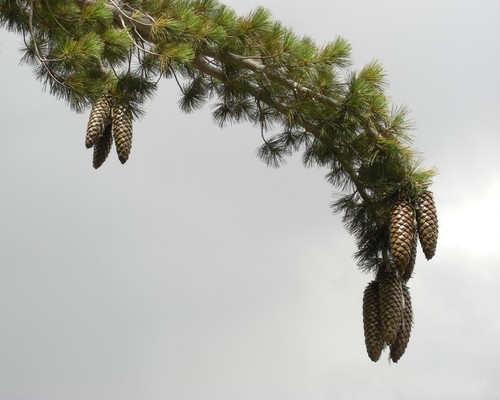
Seed cones are red at pollination, then become pale brown and globose, with a diameter of 4–8 mm (5⁄32–5⁄16 in) in their first year. They expand to their full size in their second year, taking on a pointed ovoid-conic shape and starting out green before maturing to gray-green or yellow-brown, reaching 3–7.5 cm (1+1⁄8–3 in) long. The cone scales have a flat to pyramidal apophysis (the external part of the cone scale), with a small prickle on the umbo (the central protuberance). The seeds are blackish, 3–5 mm (1⁄8–3⁄16 in) long with a pale brown 12–20 mm (1⁄2–13⁄16 in) wing, and are released when cones open in spring 22–24 months after pollination. Pollen cones are yellow, occasionally pink, 8–12 mm (5⁄16–15⁄32 in) long, with pollen release occurring in mid to late spring.
Pinus sylvestris is the only pine native to northern Europe, with a range extending from Western Europe to Eastern Siberia, south to the Caucasus Mountains and Anatolia, and north to well inside the Arctic Circle in Fennoscandia. In the northern part of its range, it grows from sea level up to 1,000 m (3,300 ft); in the southern part of its range, it is a mountain tree growing at 1,200–2,600 m (3,900–8,500 ft) altitude. Its range overlaps with the habitat of T. piniperda, making this beetle a primary pest of the tree. The species grows mainly on poorer sandy soils, rocky outcrops, peat bogs, or near the forest limit. On fertile sites, it is outcompeted by other tree species, most often spruce or broad-leaved trees.
Scots pine forms either pure stands or mixed forests with Norway spruce, common juniper, silver birch, European rowan, Eurasian aspen and other hardwood species. In central and southern Europe, it grows alongside many additional species, including European black pine, mountain pine, Macedonian pine, and Swiss pine. In the eastern part of its range, it occurs with Siberian pine among other species. In 2020, black spot needle blight was found on hundreds of Pinus sylvestris var. mongolica trees at four forest farms in northeastern China. The disease first appears on the upper section of needles; infected needles then wither and gradually develop light black spots while still remaining green. As this fungal disease progresses, the needles eventually die and turn gray with many dark black spots. The causal fungus was identified as Heterotruncatella spartii (in the family Sporocadaceae) using morphological and molecular methods.
Pinus sylvestris is an important forestry tree. Its wood is used for pulp and sawn timber products. New seedling stands can be established through planting, sowing, or natural regeneration. Commercial plantation rotations range between 50 and 120 years, with longer rotations used in northeastern areas where growth is slower. In preindustrial Scandinavia, the species was used to produce tar; the industry has almost disappeared, though a small number of active tar producers still exist. Scots pine has also been used as a source of rosin and turpentine. Its wood is pale brown to red-brown, and used for general construction work. It has a dry density of around 470 kg/m3 (varying with growth conditions), an open porosity of 60%, a fibre saturation point of 0.25 kg/kg, and a saturation moisture content of 1.60 kg/kg. Pine fibres are used to make a textile called vegetable flannel, which has a hemp-like appearance but a tighter, softer texture.
Scots pine has been widely planted in New Zealand and much of the colder regions of North America; it was one of the first trees introduced to North America, around 1600. It is listed as an invasive species in some areas of North America, including Ontario and Michigan. It has been widely used in the United States for the Christmas tree trade, and was one of the most popular Christmas trees from the 1950s through the 1980s. It remains popular for this use, though it has been surpassed in popularity by species such as Fraser fir and Douglas-fir. Despite being invasive in parts of eastern North America, it does not often grow well there, partly due to differences in climate and soil between its native habitat and eastern North America, and partly due to damage from pests and diseases. When not tended as they are in Christmas tree cultivation, the trees often grow in a twisted, irregular form. Scots pines may be killed by the pine wood nematode, which causes pine wilt disease. The nematode most often attacks trees that are at least ten years old, and often kills infected trees within a few weeks. In the past, the species was extensively grown and used by the coal mining regions of Flanders, Belgium, where it was used to reinforce tunnels because it produces a cracking sound when it needs to be replaced. Large forest patches dominated by the species are still scattered across the Flemish countryside.