About Pinus monticola Douglas ex D.Don
Taxonomic Identity
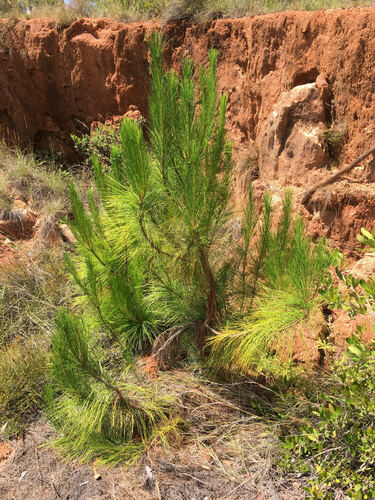
Western white pine, with the scientific name Pinus monticola Douglas ex D.Don, is a large tree that typically grows 30 to 50 meters (98 to 164 feet) tall. It belongs to the white pine group, Pinus subgenus Strobus.
Needle Structure
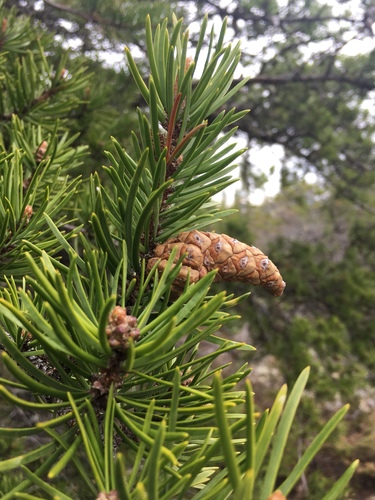
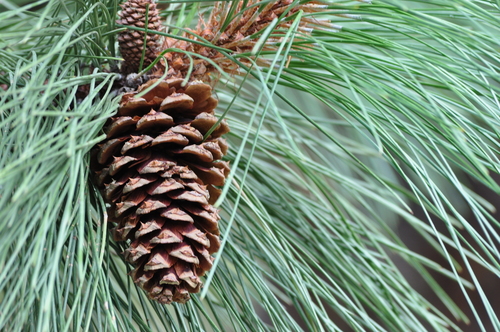
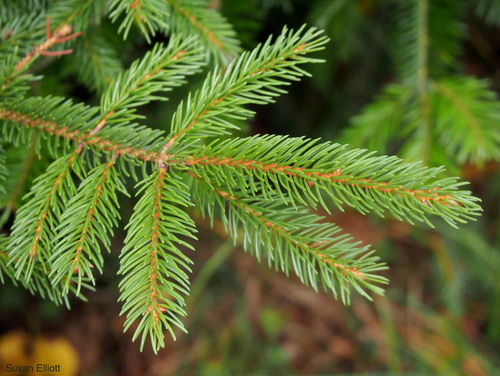
Like all members of this group, its leaves (called needles) grow in fascicles (bundles) of five, with a deciduous sheath. The needles are finely serrated, and measure 5 to 13 centimeters (2 to 5 inches) long.
Cone Characteristics
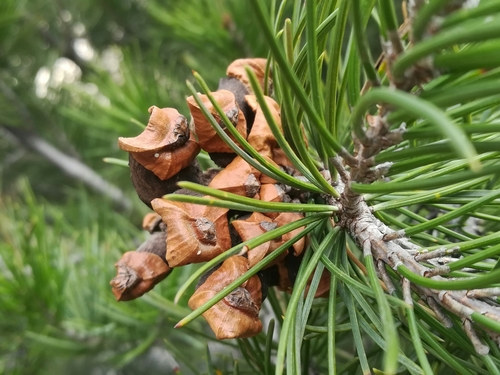
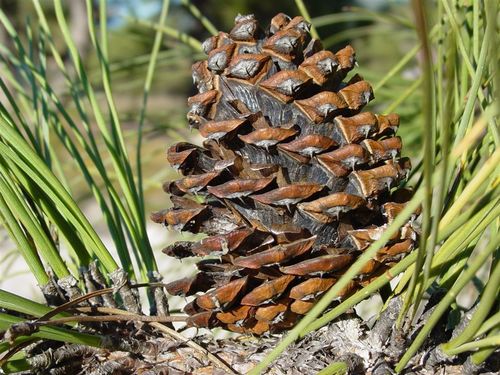
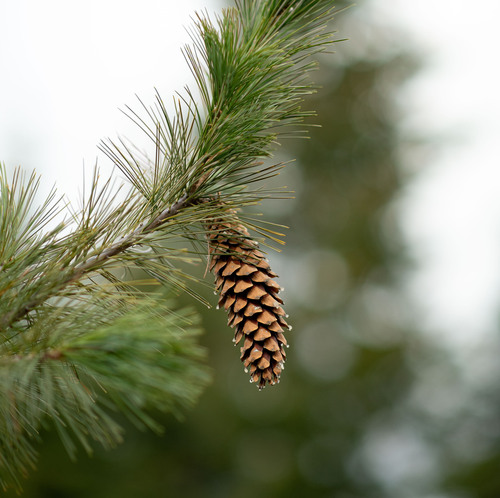
Cones appear on this species even when trees are young; they are long and slender, 12 to 32 centimeters (4 3/4 to 12 1/2 inches) long and 3 to 4 centimeters (1 1/4 to 1 1/2 inches) broad when closed, opening to 5 to 8 centimeters (2 to 3 1/4 inches) broad. The cone scales are thin and flexible.
Seed Characteristics
The seeds are small, 4 to 7 millimeters (3/16 to 1/4 inch) long, and have a long slender wing 15 to 22 millimeters (9/16 to 7/8 inch) long.
Branch Growth Pattern
Branches grow in regular whorls, with one whorl produced each year. This growth pattern is very distinct in narrow trees growing in dense stands, while trees growing in open areas may develop a more rounded form with wide-reaching limbs.
Bark Traits
When the tree reaches maturity, its bark is shaped into small, checkered units.
Geographical Distribution
This species grows in humid mountain areas of the Western United States and Western Canada, including the Sierra Nevada, the Cascade Range, the Coast Range, and the northern Rocky Mountains.
Elevation Range
Its elevation range is 600 to 1,800 meters (2,000 to 5,900 feet) above sea level in eastern Washington and Oregon's Blue Mountains, and 1,800 to 3,100 meters (5,900 to 10,200 feet) on the western face of the Sierra Nevada, reaching as far south as the headwaters of the Kern River.
Habitat Associations
It often grows in forests alongside fir and hemlock species, particularly shade-tolerant fir and hemlock. It benefits from disturbances that remove competing species, including low-severity fires that do not destroy all of its cone-protected seeds.
Soil Adaptation
It is also well adapted to grow in poor, rocky soils.
Population Decline Causes
Once abundant in northern Idaho, Western white pine populations declined drastically between the late 19th century and the late 20th century, due to logging, wildfires, white pine blister rust, and a bark beetle epidemic.
Restoration Efforts
Since 1970, millions of Western white pine seedlings have been planted to replace these losses.
Blister Rust Introduction
White pine blister rust, caused by the fungus Cronartium ribicola, was accidentally introduced from Europe in 1909.
Blister Rust Impact
The United States Forest Service estimates that 90% of all Western white pines west of the Cascades have been killed by blister rust. Large original stands have been replaced by other pine or non-pine species.
Blister Rust Range Impact
This rust has also killed much of the whitebark pine population outside of California. Blister rust infestations are less severe in California, and large numbers of both Western white pine and whitebark pine have survived there.
Blister Rust Resistance
Resistance to blister rust is a genetic trait; due to the genetic variability of Western white pine, some individual trees are relatively unaffected by the disease.
Resistant Tree Breeding Program
The United States Forest Service runs a program to locate and breed blister rust-resistant Western white pine and sugar pine. Seedlings of these resistant trees have been planted in the wild.
Traditional Native American Uses
Historically, Native Americans reportedly chewed the gum of this tree to treat coughs, and used its pitch to fasten arrowheads and coat fishing and whaling tools.
Colonial Lumber Uses
European colonists used Western white pine and Eastern white pine for softwood lumber, and both species are considered excellent for molding and carving. First Eastern white pine, and later Western white pine, were used to build transcontinental railroads in the late 19th century.
Early 20th Century Uses
In the early 20th century, white pine was used for house construction and match making.
Ornamental Use
Western white pine is also widely grown as an ornamental tree.