About Pinus strobiformis Engelm.
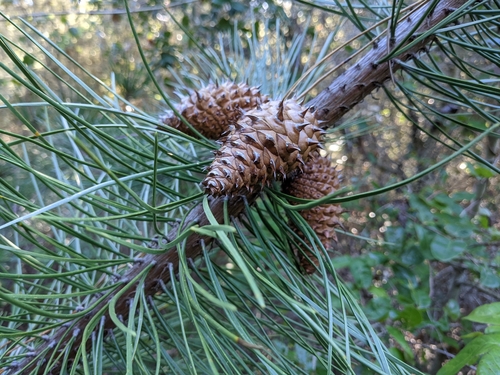
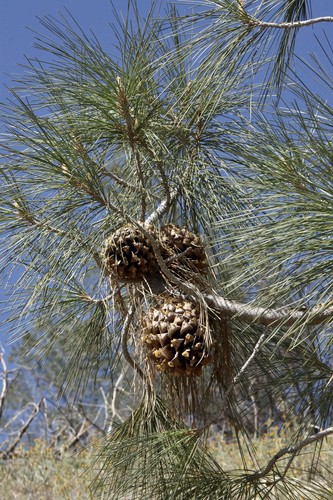
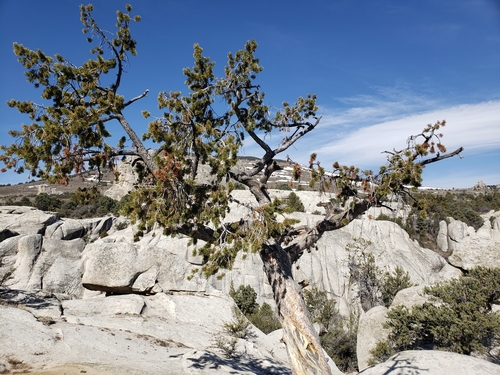
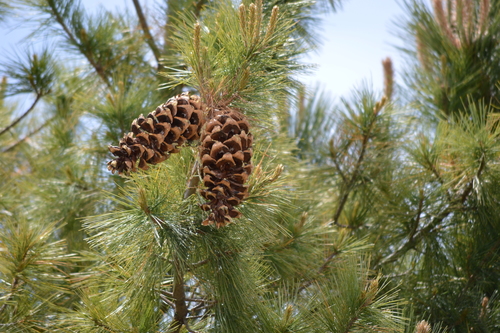
Pinus strobiformis Engelm. belongs to the white pine group, Pinus subgenus Strobus. It is a straight, slender tree that reaches 30 metres (98 ft) tall, rarely growing as large as 40 metres (130 ft), with a trunk diameter of up to 1 metre (3 ft 3 in). On young trees, the bark is smooth and silvery-grey; as the tree ages, the bark becomes furrowed and turns red-brown or dark grey-brown. Its branches spread outward and grow upward. Twigs are slender and pale red-brown when young, turning smooth grey or grey-brown with age. The buds are ellipsoid, red-brown, and resinous. Its leaves, called needles, grow in bundles (fascicles) of five. The needles are spreading, 8–14 cm long, 0.6-1.0 mm in diameter, straight, slightly twisted, and pliant. They range in color from dark green to blue-green, and persist on the tree for 3–5 years. The upper adaxial surfaces, which face the center of the fascicle, are noticeably whitened by narrow stomatal lines. The lower abaxial outer surfaces, which face away from the center of the leaf fascicle, have no visible stomatal lines. The needle margins are sharp, razor-like, and finely serrulate, with a tip that is narrowly acute to short-subulate. Each fascicle has a deciduous sheath 1.5-2.0 cm long that is shed early. The cones of this species are very large, measuring 16–50 cm long and 9–11 cm broad. The cone scales have a characteristic prolonged apex that is often recurved or S-shaped. The seeds are large with a very short wing, and are dispersed mainly by birds, particularly the Mexican jay. This species is native to the Sierra Madre Occidental mountains of Mexico, occurring from a short distance south of the US–Mexico border south through Chihuahua and Durango to Jalisco. It rarely forms pure stands, and instead grows alongside other native conifers, including Durango pine (Pinus durangensis), Arizona pine (Pinus arizonica), American aspen (Populus tremuloides), Durango fir (Abies durangensis), Douglas-fir (Pseudotsuga menziesii), and the Mexican subspecies of Engelmann's spruce (Picea engelmannii subsp. mexicana). It is a drought tolerant tree, but larger populations grow in cool, moist sites in association with other pines. Two species of dwarf mistletoe exclusively parasitize Pinus reflexa in southeastern Arizona, southern New Mexico, and the Sierra del Carmen in northern Mexico: Arceuthobium apachecum and Arceuthobium blumeri. Both species sometimes cause the formation of witch's brooms, and heavily infected stands have mortality rates up to 30 times higher than uninfected stands.