About Pinus remota (Little) D.K.Bailey & Hawksw.
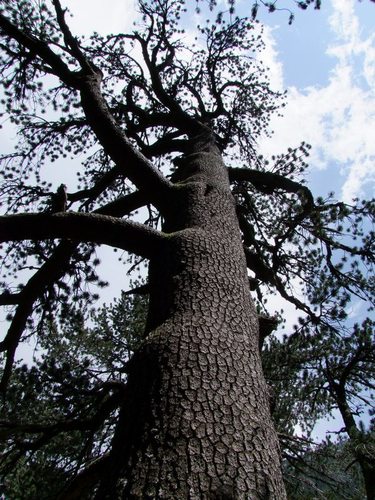
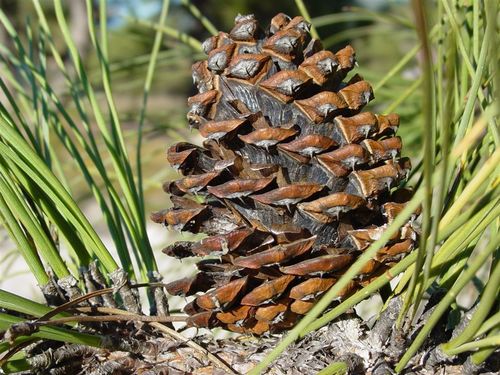
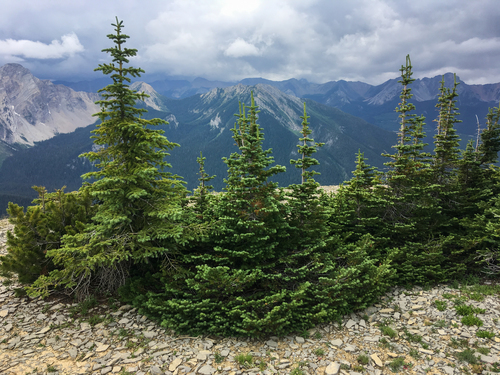
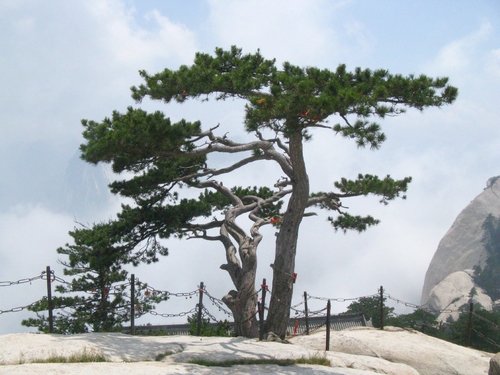
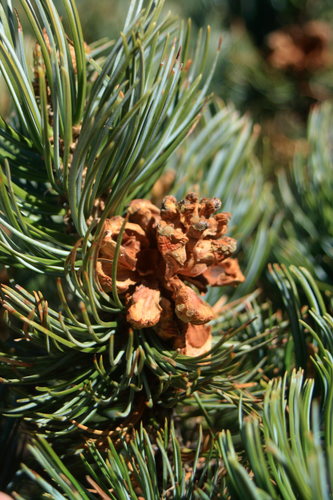
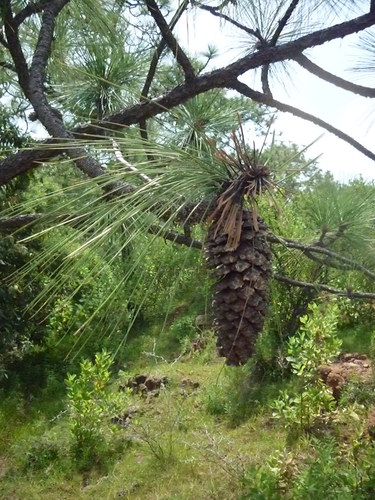
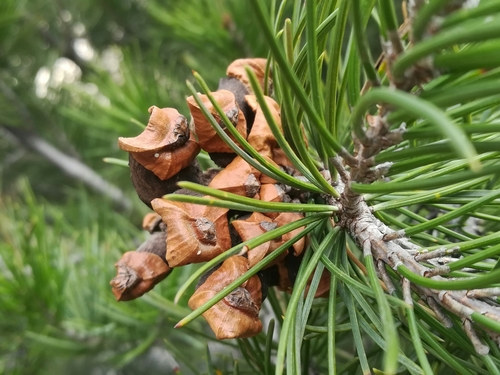
Pinus remota (Little) D.K.Bailey & Hawksw. is a small tree or large shrub that grows 3–10 meters tall, with a trunk diameter of up to 40 cm. Its bark is thick, rough, and scaly. Its leaves, called needles, grow in a mix of pairs and groups of three, mostly in pairs; they are slender, 3–5 cm long, and dull gray-green, with stomata on both their inner and outer surfaces. The cones of this species are squat and globose, measuring 3–5 cm long and wide when closed. They start out green, and ripen to a yellow-buff color when they are 18–20 months old. The cones have only a small number of thin scales, with typically 5 to 12 fertile scales. When mature, the cones open to 4–6 cm wide, and retain the seeds on their scales after opening. The seeds are 10–12 mm long, with a very thin shell, a white endosperm, and a vestigial 1–2 mm wing. They are dispersed by Woodhouse's scrub jays, which pluck seeds out of open cones to use as food. Jays store many seeds for later use, and some stored seeds are not eaten and are able to grow into new trees. This species is distributed in western Texas, United States, on the southern edge of the Edwards Plateau and in the hills between Fort Stockton and Presidio, and also in northeastern Mexico, mainly in Coahuila with small populations extending just into Chihuahua and Nuevo León. It grows at low to moderate altitudes, from 450–700 m on the Edwards Plateau and from 1200–1800 m across the rest of its range. It is an uncommon species, forming small, scattered populations that are usually found on dry, rocky sites and arroyos; the bare rock in these locations lowers the chance of wildfire spreading easily. Its edible seeds are occasionally collected just like seeds from other pinyon pines, and sold as pine nuts. Because it grows in a barren, dry habitat, small, infrequent seed crops are normal, which reduces the species' economic value. It is occasionally planted as an ornamental tree; its notable tolerance for drought and even semi-desert conditions makes it a valuable plant for hot, dry locations.