About Pinus pungens Lamb.
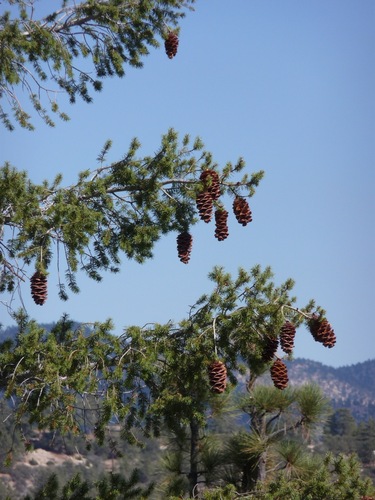
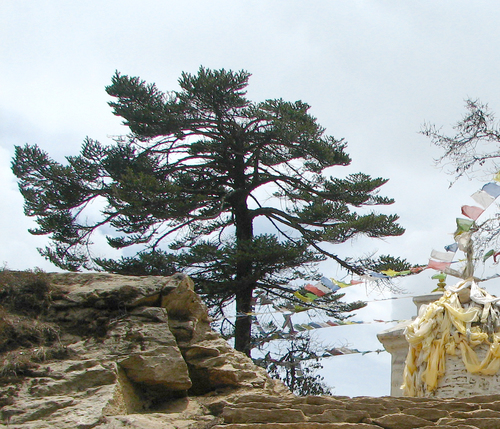
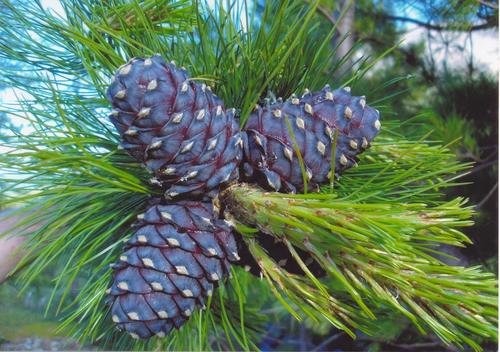
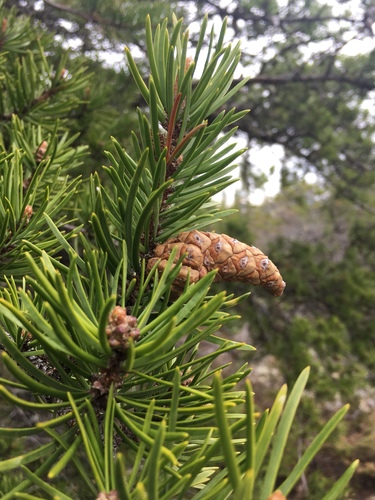
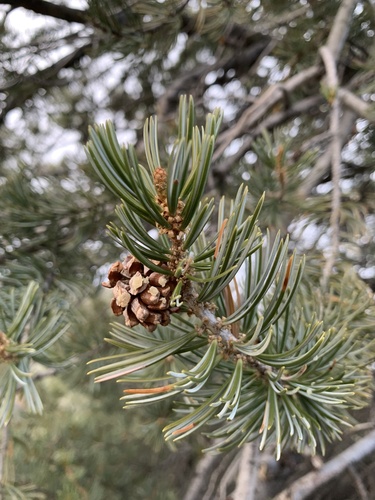
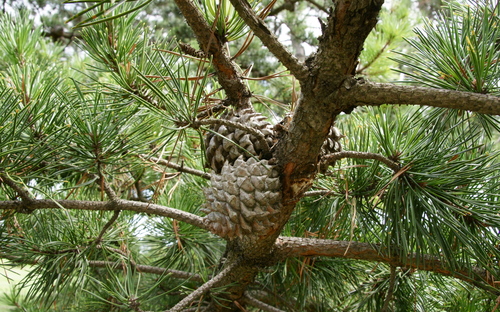
Pinus pungens Lamb. is a native, slow-growing conifer tree, normally reaching a modest size of 6–12 metres (20–39 feet) with a rounded, irregular shape. It rarely exceeds 20 metres (66 feet) in height, though the tallest recorded individual measured 29.96 metres (98 feet 4 inches) in Paris Mountain State Park, South Carolina, and another previously recorded maximum height was 29 metres (95 feet). Typically, it grows to around 41 centimetres (16 inches) diameter at breast height, with the maximum recorded DBH being 86 centimetres (34 inches). Trunks are often crooked with irregular cross-sections. Young trees vary in form: open-grown specimens look like large bushes, while those in dense stands are slender with relatively small limbs. Older trees are usually flat-topped. Even in closed canopy stands, the species typically retains long, thick limbs along most of its trunk, and it is generally very limby and small in stature. The needles grow in bundles of two, and occasionally three. They are yellow-green to mid green, fairly stout, and 4–7 centimetres (1+1⁄2–3 inches) long. Buds are ovoid to cylindric, red-brown, resinous, and 6–9 millimetres (15⁄64–23⁄64 inch) in size. Male cones are 1.5 centimetres (0.59 inches) long. The species releases pollen earlier than other pines in its native area, which minimizes hybridization. Female (seed) cones are very short-stalked, almost sessile, ovoid, and pale pinkish to yellowish buff. They measure 4–9 centimetres (1+1⁄2–3+1⁄2 inches) long, with a recorded size range of 4.2 to 10 centimetres (1.7 to 3.9 inches). Each cone scale is tough and bears a stout, sharp spine 4–10 millimetres (5⁄32–25⁄64 inch) long; the spines are broad and curve upward. Sapling trees can produce cones when they are as young as 5 years old. The distribution of Pinus pungens is centered in the Appalachian Mountains of the eastern United States, primarily in the Blue Ridge and Valley-and-Ridge provinces of the Appalachian Highlands. Its range extends from central Pennsylvania southwest to eastern West Virginia, then south into North Carolina, Tennessee, and the extreme northeast corner of Georgia. There are outlying populations to the east of the Appalachians in the piedmont, most often on isolated peaks and monadnocks. Pinus pungens prefers dry conditions, and grows mostly on rocky slopes, rocky knobs, and peaks, favoring higher elevations between 300–1,760 metres (980–5,770 feet) in altitude. It most commonly grows as single scattered trees or in small groves, rather than forming large forests like most other pine species, and it requires periodic disturbances for seedling establishment. Throughout the Appalachian Mountain range, Pinus pungens is a component of conifer-dominated plant communities, growing alongside other pine species. Fire history studies of two Pinus pungens communities in southwestern Virginia show that between 1758 and 1944, fires burned through these areas approximately every 5 to 10 years during the dormant season. After 1950, fire exclusion practices were introduced, and this coincided with a lack of Pinus pungens regeneration, as well as increasing dominance of trees from the Fagaceae family (oaks and beeches).