About Pinus pinaster Aiton
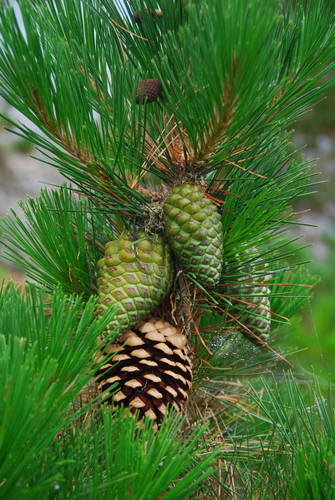
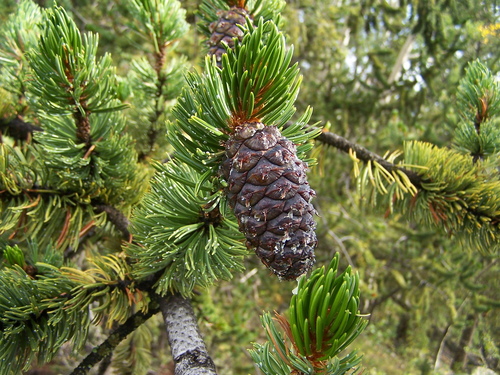
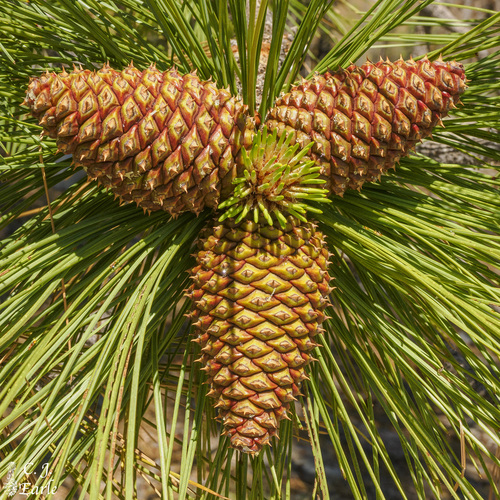
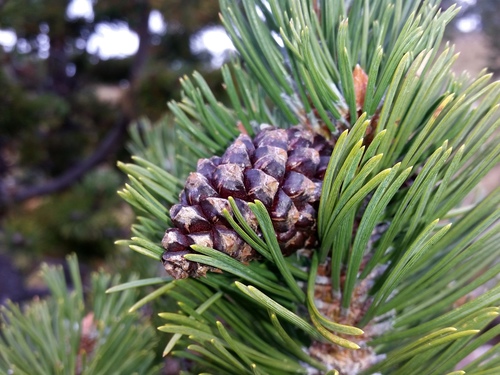
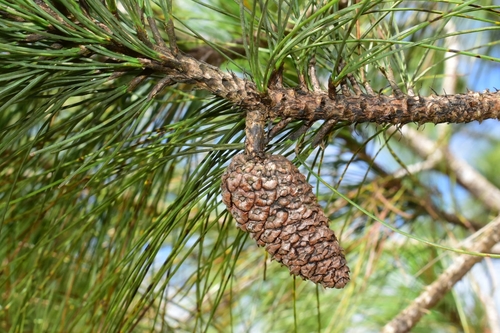
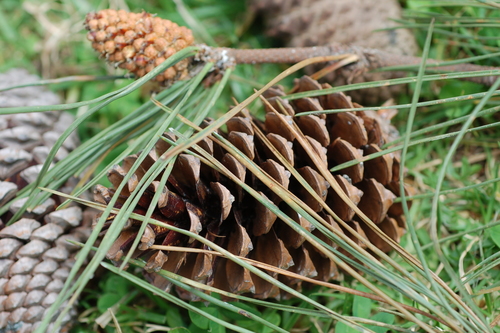
Pinus pinaster Aiton (maritime pine) is a medium-sized tree, growing 20 to 35 metres (66 to 115 feet) tall, and exceptionally reaching 41 m (135 ft). It has a trunk diameter of up to 1.2 m (4 ft), with exceptional specimens reaching 1.9 m (6 ft). The bark is orange-red, thick, and deeply fissured at the base of the trunk, and somewhat thinner in the upper crown. Its leaves, called needles, grow in pairs, are 10–25 cm (4–10 in) long, very stout at 2 mm (0.079 in) broad, and range in color from bluish-green to distinctly yellowish-green. Maritime pine has the longest and most robust needles of all European pine species. Its cones are conic, measuring 8–22 cm (3–8+1⁄2 in) long and 4–6 cm (1+1⁄2–2+1⁄2 in) broad at the base when closed. They start out green, and ripen to a glossy red-brown after 24 months. The cones open slowly over the next several years, or open quickly after being heated by a forest fire, to release seeds; when fully open, they reach 8–12 cm (3–4+1⁄2 in) broad. The seeds are 8–10 mm (0.31–0.39 in) long, shiny black on the upper surface and matt grey-brown on the lower surface, with a 20–25 mm (0.79–0.98 in) wing; the seeds are dispersed by wind. Its native range covers the western Mediterranean Basin and the southern Atlantic coast of Europe, extending from central Portugal and Northern Spain (especially Galicia) to southern and western France, east to western Italy and Croatia, and south to northern Tunisia, Algeria and northern Morocco. This species favors a Mediterranean climate, which has cool, rainy winters and hot, dry summers. North of its native range, it is naturalised and locally invasive in southern England. It generally grows at low to moderate altitudes, mostly from sea level to 600 m (2,000 ft), but can grow up to 2,000 m (6,600 ft) in the southern part of its range in Morocco. The high level of fragmentation seen in its current natural distribution is caused by two factors: the discontinuity and altitude of mountain ranges that isolates even nearby populations, and human activity. Dispersal, habitat loss, and fecundity are all factors that affect this species' spread rate. It favors acidic soils with medium to high-density vegetation, but it can also grow in basic soils, and even in sandy and poor soils where only a few commercial species can grow. Pinus pinaster is a diagnostic species of the vegetation class Pinetea halepensis. Pinus pinaster is widely planted for timber within its native area, and is one of the most important trees for forestry in France, Spain and Portugal. The Landes forest in southwest France is the largest man-made maritime pine forest in Europe. It has also been cultivated as a plantation tree in Australia to produce softwood timber. Resin from P. pinaster is a useful source of turpentine and rosin. In addition to industrial uses, maritime pine is a popular ornamental tree, often planted in parks and gardens in areas with warm temperate climates. It has become naturalised in parts of southern England, Uruguay, Argentina, South Africa and Australia. It is also used as a source of flavonoids, catechins, proanthocyanidins, and phenolic acids. A dietary supplement derived from P. pinaster bark extract called Pycnogenol is marketed with claims that it can treat many conditions; however, a 2012 Cochrane review found the evidence is insufficient to support its use for treating any chronic disorder.