About Pinus muricata D.Don
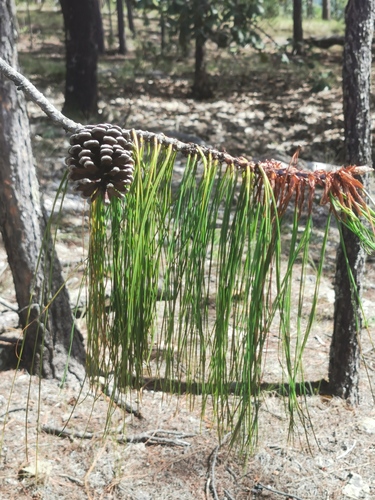
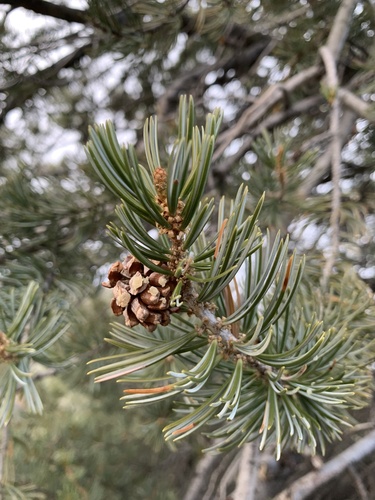
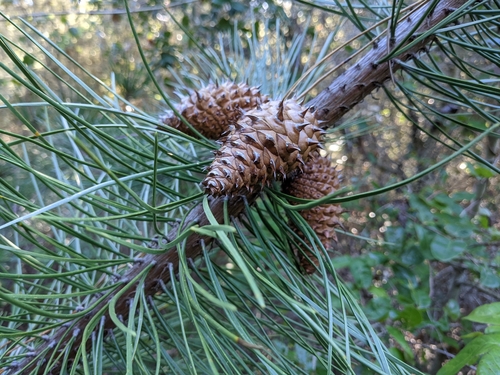
Pinus muricata D.Don is a coniferous evergreen tree that typically reaches 15 to 26 metres (49 to 85 ft) in height, and rarely grows as tall as 34 metres (112 ft). Its trunk can reach up to 1.2 metres (3.9 ft) in diameter. When growing in exposed coastal locations, the species is often smaller, with a stunted, twisted growth form. It is drought-tolerant and grows on dry, rocky soil. Its needles grow in pairs, range in color from green to blue-green, and are 8–16 cm (3–6.5 in) long. Cones grow in clusters of one to five, and are strongly reflexed downward along the branch. The cones are 5 to 10 centimetres (2.0 to 3.9 in) long. Their scales are stiff and thin on the side facing the tree stem, but are greatly thickened on the outward-facing side and bear a stout 5 to 12 millimetres (0.20 to 0.47 in) spine. Both the thickened scales and spines are adaptations that reduce squirrel predation and fire damage to the cones. The cones stay closed for many years, only opening to release seeds after exposure to fire or strong heat. In terms of ecology, Pinus muricata grows alongside several oak and cypress species in the California Coast Ranges. It also has a number of common understory plant associates, including sword fern, salal, and western poison oak. A well-known occurrence of P. muricata is in pygmy forest stands growing with Mendocino cypress on coastal terraces in Mendocino County and Sonoma County, California, including one stand located within Salt Point State Park. This species is classified as endangered in Mexico. Along with Pinus radiata, P. muricata is one of the main host trees for the dwarf mistletoe species Arceuthobium littorum. Infection by A. littorum harms the host tree's vigor, longevity, and reproductive rate, and often triggers the growth of large, abnormal growths called witch's brooms. For uses, Pinus muricata has been grown in plantations, where it reaches higher growth rates than it does in wild populations, but its cultivation in plantations has negative impacts on local biodiversity. The species has ornamental value, and is cultivated in parks and gardens. It has been awarded the Royal Horticultural Society's Award of Garden Merit.