About Pinus greggii Engelm. ex Parl.
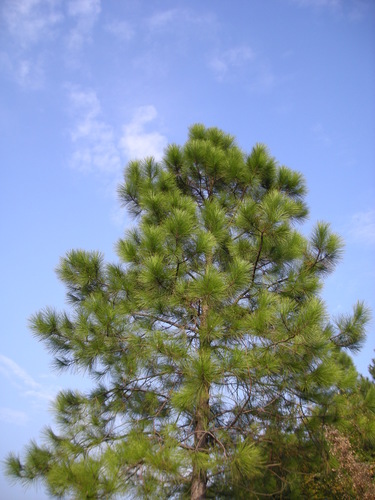
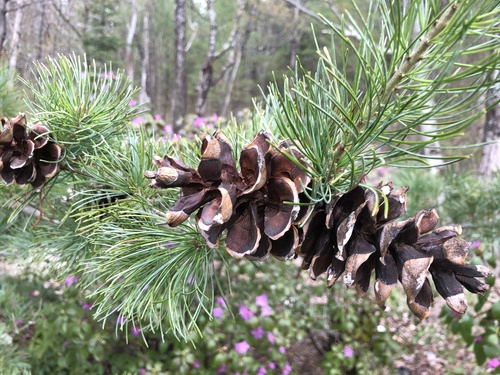
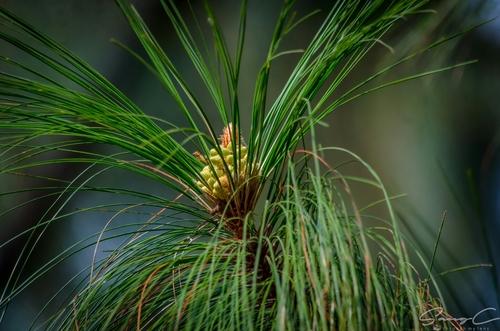
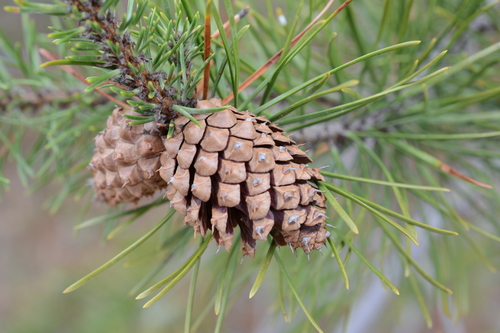
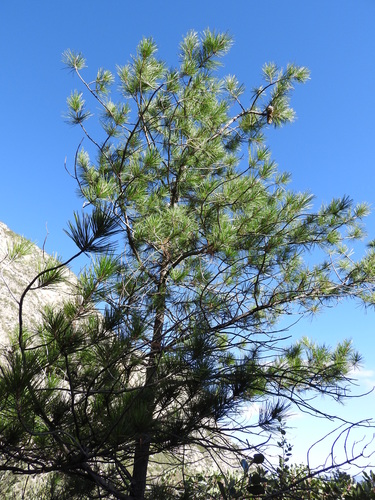
Pinus greggii Engelm. ex Parl. is a small to medium-sized tree that reaches 15–25 m in height. Its bark stays smooth for a long time; only old trees develop thick, rough bark at the trunk base, marked by deep longitudinal fissures and rough elongated plates. The bark on the upper trunk and branches remains smooth to scaly, and is greyish-brown. The crown is loose and open, with long, slender branches that spread or curve downward (not pendulous), forming a rounded crown that can be dense or more open. Young twigs are initially bluish-green with a glaucous wax bloom, later turning reddish brown to grey-brown. Winter buds are narrow, sharp-pointed, without resin, have loose scales, and are usually light brown. Needles measure (7–)9–13(–15) cm by 1–1.2 mm, are bright lustrous green, grow in fascicles of three, and have a short basal sheath. Pollen cones grow crowded near the base of new shoots, are subtended by broad, scarious bracts, spreading, ovoid-oblong to cylindrical, 15–20 × 5–6 mm, yellowish, and turn yellowish brown as they age. Seed cones are (6–)8–13(–15) cm long and 3.5–5 cm wide when closed, opening to (4–)5–7 cm wide. They are light buff-brown when ripe, long, often slightly curved, and irregularly conical. They remain closed for many years until opened by forest fire heat, which allows seed release just after a fire. They grow singly or in clusters of up to 5–10 on branches. In its native environment, Pinus greggii begins producing flowers and cones at approximately 4 to 5 years of age. Cones ripen in December and January, around 21 months after pollination. The apophysis has a weak transverse keel and a blunt umbo. Pinus greggii is closely related to Pinus patula, and has been successfully crossed with this species. The main morphological difference between the two species is in their needles: Pinus patula has longer, drooping needles. Pinus patula also has smaller cones, all under 10 cm long, and differs in bark characteristics. Pinus greggii is native to Mexico, found in the Sierra Madre Oriental, originally recorded only in a limited area of the states of Coahuila, Nuevo León and Hidalgo. It occurs farther north than its close relative Pinus patula, though the range of Pinus greggii var. australis overlaps with Pinus patula's range slightly. Natural hybrids between the two exist, and artificial hybrids have also been made successfully. Dvorak notes that Pinus greggii occurs in two distinct geographic regions in Mexico: a northern population in Coahuila and Nuevo León (24° to 25° N latitude), and a southern population in Puebla, San Luis Potosí, Hidalgo, Querétaro, and Veracruz (20° to 21° N). There is a 360 km gap between these two populations, and the two populations differ in needle and cone morphology, seed size, ecology, and tree size. In its natural habitat, Pinus greggii grows in cool highlands, at altitudes between 1300–2600 m; in the northern part of its range it occurs at 2300–2700 m. Annual precipitation across most of its range is 600–800 mm, with the exception of the eastern escarpment of the mountain ranges along the Hidalgo-Veracruz border, where annual precipitation is 1000–1600 mm. In the north, it most often grows on slightly alkaline soils (pH 7–8); in the south it grows on acid soils (pH 4–5). It is more resistant to frost than most other Mexican pines, particularly the nominate var. greggii: temperatures as low as -15°C have been recorded during norte events in Galeana, Nuevo León at 1700 m, and even lower temperatures occur in the mountains where this species grows. It is also hardy in cultivation in England, and survived the severe 1946–47 and 1962–1963 winters at Bedgebury Pinetum. The climate of these northeastern Mexican mountains is usually rather humid. Pinus greggii is nowhere abundant across its scattered native range, and always grows mixed with other tree species: examples include oaks (Quercus), plane trees (Platanus), sweetgums (Liquidambar), ashes (Fraxinus), and other pines such as P. montezumae, Pinus patula, P. stormiae, P. stylesii, and P. teocote. On dry sites it mixes with P. cembroides and Juniperus flaccida; at higher, more mesic locations it mixes with Abies vejarii, Pseudotsuga menziesii or Cupressus arizonica. The first recorded introduction of Pinus greggii to cultivation was to Britain around 1905, from the northern population. Two specimens were first grown under glass at Kew, then moved to outdoor planting at Bedgebury in 1926. One of these died in 1965, the other survived until the mid-1970s, by which time other introductions had been made. One specimen was also planted at Fota in Ireland in 1911. Further introductions from the southern population were made to approximately 10 subtropical countries between the 1960s and 1980s. Trials using both northern and southern populations were carried out in Brazil, Colombia, New Zealand, South Africa, and Zimbabwe in the late 1980s. These trials led to limited-scale plantation development, for example 1000 hectares of planting per year in South Africa. Pinus greggii has also been introduced to Italy, India, Nepal and Argentina.