About Pinus banksiana Lamb.
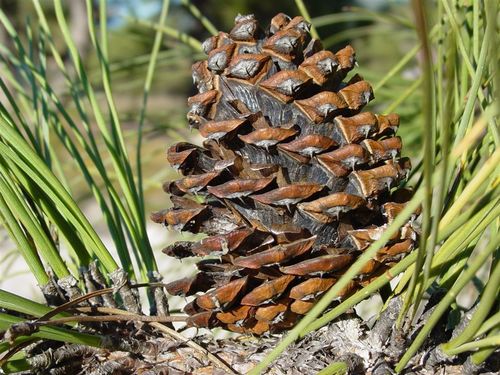
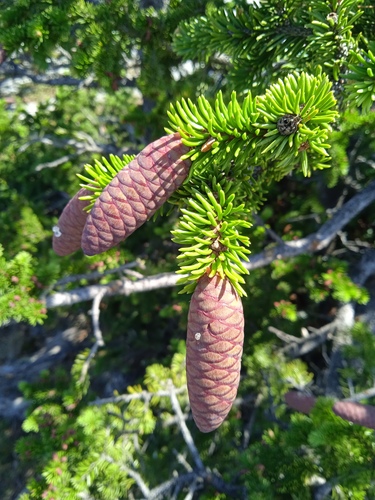
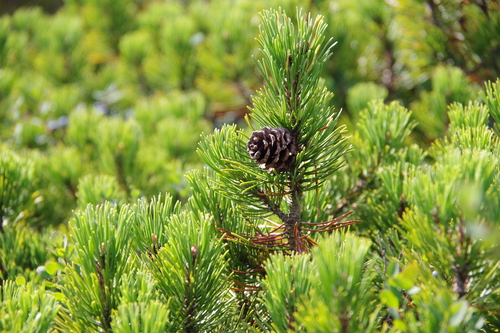
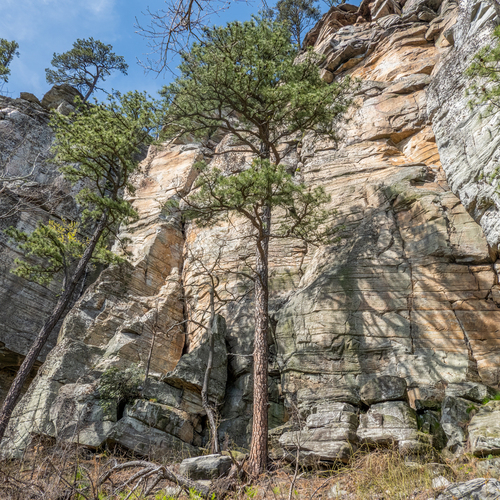
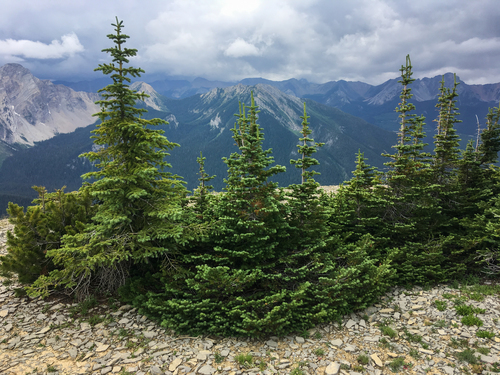
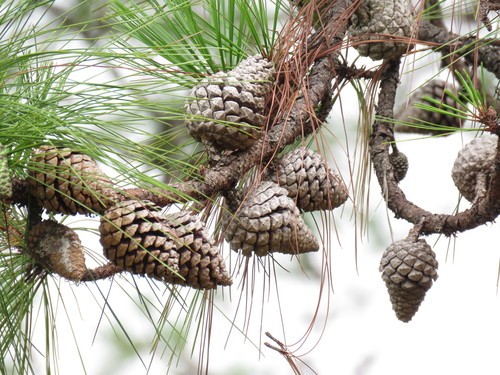
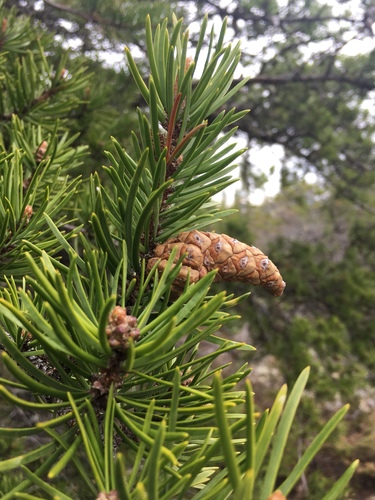
Pinus banksiana Lamb., commonly known as jack pine, typically grows between 9 and 22 metres (30 to 72 feet) in height. Poor growing conditions can leave some individuals at shrub size. Jack pines do not usually grow perfectly straight, so they often have an irregular shape similar to pitch pine (Pinus rigida). This species frequently forms pure stands on sandy or rocky soil. Many jack pine populations are adapted to stand-replacing wildfires: their cones stay closed for many years until fire kills mature trees, heat opens the cones, and released seeds reseed the newly burned ground. Populations not shaped by regular stand-replacing fires have reduced serotiny (closed cones). A population on the Maine coast does not appear to rely on fire for reproduction, and some of its stands have developed multiple age classes. Populations with lower serotiny often grow on soils that limit growth of faster competing vegetation, including soils shallow to bedrock, shallow to the water table, or very young soils. Jack pine has evergreen, needle-shaped leaves borne in fascicles of two. The needles are straight or slightly twisted, stiff, sharp-pointed, light yellowish-green, spread apart, have toothed edges, and measure 2 to 4 cm (3⁄4 to 1+1⁄2 inches) long. The fascicle bundle-sheath is persistent. The tree's buds are blunt-tipped, up to 15 mm long, reddish-brown, and resinous. Vigorous shoots can have more than one cyclic growth component. Juvenile jack pine has thin, reddish-brown to gray bark. Mature bark becomes dark brown and flaky. Jack pine wood is moderately hard, moderately heavy, weak, and light brown in color. Jack pine seed cones vary in shape, ranging from rectangular to oval-conical, and can be straight or curved inward. The cones are 3 to 5 cm (1+1⁄4 to 2 inches) long. Each cone scale bears a small, fragile prickle that usually wears off before the cone matures, leaving the cone surface smooth. Unusual for pines, jack pine cones normally point forward along the branch, sometimes curling around the branch itself. This trait makes it easy to distinguish jack pine from the similar lodgepole pine in more western regions of North America. Cones on many mature jack pines are serotinous, opening only when exposed to intense heat of 50 °C (122 °F) or higher. The species' native range extends across Canada east of the Rocky Mountains, from the Mackenzie River in the Northwest Territories to Cape Breton Island in Nova Scotia. In the United States, it is native to north-central and northeastern regions from Minnesota to Maine, with the southernmost edge of its range reaching just into northwest Indiana and northwest Pennsylvania. Kirtland's warbler (Setophaga kirtlandii), a formerly endangered bird, relies on pure stands of young jack pine in a very limited area of northern Lower and Upper Peninsulas of Michigan for breeding; most known nesting areas are restricted to Crawford, Oscoda, and Ogemaw counties. Mature jack pine forests are typically open, and blueberries are often abundant in the understory. Young jack pines act as an alternate host for sweet fern blister rust (Cronartium comptoniae). Infected sweet ferns (Comptonia peregrina) release powdery orange spores in summer, and nearby jack pines become infected in fall. Diseased jack pines develop vertical orange cankers on the trunk and galls on lower branches; this disease rarely affects older trees. Jack pine is also susceptible to scleroderris canker (Gremmeniella abietina), which causes yellowing at the base of needles, and prolonged infection can eventually kill the tree. Insects that commonly attack jack pine stands include the white pine weevil (Pissodes strobi), Swaine jack pine sawfly (Neodiprion swainei), and jack pine budworm (Choristoneura pinus). Fossil evidence indicates jack pine survived the last glacial period in the Appalachian and Ozark Mountains. Like other pine species, Pinus banksiana is used for timber, though its wood tends to be knotty and not highly resistant to decay. Commercial products made from jack pine include pulpwood, fuel, decking, and utility poles.