About Pimelea longiflora R.Br.
Growth Form
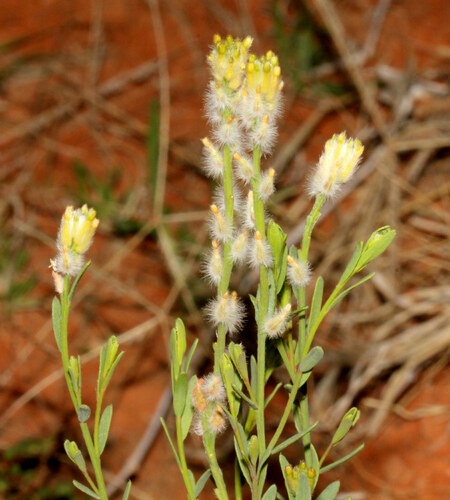
Pimelea longiflora R.Br. is an erect, spindly shrub that typically reaches a height of 0.3–1.3 m (1 ft 0 in – 4 ft 3 in), and its young stems are covered in dense hairs.
Leaf Characteristics
Its leaves are linear to narrowly elliptic, measuring 4–18 mm (0.16–0.71 in) long and 1–3 mm (0.039–0.118 in) wide, and grow on a short petiole.
Flower Clusters
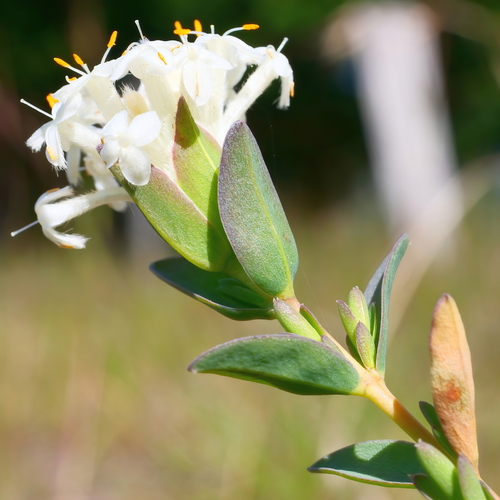
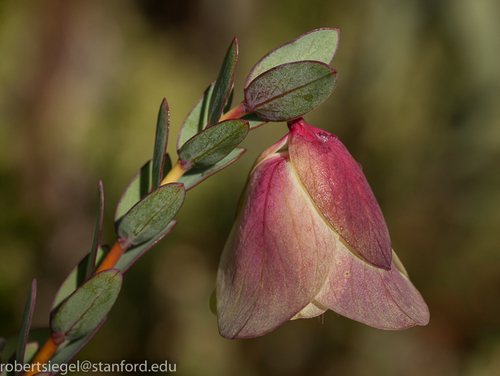
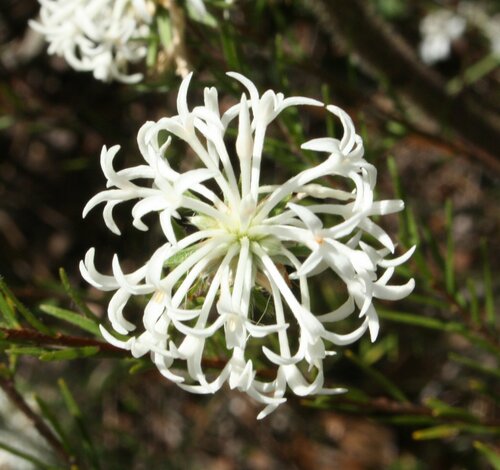
The flowers are arranged in erect clusters of many blooms, carried on a peduncle 2–20 mm (0.079–0.787 in) long. The clusters are surrounded by 4 to 6 egg-shaped or narrowly egg-shaped involucral bracts, which are 5–12 mm (0.20–0.47 in) long and 1.5–3 mm (0.059–0.118 in) wide.
Individual Flower Structure
Each individual flower sits on a pedicel 0.4–0.5 mm (0.016–0.020 in) long, has a floral tube 7–12 mm (0.28–0.47 in) long, and sepals 5–6 mm (0.20–0.24 in) long.
Flowering Period
Flowering of this species takes place from August to February.
Habitat Preferences
This pimelea most commonly grows in swampy, winter-wet locations in sand or sandy clay.
Distribution Range
Its main range lies between Bunbury and Cape Riche in south-western Western Australia, with a separate disjunct population located in Fitzgerald River National Park.
Bioregions
It occurs within the Avon Wheatbelt, Esperance Plains, Jarrah Forest, Swan Coastal Plain and Warren bioregions.