About Pimelea hewardiana Meisn.
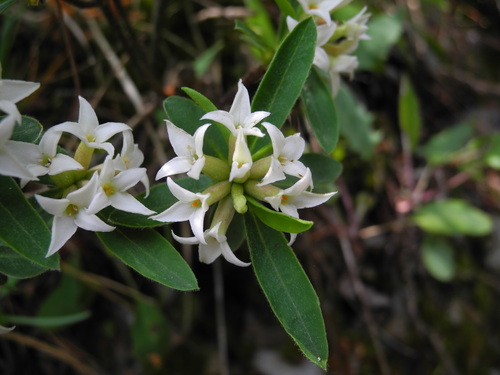
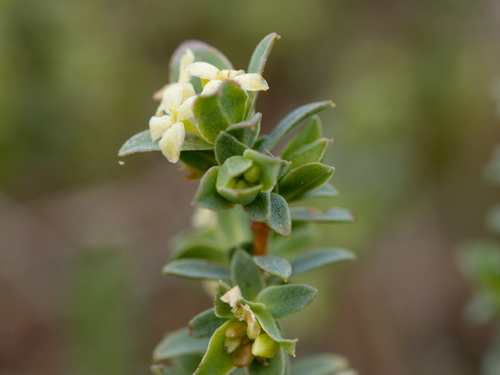
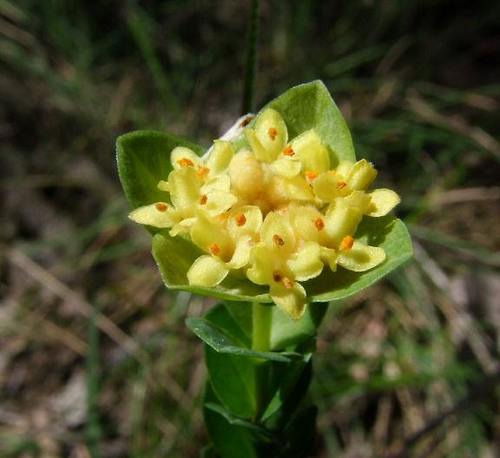
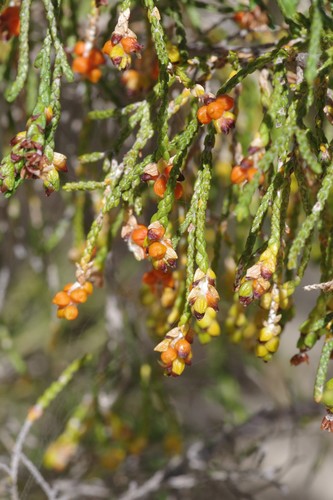
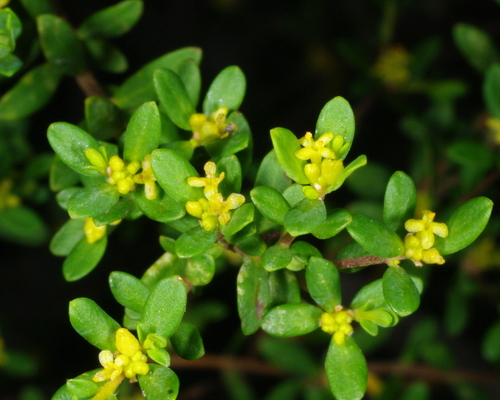
Pimelea hewardiana, also known as forked rice-flower, is a shrub that typically grows 40 to 70 centimeters (16 to 28 inches) tall. Its young stems are covered in short hairs. The leaves are arranged in opposite pairs, and are narrowly elliptic to egg-shaped, with the narrower end positioned toward the base. They measure 3 to 11.5 millimeters (0.12 to 0.45 inches) long and 1.0 to 3.5 millimeters (0.039 to 0.138 inches) wide, and grow on a short petiole. The lower surface of each leaf is paler than the upper surface. The flowers grow in compact, head-like clusters containing 7 to 34 flowers, arranged at the ends of branches or in leaf axils. These clusters are surrounded by 4 hairless, leaf-like involucral bracts that measure 5 to 11 millimeters (0.20 to 0.43 inches) long and 1 to 3 millimeters (0.039 to 0.118 inches) wide. The flowers are unisexual and yellow, with a flower tube 1.0 to 2.5 millimeters (0.039 to 0.098 inches) long and sepals 0.5 to 1.5 millimeters (0.020 to 0.059 inches) long. In male flowers, the stamens are shorter than the sepals. Flowering occurs mainly from April to October. This species grows in mallee shrubland, usually on rocky ground, ranging from the Glenelg River to the Bacchus Marsh area, west of Melbourne. It was formerly found in south-eastern South Australia, but is now considered extinct in that state.