About Pimelea ferruginea Labill.
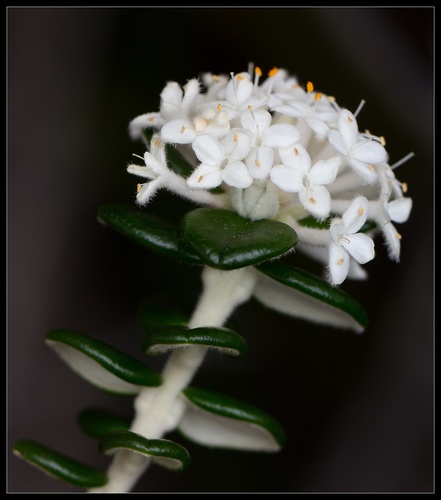
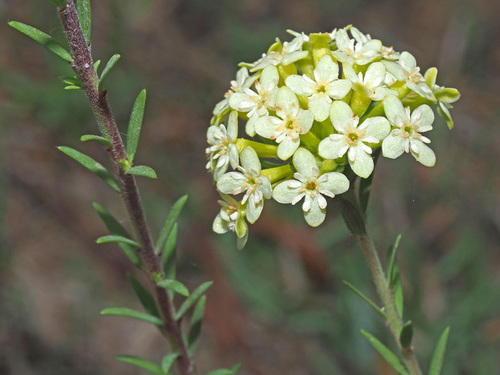
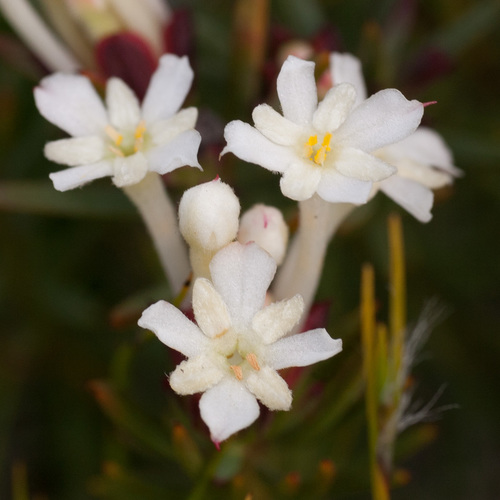
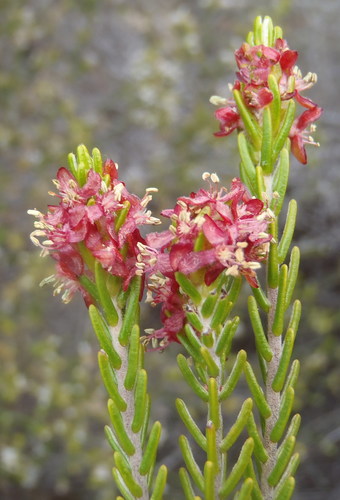
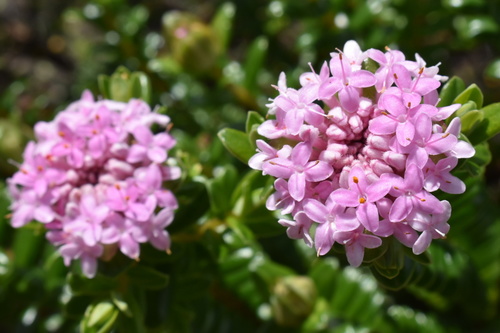
Pimelea ferruginea Labill. is a dense, erect shrub that usually reaches a height of 0.3 to 1.5 meters (1 foot 0 inches to 4 feet 11 inches), and it typically grows from a single stem at ground level. Its leaves are elliptic to narrowly elliptic, with edges that curve downward. Each leaf measures 5 to 16 millimeters (0.20 to 0.63 inches) long and 1.5 to 6.5 millimeters (0.059 to 0.256 inches) wide, attached to a petiole 0.1 to 1 millimeter (0.0039 to 0.0394 inches) long. The flowers range from pale to deep pink, and are arranged in erect, head-like clusters. These clusters grow on a hairy peduncle 0.5 to 1.2 millimeters (0.020 to 0.047 inches) long, and are surrounded by 4 broadly egg-shaped bracts that are 5 to 14 millimeters (0.20 to 0.55 inches) long. Each individual flower sits on a hairy pedicel 0.5 to 1.2 millimeters (0.020 to 0.047 inches) long. The floral tube of the flower is 7 to 13 millimeters (0.28 to 0.51 inches) long, and the sepals are 2.5 to 4 millimeters (0.098 to 0.157 inches) long. Flowering occurs mainly from August to February. This species, commonly known as pink rice flower, grows on coastal sand dunes and rocky headlands in near-coastal areas. Its distribution spans from Cliff Head near Arrowsmith to Point Culver, across the Esperance Plains, Geraldton Sandplains, Jarrah Forest, Mallee, Swan Coastal Plain and Warren bioregions of south-western Western Australia.