About Piliostigma reticulatum (DC.) Hochst.
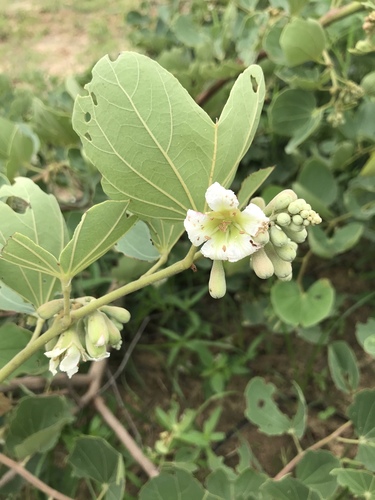
Piliostigma reticulatum (DC.) Hochst. is a perennial dioecious plant that can grow up to 10 meters tall. It has deeply fissured to cracked grey bark, with a fibrous slash that turns brown. Its leaves are alternate, bilobed in overall shape, with lobes ranging from rounded to cuneate. The leaf blade measures 5–11 cm long and 4–18 cm wide, and the petiole is 1–3.5 cm long; the leaf surface is leathery and glabrous. Its inflorescences are terminal or axillary panicles bearing white-pink striped flowers, and it produces glabrous pod fruits. This species is widespread across the Sudan and Sahel savannah regions of West Africa, extending eastwards to Sudan. In the West African Sahel, research has found that cropped fields containing Piliostigma reticulatum and Guiera senegalensis have better soil quality than fields without these shrubs. Both species carry out hydraulic redistribution, which helps improve soil fertility. Adding Piliostigma reticulatum near mango seedlings supported soil decomposition and nutrient mineralization, which aided the growth of mango seedlings in a rainfed Sahelian community. Local communities use extracts of this species as an antiseptic and to treat a range of illnesses. Herbalists use root extracts to treat diarrhea, gonorrhea, uterine pain, and liver and gall bladder pain. Bark decoctions are used to support the wound healing process. Leaf extracts are used to treat issues including cough, bronchitis, and rheumatism. In the Sahel region, the species is also used as forage: farmers sell leaves, pods, and branches to herders for cattle fodder. A bark decoction is used in the dyeing process of bogolan cloths, and its fibrous bark is also used for tying roof rafters, and for making baskets and mats. In Burkina Faso, young leaves are prepared, cooked, and eaten.