About Picea schrenkiana Fisch. & C.A.Mey.
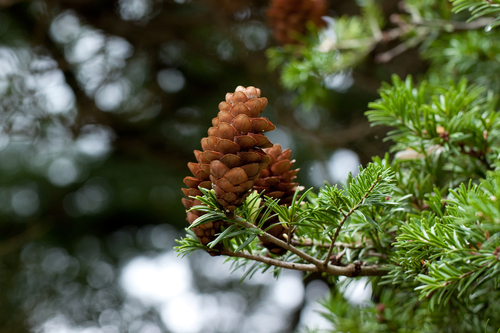
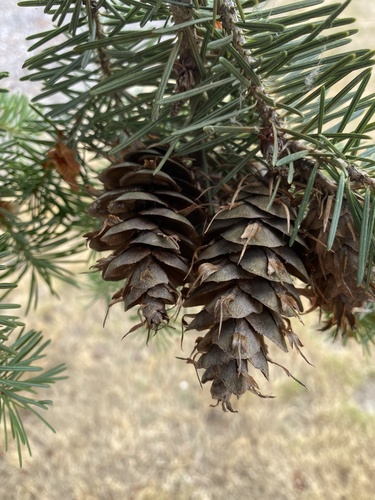
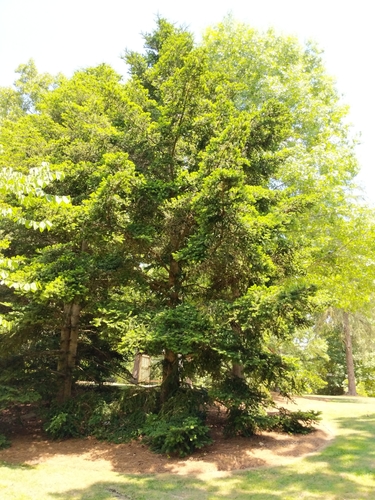
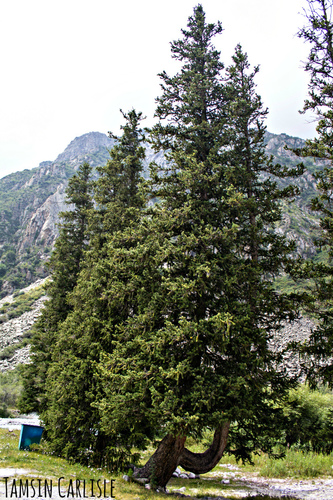
Picea schrenkiana, commonly known as Schrenk's spruce, is a large evergreen tree. It typically grows 40 to 50 meters (130 to 160 feet) tall, and can rarely reach 60 meters (200 feet) in height, with a trunk diameter that can grow up to 1 to 2 meters (3 to 7 feet) across. It bears a narrow conical crown, with level main branches and sometimes hanging secondary branchlets. Its young shoots are pale buff-brown in color and glabrous, meaning completely hairless. The leaves are needle-shaped, between 1.5 and 3.5 cm (0.6 to 1.4 inches) long, and rhombic when cut in cross-section. They are dark green with faint, hard-to-distinguish stomatal lines. The species produces cylindrical to conical cones that measure 6 to 12 cm (2.4 to 4.7 inches) long and 2 cm (0.8 inches) broad when closed. The cones are purple when young, and mature to dark brown 5 to 7 months after pollination, at which point they open to a width of 2.5 to 3.5 cm (1.0 to 1.4 inches). The cone scales are moderately stiff and have smoothly rounded edges. In central Asia, where few other large tree species grow naturally, Schrenk's spruce is an important tree for timber and paper production. It grows more slowly than Norway spruce (Picea abies), which reduces its commercial importance in regions outside its native range. It is cultivated as an ornamental tree for planting in large gardens and public parks across Europe.