About Phyllostomus discolor Wagner, 1843
Species Identification
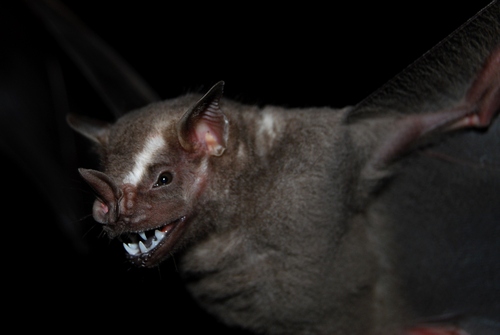
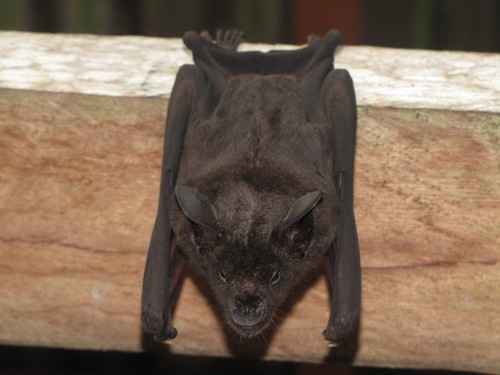
Pale spear-nosed bats (Phyllostomus discolor Wagner, 1843) are relatively robust bats.
Body Size and Wingspan
Adult total length ranges from 8 to 11 centimetres (3.1 to 4.3 in), with an average wingspan of 42 centimetres (17 in). Males are significantly larger than females: the average male weighs 45 grams (1.6 oz), while the average female weighs 40 grams (1.4 oz).
Dorsal Fur Coloration
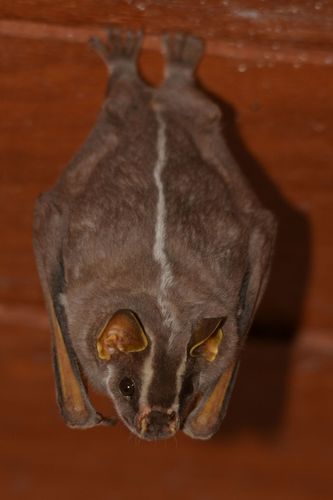
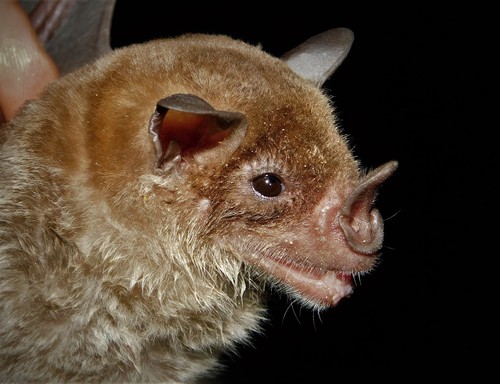
Fur colour across most of the body is variable, ranging from pale yellowish brown to a much darker, almost blackish shade. The chest and belly are much paler, ranging from near white to frosted grey.
Wing Characteristics
The large, rounded-tip wings have an average aspect ratio of 7.13 and a wing loading of 13.6 pascals (0.00197 psi).
Uropatagium and Tail Structure
The uropatagium is large, extending to the ankles, and is around three times the length of the tail; the tail tip projects from the upper surface of the membrane.
Cranial and Facial Structure
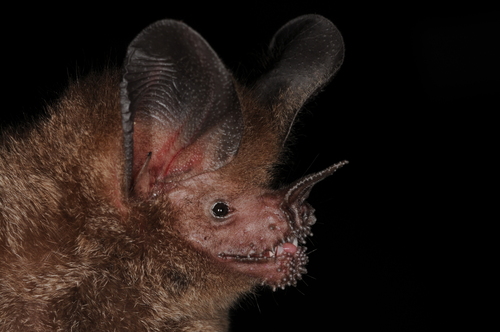
The face is broad, with a short snout and rounded cranium that encloses a large brain with well-developed cerebral hemispheres.
Nose-leaf Morphology
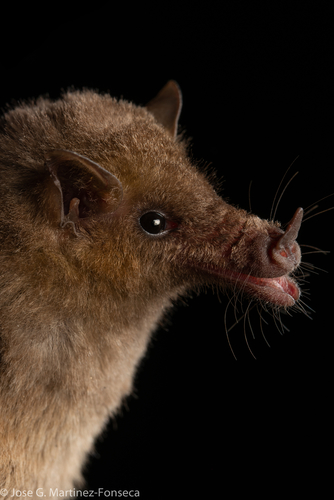
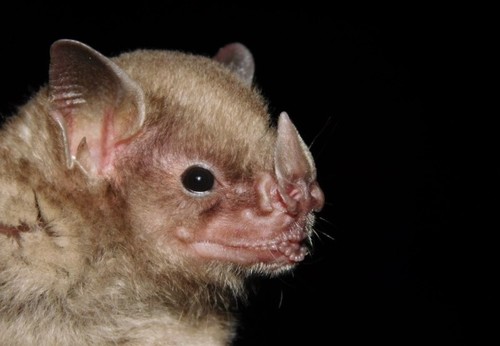
The nose-leaf is well developed, with a long, broad, spear-like projection from its upper surface.
Ear Characteristics
The ears are also broad, and are long enough to reach the tip of the snout when projected forward.
Sexual Dimorphism in Throat Glands
Males have a large glandular sac in the throat region that is almost entirely absent in females.
Geographical Range
The species ranges from southern Mexico to northern Peru, Bolivia, and Paraguay, and extends across to southeastern Brazil. Reports of its occurrence in northernmost Argentina are controversial, as they are based on only a single specimen that was subsequently lost.
Habitat and Elevation Range
It inhabits lowland forests and agricultural areas, at elevations up to 610 metres (2,000 ft).
Subspecies Classification
Two subspecies are currently recognised, though the validity of their distinct status has been questioned: Phyllostomus discolor discolor is found across most of Colombia, eastern Ecuador, Venezuela, the Guianas, Bolivia, Peru, Paraguay, and Brazil; Phyllostomus discolor verrucosus is found in Mexico, Central America, and Colombia and Ecuador west of the Andes.
Mating System
Mating occurs primarily within harem groups, although females may sometimes be chased by non-harem males before copulation.
Mating Season Variation
The mating season varies across the species' range: it is restricted to summer in Guatemala, but apparently occurs year-round in Brazil. The gestation period may also be variable.
Newborn Physical Traits
Newborn young are nearly hairless, but already have whiskers and some hair on their limbs and uropatagium.
Juvenile Roosting and Care
The mother initially carries her young with her while foraging, but after a few days begins leaving the young at the roost. Other adults in the harem tolerate the presence of roosting young, and young may even cling to the harem male.
Juvenile Development Milestones
Young bats gain the ability to fly at five to six weeks of age, and are fully weaned by three months of age.
Vocal Development in Juveniles
If separated from adults, young bats make ultrasonic distress calls, but do not begin producing echolocation calls until about ten days after birth. Their initial calls are longer in duration, with more intense lower harmonics, and change to the adult form by the time they are able to fly.