About Phylloscopus proregulus (Pallas, 1811)
Basic Morphology
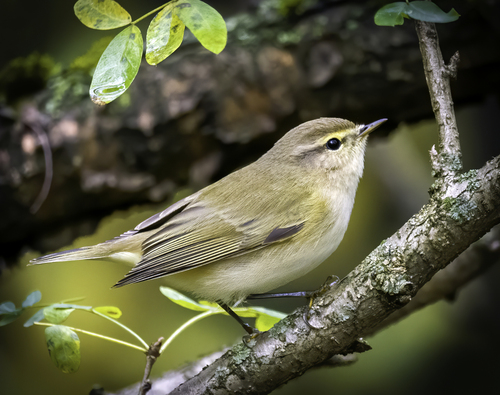
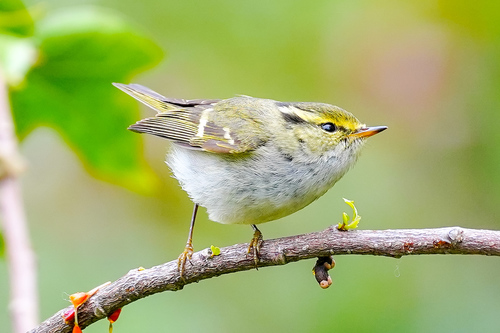
Pallas's leaf warbler (Phylloscopus proregulus) is one of the smallest warblers, with a large head and short tail.
Size and Weight
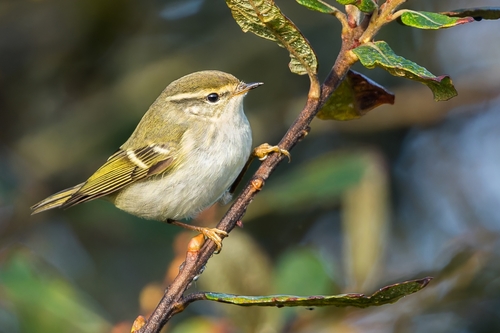
It measures 9–10 centimetres (3.5–3.9 in) in length and weighs 4–7 grams (0.14–0.25 oz), making it slightly smaller than a yellow-browed warbler and barely larger than a goldcrest.
Plumage Markings
It has greenish upperparts and white underparts, with striking prominent markings: pale yellow double wingbars on the wing covert feathers, bold yellow supercilia, a central yellow crown stripe, and a lemon-yellow rump.
Soft Part Coloration
Its bill is blackish-brown with a yellowish tinge on the cutting edges and the base of the lower mandible, its iris is brown, and its legs are brown with a green or greyish tinge.
Rump Visibility
While the yellow rump is obvious when the bird is low in vegetation or hovering, it can be hard to see in other positions.
Distinction from Former Subspecies
In Asia, this species can be distinguished from its former subspecies by yellower head stripes, wingbars, and throat, as well as different vocalisations.
Similar Asiatic Warbler Comparison
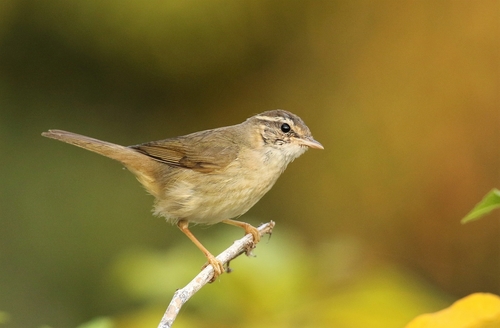
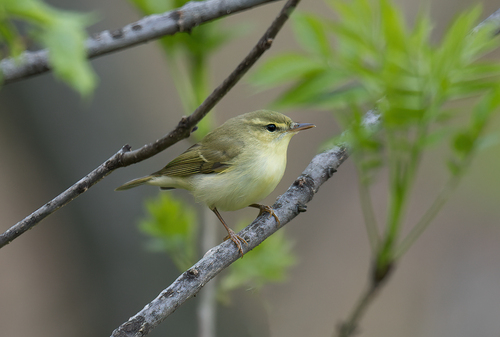
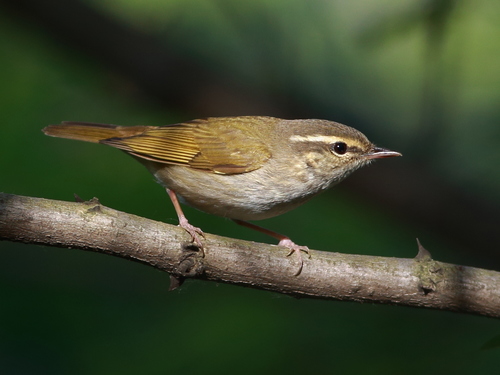
Other yellow-rumped Asiatic warblers resemble Pallas's leaf warbler: buff-barred and Brooks's leaf warblers are larger, duller green on the upperparts, less strongly marked, and have buff and white wing bars respectively, rather than yellow. Ashy-throated warblers have grey head markings, face, and throat, and pale yellow underparts.
Sex Plumage Similarity
The sexes of Pallas's leaf warbler have similar plumage.
Non-breeding Plumage
Non-breeding birds have somewhat brighter green upperparts and broad, bright fringes on their flight feathers.
Juvenile Plumage
Juveniles resemble adults, but have a brown tinge on the upperparts, greyish-white underparts, and a duller supercilium.
Post-breeding Moult
Adults undergo a complete post-breeding moult in August or September before migrating south.
Pre-breeding Moult
Juveniles and pre-breeding adults have a partial moult in March or April, which replaces all body plumage and some tail feathers.
Song Perch Location
The song of Pallas's leaf warbler is sung from a concealed perch near the top of a tall tree.
Song Structure
It is strong and prolonged, made up of a medley of whistles, transcribed as tirrit-tirrt-tirrit-terchee-choo-choo-chee-chee-chee or similar. Some phrases are reminiscent of a canary, and trills are interspersed throughout.
Song Duration
The song lasts 2–4 seconds, and can be heard both from breeding birds and on the winter quarters.
Species Call
The call is a short, soft dju-ee.
Former Subspecies Vocalizations
In contrast, the former subspecies have quite different songs that include sustained rattles lasting for several seconds, or sometimes minutes. Their calls are typically sharp and monosyllabic.
Breeding Range
Pallas's leaf warbler breeds in Siberia from the Altai Mountains east to the Sea of Okhotsk, northern Mongolia, northeast China, and possibly North Korea.
Wintering Range
It is strongly migratory, and winters mainly in subtropical south China, northern Thailand, and other parts of northeastern Indochina. It is rare but occurs annually in Japan.
Breeding Habitat
This species breeds in coniferous taiga forests including fir, spruce, pine, and larch, or in mixed forest that includes willow, alder, and a high percentage of conifers.
Breeding Elevation Range
In southern and far-eastern Russia, its breeding range extends from sea level up to 1,500–1,700 metres (4,900–5,600 ft).
Winter Habitat
In winter, it uses a wider range of habitats, including broadleaf forest, scrub, and conifers, and can be found in river valleys down to sea level.