About Phylloscopus collybita (Vieillot, 1817)
Species Classification and Size
The common chiffchaff, whose scientific name is Phylloscopus collybita (Vieillot, 1817), is a small, stocky leaf warbler that measures 10–12 centimetres (3.9–4.7 inches) in length. Males weigh 7–8 grams (0.28–0.31 oz), while females weigh 6–7 grams (0.25–0.28 oz).
Nominate Adult Plumage
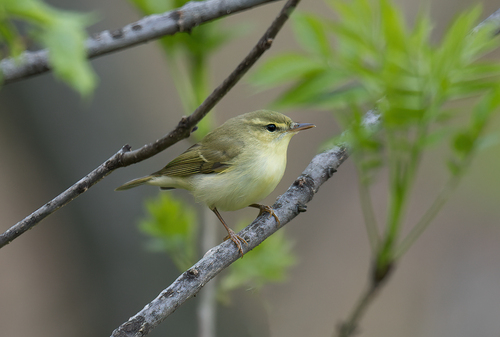
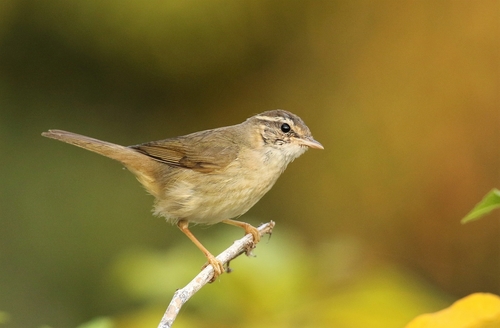
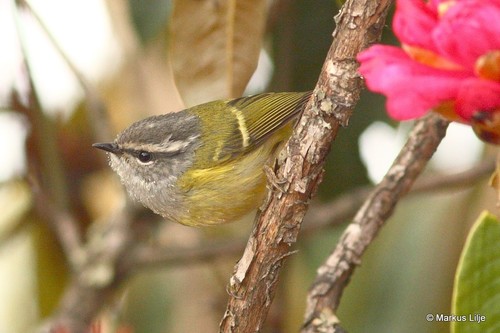
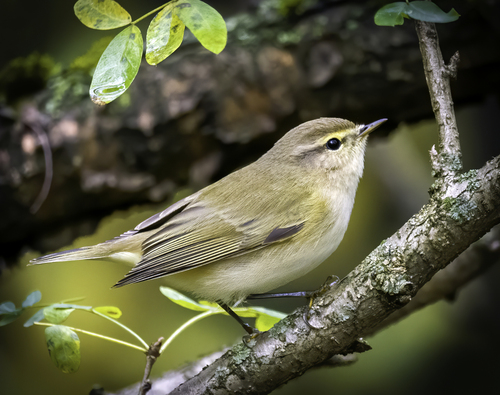
Spring adults of the western nominate subspecies P. c. collybita have dull green upperparts washed with brown, off-white underparts that turn yellowish on the flanks, and a short whitish supercilium. They have dark legs, a fine dark bill, and short primary projection, the length that flight feathers extend beyond the folded wing.
Plumage Wear and Moult
As plumage wears over time, common chiffchaffs become duller and browner, and typically lose the yellow coloring on their flanks. After the breeding season, they undergo a prolonged complete moult before migrating.
Juvenile Plumage
Newly fledged juvenile common chiffchaffs are browner on their upperparts than adults, and have yellow-white underparts. Juveniles moult roughly 10 weeks after growing their first full set of plumage.
Post-Moult Appearance
After moulting, both adults and juveniles have brighter, greener upperparts and a paler supercilium.
Species Etymology
This species gets its common name from its simple, distinctive repetitive cheerful chiff-chaff song, which is one of the first avian signs that spring has arrived.
Call Characteristics
Its call is a single-syllable hweet, which is less disyllabic than the hooeet call of the willow warbler or the hu-it call of the western Bonelli's warbler.
Song Comparison
The common chiffchaff's song differs from that of the Iberian chiffchaff, which produces a shorter song pattern of djup djup djup wheep wheep chittichittichiittichitta. However, mixed singers occur in the hybridisation zone and other areas, and can be difficult to assign to a species.
General Identification Challenges
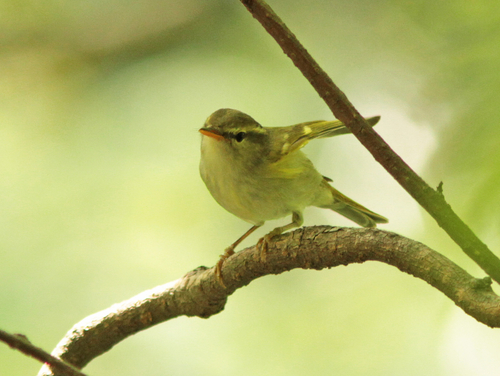
When it is not singing, the common chiffchaff can be hard to distinguish from other leaf warblers with greenish upperparts and whitish underparts, especially the willow warbler. Willow warblers differ by having a longer primary projection, a sleeker, brighter overall appearance, and generally pale legs.
Bonelli's Warbler Comparison
Bonelli's warbler (P. bonelli) may be confused with the common chiffchaff subspecies tristis, but Bonelli's warbler has a plain face and green coloring in its wings.
In-Flight Identification
In flight, the common chiffchaff has rounded wings, and a diagnostic tail movement that consists of a dip followed by a sideways wag. This movement distinguishes it from other Phylloscopus warblers and has earned it the name "tailwagger" in India.
Iberian Chiffchaff Comparison
The greatest field identification challenge is distinguishing non-singing nominate common chiffchaffs from Iberian chiffchaffs; in Great Britain and the Netherlands, all accepted records of vagrant Iberian chiffchaffs involve singing males.
Breeding Range
The common chiffchaff breeds across Europe and Asia, ranging east to eastern Siberia and north to approximately 70°N, with isolated populations in northwest Africa, northern and western Turkey, and northwestern Iran.
Migration Timing
It is a migratory species, but it is one of the first passerine birds to return to its breeding areas in spring, and among the last to leave breeding areas in late autumn.
Breeding Habitat Requirements
During the breeding season, the common chiffchaff lives in open woodlands that have some taller trees and ground cover for nesting. These trees are typically at least 5 metres (16 feet) high, with open undergrowth made up of a poor to medium mix of grasses, bracken, nettles, or similar plants.
Niche Differentiation from Related Warblers
This breeding habitat is quite specific, and even closely related warbler species do not use the same habitat: for example, the willow warbler (P. trochilus) prefers younger trees, while the wood warbler (P. sibilatrix) prefers areas with less undergrowth.
Non-Breeding Habitat
In winter, the common chiffchaff uses a wider range of habitats including scrub, and is not as dependent on trees. It is often found near water, unlike the willow warbler which tolerates drier habitats.
Overwintering in Northern Europe
There is an increasing trend for common chiffchaffs to winter in western Europe well north of their traditional wintering areas, especially in coastal southern England and the mild urban microclimate of London. These overwintering common chiffchaffs include some visiting individuals of the eastern subspecies abietinus and tristis, so they are certainly not all locally bred birds, though some of them undoubtedly are.