About Phelsuma cepediana (Milbert, 1812)
Common Name & Size
Phelsuma cepediana, commonly called the blue-tailed day gecko, is a mid-sized day gecko. Adults reach a total length including tail of 3.75–5.5 inches (9.5–14 cm).
Sexual Size Dimorphism
Females are typically smaller and less vividly colored than males.
Male Coloration
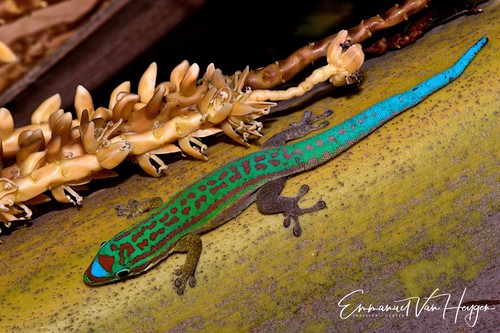
Male blue-tailed day geckos have a light green or bluish green body, with bright blue coloration on the back that is marked by dark red spots and dashes. Males also have a deep blue tail, and this blue color may also appear on the face.
Female Coloration
Females do not have the male's bright blue coloration: they have a bright green back with rust-colored spots.
Shared Color Markings
All individuals of this species always have a dorso-lateral stripe, which may be broken, and a red stripe that runs from the nostril to the shoulder.
Activity Pattern
Like most other members of the genus Phelsuma, this species is primarily diurnal.
Artificial Light Sensitivity
Blue-tailed day geckos and other reptiles are sensitive to artificial night light, and change their behaviors when exposed to it.
Foraging Behavior Shift
When artificial light is available at night, blue-tailed day geckos shift their foraging behavior from diurnal to nocturnal.
Nocturnal Activity Types
Nocturnal activity in this species includes agonistic or aggressive behavior, courtship, and foraging. Artificial night light also changes the amount of time and effort visual predators spend foraging.
Taxonomic Status
This species is one of only seven still-extant Mascarene Phelsuma species.
Ecological Role
It is the only pollinator and seed disperser for Roussea simplex, a climbing shrub endemic to the mountains of Mauritius.
Habitat Preferences
Blue-tailed day geckos are most often found on fruit-producing trees and bushes, such as coconut palms, banana trees, and papayas. They prefer warm, moist climates, which are typical of these habitats.
Native Distribution
This species is widely distributed across the island of Mauritius.
Introduced Range Reports
It has been reported a small number of times from the Iviloina region of Madagascar, which suggests it may have been introduced there, but these observations have not been confirmed.
Habitat Tolerance
The species cannot colonize agricultural areas, but it can survive in heavily watered, planted suburban gardens, as long as these gardens are located near trees that produce fruit or flowers year-round.
Reproductive Output
Adult females lay a clutch of two eggs every 3–4 weeks.
Egg Laying Behavior
Females lay eggs in locations they perceive as safe and protected, and glue their eggs to these locations to improve their safety.
Incubation Period
When incubated at 28 degrees Celsius, the eggs hatch after 40 to 45 days.
Hatchling Size
Newborn geckos are typically around 40 mm (1.6 inches) in length.