About Pharomachrus auriceps (Gould, 1842)
Size and Measurements
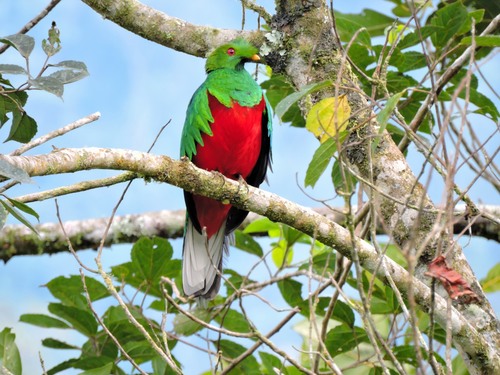
Pharomachrus auriceps, commonly called the golden-headed quetzal, has a body weight of 154–182 grams, a wingspan of 30–36 cm, and a body length of 33–36 cm, with tail plumes adding an extra 8–10 cm.
Plumage: Iridescent Body Features
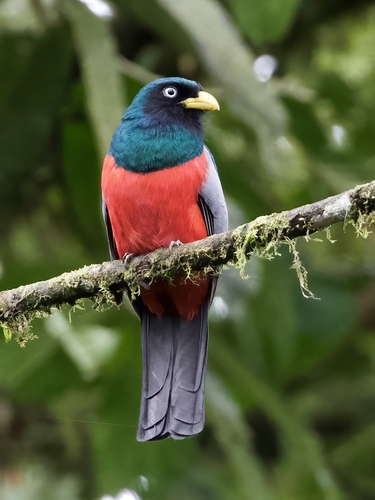
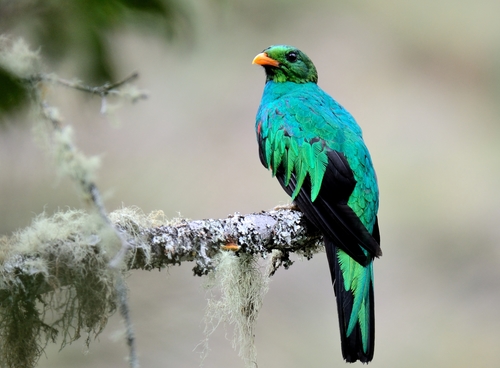
Like other species in the genus Pharomachrus, it has iridescent golden-green wings and breast that can look blue in certain light.
Sexual Dimorphism: Head and Breast
Females differ from males in coloration: their breast is duller brown, and their head is duller golden-brown, compared to the male's gold-bronze head that gives the species its name.
Sexual Dimorphism: Bill Traits
Both sexes have short, broad bills: males have yellow bills, while females have brownish-grey bills.
Tail Plumage Differences
The species' darker green uppertail coverts extend past the tip of the tail, and this extension is longer in males than in females. Both sexes have a black undertail, though females sometimes have greyish-black undertail tips.
Common Adult Plumage Traits
The lower breast feathers of both sexes are bright red.
Foot and Leg Features
Like all trogons, golden-headed quetzals have heterodactyl feet: the first and second toes point backwards, while the third and fourth point forwards. Their legs and feet are olive green or brownish.
Juvenile Plumage
Juvenile golden-headed quetzals are brownish-black, with only a small number of iridescent green feathers on the neck and breast, and lack the adult's specialized tail coverts.
Head Crest Distinction
Unlike other quetzal species, male golden-headed quetzals do not have a head feather crest.
Recognized Subspecies
There are two recognized subspecies: the nominate subspecies P. a. auriceps, and P. a. hargitti, which can be told apart by longer tails and a slightly more golden color in P. a. hargitti.
Distribution and Habitat
Overall Geographic Range
Golden-headed quetzals live across Central and South America.
Nominate Subspecies Range
The nominate subspecies P. a. auriceps occurs in eastern Panama's Cerro Pirre mountain, and along the Andes from southern Colombia to eastern Peru and northern Bolivia.
P. a. hargitti Range
The subspecies P. a. hargitti is only found in the Venezuelan Andes.
Preferred Habitat Types
Their most common natural habitat is humid, wet moderate-elevation montane and foothill forests, though they are also observed less often at forest edges, in clearings, and in temperate cloud forests and elfin forests.
Elevation Range
They live at elevations between 1200m and 3100m.
Behaviour and Breeding
Non-Breeding Social Structure
Outside the breeding season, golden-headed quetzals are usually solitary.
Breeding Mating System
During the breeding season, they are seasonally monogamous.
Courtship and Pair Formation
Males attract females by establishing and singing to advertise a territory. Once paired, the two birds work together to find a nesting site and excavate a nest.
Nesting Cavity Traits
Like all trogons, golden-headed quetzals are cavity-nesters: they use their bills to dig nests into decaying tree trunks, or modify existing hollows in old trees. The resulting cavities are shallow, more open, and unlined, and part of the nesting bird (either the head or tail) is usually visible from outside.
Nest Site Selection Requirements
Golden-headed quetzals often need to investigate many trees before finding a suitable site, because the dead tree must be soft enough to carve but not so rotten that it cannot support the nest.
Copulatory Behaviour
Little is known about the species' copulatory behaviour, as they mate discreetly.
Breeding Timing and Egg Laying
Golden-headed quetzals breed once per year between February and June. Females lay 1–2 pale blue eggs.
Incubation Period Duties
Females handle most of the 18–19 day incubation period, except for one long daily incubation shift done by the male.
Chick Development Post-Hatch
Chicks fledge 25–30 days after hatching. Like all trogons, golden-headed quetzal chicks are born blind and naked.
Pre-Fledging Plumage Development
Their final juvenile plumage develops around three days before fledging: it is mostly brown and black, with visible green feathers on the nape, upper back, and throat.
Brooding Duty Split
Brooding duties after hatching are shared equally between males and females.
Brooding Frequency Timeline
In the first 8–14 days after hatching, adults are present at the nest and brood 60–90% of each day; after this period, brooding frequency drops rapidly.
Sex-Specific Brooding Patterns
There is no clear pattern to when males or females brood, but males consistently brood for longer periods early in the brooding period, while females brood more often towards the end of the period. It is thought that only females brood at night.
Feeding Duty Structure
Feeding duties are also equally split between the two sexes: the non-brooding adult brings food to the nest before swapping places with the brooding adult.
Nest Swap Signalling
When swapping, the incoming adult perches above the nest and gives a whinnying call to signal the brooding adult to leave.
Feeding Behaviour Timeline
While brooding is still ongoing, adults enter the nest to feed chicks. After brooding ends, adults initially still enter the nest but spend less time inside before leaving; eight days before fledging they only lean into the nest to feed the chick before leaving; finally, 4–6 days before fledging, the chick can perch on the edge of the nest, and adults feed it while it perches there before leaving.
Nestling Diet
Food brought to nestlings is usually insects, and can also include fruit.
Fledging Day Process
On the day of fledging, the chick perches at the front of the nest, flies away, and stays near the nest for a short time before leaving the area.
Nest Sanitation
Like other quetzals, but unlike many other trogons, golden-headed quetzals keep their nests clean by removing or, more commonly, swallowing all chick droppings.