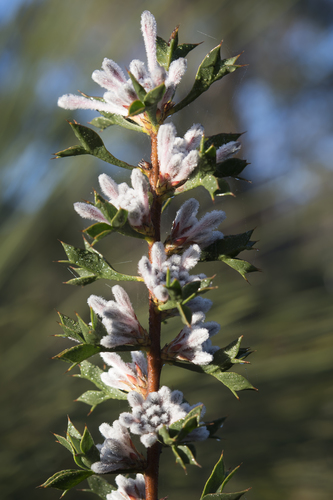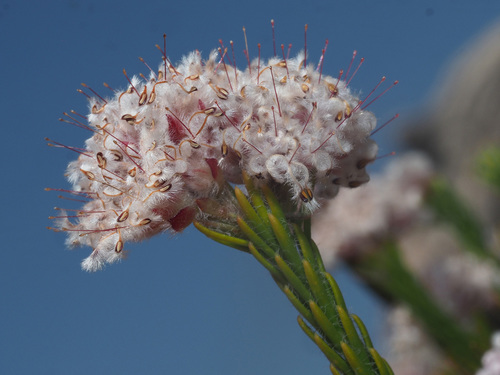
About Petrophile pulchella (Schrad. & J.C.Wendl.) R.Br.
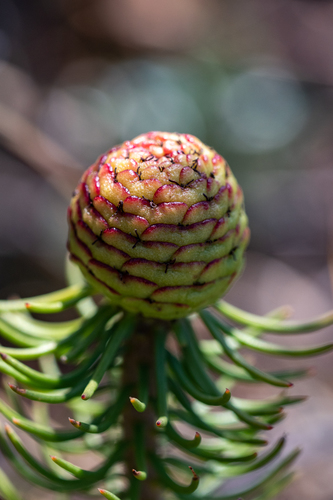
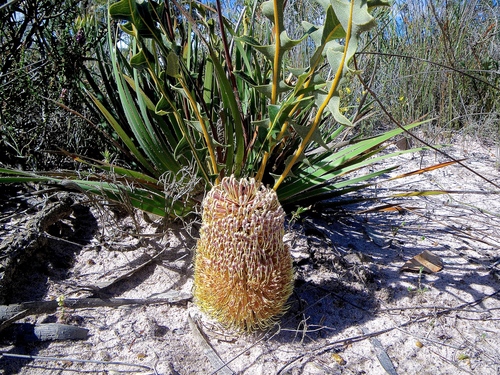
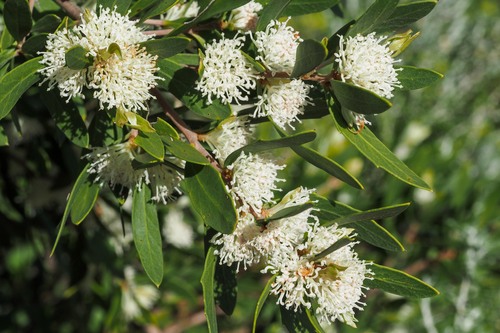
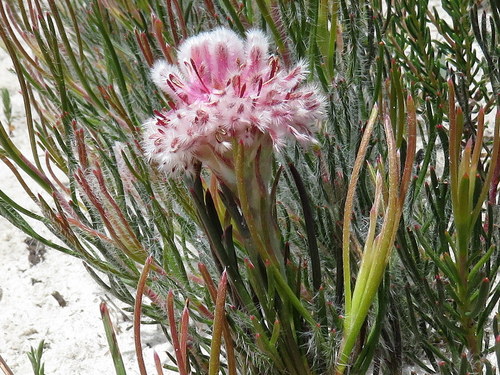
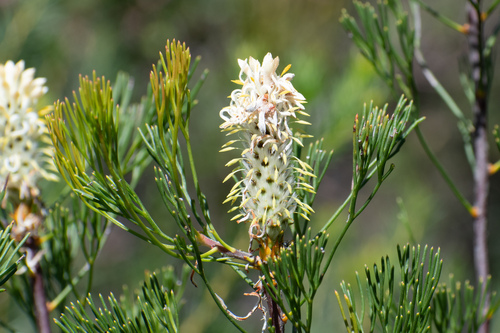
Petrophile pulchella (Schrad. & J.C.Wendl.) R.Br. is a shrub that typically reaches a height of 1.5–3 m (4 ft 11 in – 9 ft 10 in) when growing in sheltered locations, but only grows to 50 cm (20 in) tall in exposed heathland. Its young branchlets and leaves are covered in soft hair, but become glabrous as they age. The leaves are 40–90 mm (1.6–3.5 in) long, borne on a 30–50 mm (1.2–2.0 in) petiole, and are divided two or three times into needle-shaped pinnae that are soft, rather than having sharp tips. Its flowers are arranged in oval heads 20–35 mm (0.79–1.38 in) long, growing in leaf axils and at the ends of branchlets. The flower heads are either sessile, or borne on a peduncle up to around 6 mm (0.24 in) long. The individual flowers are 6–10 mm (0.24–0.39 in) long, cream-coloured, and covered in silky hair. Flowering occurs mostly from August to March. The fruit is a 3–4 mm (0.12–0.16 in) nut, and multiple nuts fuse together to form an oval head up to 65 mm (2.6 in) long. This species can be told apart from P. pedunculata because P. pedunculata has flower heads on peduncles 10–30 mm (0.39–1.18 in) long. The two other Petrophile species found in eastern Australia, P. canescens and P. sessilis, both have new growth covered in fine hair. Petrophile pulchella is distributed from south-eastern Queensland, south along the coast and adjacent tablelands to Jervis Bay in New South Wales. It often grows alongside trees such as Sydney peppermint (Eucalyptus piperita) and smooth-barked apple (Angophora costata), or in more open woodland with species including scribbly gum (Eucalyptus sclerophylla) and silvertop ash (E. sieberi). It also grows alongside shrubs such as mountain devil (Lambertia formosa), broad-leaved drumsticks (Isopogon anemonifolius) and paperbark tea-tree (Leptospermum trinervium). This species, commonly called conesticks, is killed by fire, and regenerates after fire from a seedbank stored in the plant canopy. Wild individual plants can live up to 60 years. A field study conducted in Brisbane Water National Park found that Petrophile pulchella produced more reproductive output in areas that had two short fire intervals of under seven years, compared to areas that had only one short fire interval. Plants in areas with one short fire interval in turn had greater reproductive output than areas with no fire intervals shorter than seven years. Seeds can germinate up to 700 days after a bushfire, and it is theoretically possible for the species' seedbank to last up to 90 years between fires. Native bees are thought to be possible pollinators of this species.