About Grevillea repens F.Muell.
Species Nomenclature and Habit
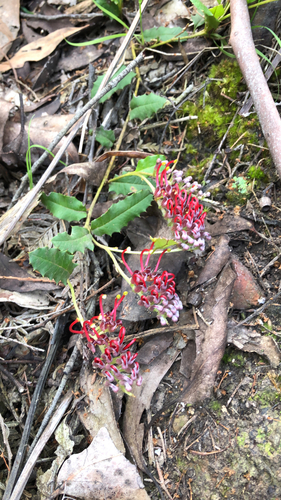
Grevillea repens (creeping grevillea) is a prostrate, trailing, often mat-forming shrub that typically reaches 3 meters (9.8 feet) across.
Leaf Shape and Dimensions
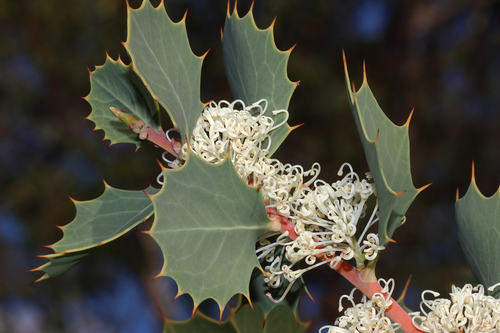
Its leaves are narrowly oblong to egg-shaped or elliptic, measuring 15–115 mm (0.59–4.53 in) long and 10–40 mm (0.39–1.57 in) wide.
Leaf Margins
Leaf edges usually have 5 to 19 more or less evenly spaced teeth or lobes up to 3 mm (0.12 in) long, and these teeth are sometimes sharply pointed.
Leaf Lower Surface
The lower leaf surface is usually covered with wavy, flattened hairs pressed against the surface.
Flower Cluster Structure
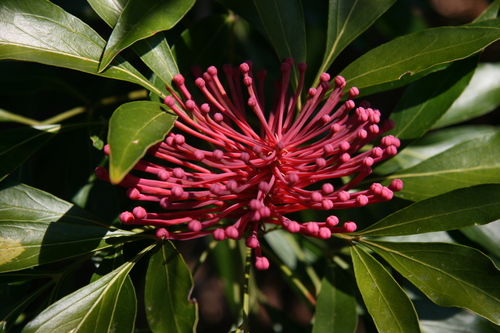
Flowers grow in clusters at the ends of branches, arranged along one side of a 35–80 mm (1.4–3.1 in) long rachis.
Flower Color and Pistil Size
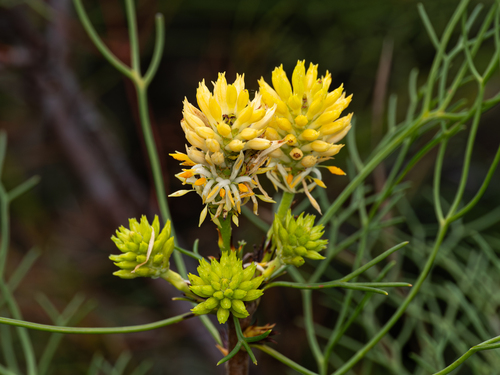
The flowers themselves are light green or grey with reddish stripes, with a pistil 16–19 mm (0.63–0.75 in) long.
Style Characteristics
The style is deep red, or dull orange to yellow, and is glabrous.
Flowering Period and Fruit
Flowering occurs between October and April, and the dry fruit is a 10–12 mm (0.39–0.47 in) long silky-hairy follicle.
Habitat and General Distribution
This species occurs in montane eucalypt forests in two main regions of central Victoria.
Regional Population Locations
One is an eastern population centered around the Kinglake area, and the other is a western population extending from near Daylesford to the Lerderderg Gorge area.
Eastern Population Reproduction and Fertility
Eastern region plants (the Mt Slide form) can reproduce both sexually via seed and clonally via root suckering, and tend to have lower fertility than western (Daylesford) population plants.
Western Population Regeneration
Plants from the western population regenerate by seed, or by reshooting from a lignotuber after disturbance events such as fire.
Chromosome Ploidy
Some clonally reproducing plants from the eastern region are triploid, with three sets of chromosomes, while the species is typically diploid with 2n=20.
Lerderderg Gorge Population Affinities
Populations in the Lerderderg Gorge have closer genetic and morphological similarity to plants from the Daylesford area than to those from the Kinglake area.
Regional Floral Color Variation
Western populations have the widest range of floral color variants, with styles ranging from green to dark red, while styles in eastern populations range from dark red to deep burgundy.