About Petrodromus tetradactylus Peters, 1846
Nomenclature
This species, scientifically named Petrodromus tetradactylus Peters, 1846, is commonly called the four-toed elephant shrew.
Fur Coloration
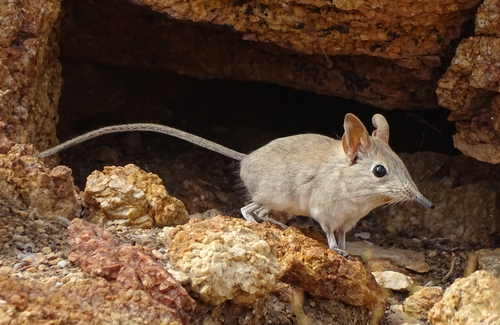
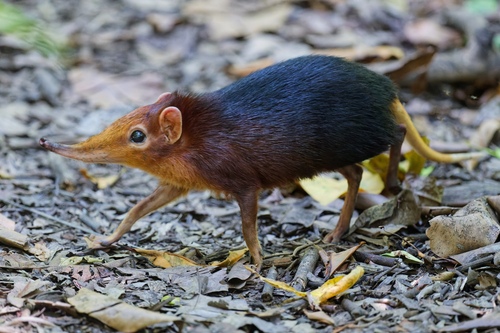
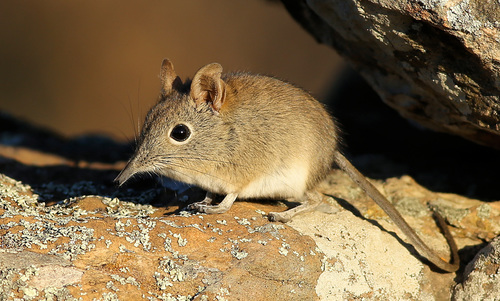
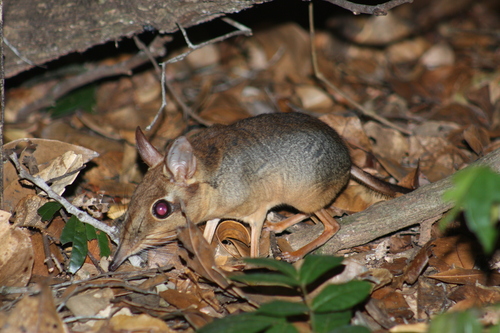
It has long, soft fur that ranges in color from greyish pale brown to dark brown, with white rings around the eyes and wide dark stripes on its back.
Distinct Markings
Its markings have additional consistent color traits: the upper parts of the feet are brownish-yellow, the ears are dark brown with pure white hair at the base of the inner margin, the upper side of the tail is black, the underside is pale yellow-brown, the tail darkens along its midsection and becomes almost black at the tip.
Snout Characteristics
The four-toed elephant shrew has a long, pointed, flexible and sensitive snout that it uses for hunting.
Limb Structure
It also has short forelimbs and long hind limbs.
Species Distinguishing Traits
This species can be distinguished from other regular elephant shrews by differences in facial features, body length, and weight.
Facial Feature Comparison
Regular elephant shrews have small eyes and ears, while the four-toed elephant shrew has broad, upstanding ears and large eyes.
Body Length Range
Overall elephant shrews generally range in body length from about 10 to 30 cm (4 to 12 in), but the body length of the four-toed elephant shrew falls in a narrower range of 19 to 23 cm (7.5 to 9 in).
Tail Length Range
Similarly, the tail length of general elephant shrews ranges from 8.0 to 26.5 cm (3.1 to 10.4 in), while the tail length of the four-toed species is 15.5 to 17 cm (6.1 to 6.7 in.
Weight Range
All elephant shrews are small mammals with weights ranging from 45 to 540 g (1.6 to 19.0 oz), and the four-toed elephant shrew is one of the largest elephant shrew species, with a weight between 160 and 280 g (5.6 and 9.9 oz).
Geographical Distribution
The four-toed elephant shrew is found in Central and Southern East Africa, specifically in Angola, the Democratic Republic of the Congo, Kenya, Malawi, Mozambique, South Africa, Tanzania, Zambia, Zimbabwe, and possibly also occurs in Namibia.
Natural Habitat Types
Its natural habitats are subtropical or tropical dry forests, montane forests, and moist savannas.
Distribution Prevalence
Within this range, it is the second most widespread elephant shrew species, after the short-snouted elephant shrew.
Preferred Habitat Features
It thrives in dense forests, particularly dense evergreen growths, woodlands, and thickets that provide suitable cover and protection, as well as access to the invertebrates it eats.
Roosting Behavior
At night, it prefers to sleep under dense brush, rather than in a nest.
Conservation Status
Although habitat destruction and hunting have impacted some of its populations, its conservation status is ranked as least concern.
Breeding Patterns
Four-toed elephant shrews breed year-round, with breeding activity increasing when more feeding grounds are available; breeding frequency depends on overall habitat quality.
Breeding Habitat Requirements
Lowland forests and savannas provide shelter from midday heat, resting sites, and suitable locations for giving birth.
Mating System
Copulation typically occurs on land, and this species is monogamous.
Mating Behavior
Mating involves sexual intercourse over several days, after which each mate returns to its solitary lifestyle.
Gestation and Offspring Count
Gestation lasts between 40 and 60 days, and one or two offspring are born.
Offspring Development
Young are born in a highly developed state, are weaned by their mother 15 to 25 days after birth, and reach full sexual maturity around 50 days after birth.
Reproductive Anatomy Traits
For reproductive anatomy, large granulated uterine natural killer cells occupy the walls of the mesometrial and myometrial arteries.
Shared Reproductive Traits
This species shares the trait of having a persistent relatively large yolk sac and large lobulated allantoic sac with other elephant shrews and other members of the genus Petrodromus.