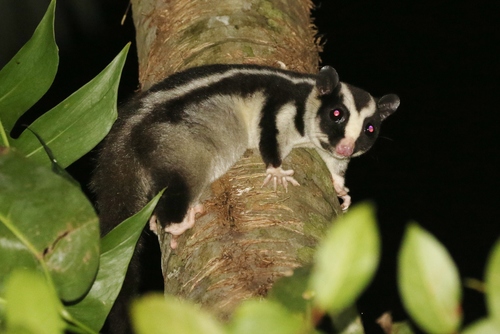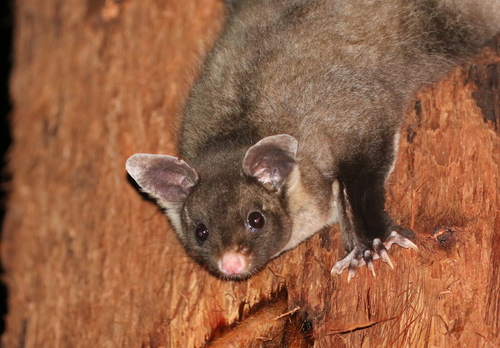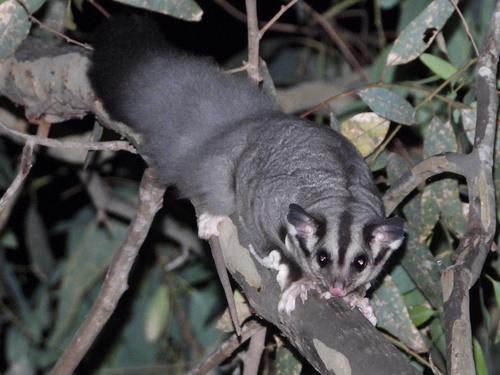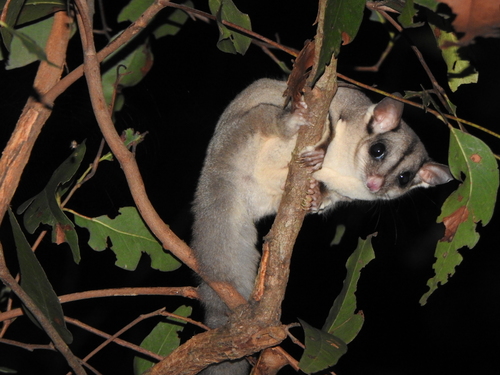
About Petaurus breviceps Waterhouse, 1838
Taxonomic Naming
The sugar glider, scientifically named Petaurus breviceps Waterhouse, 1838, is a small, omnivorous, arboreal, nocturnal gliding possum.
Common Name Etymology
Its common name comes from two of its traits: its preference for sugary foods like sap and nectar, and its ability to glide through the air, which is very similar to how a flying squirrel moves.
Convergent Evolution Example
Sugar gliders share very similar habits and appearance with flying squirrels, but they are not closely related, making this pair a clear example of convergent evolution.
Scientific Name Meaning
The scientific name Petaurus breviceps translates from Latin to "short-headed rope-dancer", a reference to the acrobatic movements the species performs in forest canopies.
Gliding Membrane Structure
A defining trait of the sugar glider is its pair of gliding membranes called patagia, which stretch from its forelegs to its hindlegs.
Gliding Function
Gliding is an efficient method for the sugar glider to reach food sources and escape predators.
Fur and Coloration
The animal is covered in soft fur that ranges from pale grey to light brown, and has countershaded coloration, with a lighter underside.
Strict Native Distribution
When strictly defined by a recent analysis, P. breviceps is only native to a small area of southeastern Australia, covering southern Queensland and most of New South Wales east of the Great Dividing Range.
Broader Species Group Range
The broader P. breviceps species group, which includes populations that may or may not belong to P. breviceps, occupies a much larger range across most of coastal eastern and northern Australia, New Guinea, and nearby islands.
Pet Genus Popularity
Members of the genus Petaurus are very popular exotic pets, and these pet animals are often commonly called sugar gliders.
Pet Species Misidentification
However, recent research shows that at least the sugar gliders kept as pets in America are not actually P. breviceps, but a closely related species.
Pet Population Origin
All of these pet pets ultimately trace their origin to a single source near Sorong in West Papua.
Pet Taxonomy Uncertainty
They may be members of Krefft's glider (P. notatus), but the taxonomy of Petaurus populations from New Guinea is still poorly understood.
Strict Species Altitudinal Range
In its strict definition, the sugar glider is distributed across the coastal forests of southeastern Queensland and most of New South Wales, and its range extends to altitudes as high as 2000m in the eastern ranges.
Range Overlap with Krefft's Glider
Parts of its range may overlap with the range of Krefft's glider (P. notatus).
Sympatric Species and Niche Partitioning
The sugar glider lives in sympatry with the squirrel glider and the yellow-bellied glider, and the three species can coexist thanks to niche partitioning, where each species uses different resources in different patterns.
Activity Cycle and Shelter
Like all arboreal, nocturnal marsupials, sugar gliders are active during the night, and shelter during the day inside tree hollows that they line with leafy twigs.
Home Range Characteristics
The average home range of wild sugar gliders is 0.5 hectares (1.2 acres), and home range size is largely tied to the abundance of local food sources.
Population Density
Population density ranges from two to six individuals per hectare (0.8–2.4 per acre).
Native Predators
Native owls of the genus Ninox are the primary predators of sugar gliders; other predators in the species' range include kookaburras, goannas, snakes, and quolls.
Feral Predator Threat
Feral cats (Felis catus) also pose a significant threat to the species.
Female Reproductive Anatomy
Like most marsupials, female sugar gliders have two ovaries and two uteri, and are polyestrous, meaning they can enter heat multiple times per year.
Marsupium Structure
Females have a marsupium (pouch) located in the center of their abdomen to carry developing offspring.
Pouch Morphology
The pouch opens toward the head, and two lateral pockets extend toward the tail when young are present.
Pouch Nipple Count
Most pouches hold four nipples, though some individuals have been recorded with only two nipples.
Male Reproductive Anatomy
Male sugar gliders have two pairs of bulbourethral glands and a split (bifurcated) penis that matches the structure of the female's two uteri.
Sexual Maturity Timing
The age when sugar gliders reach sexual maturity differs slightly between males and females.
Sexual Maturity Age Ranges
Males become sexually mature between 4 and 12 months of age, while females reach maturity between 8 and 12 months of age.
Breeding Frequency
In the wild, sugar gliders breed once or twice per year depending on local climate and habitat conditions, while they can breed multiple times per year in captivity, thanks to consistent living conditions and a consistent, proper diet.
Litter Size
A female sugar glider produces one (19% of litters) or two (81% of litters) babies, called joeys, per litter.
Gestation and Pouch Migration
The gestation period is between 15 and 17 days, after which the tiny joey, weighing just 0.2 g (0.0071 oz), crawls into the mother's pouch to continue developing.
Newborn Joey Development
Joeys are born largely undeveloped and furless, with only the sense of smell fully formed.
Pouch Navigation Mechanism
The mother has a scent gland on the outside of her marsupium that guides the sightless joeys from the uterus to the pouch.
Neonatal Shoulder Structure
Joeys have a continuous arch of cartilage in their shoulder girdle that disappears shortly after birth; this structure supports the joey's forelimbs to help it climb into the pouch.
Pouch Development Period
Young joeys stay completely contained within the mother's pouch for 60 days after birth, and get all their nourishment from the mother's mammary glands during this stage of development.
Post-Pouch Development Milestones
Joeys' eyes first open around 80 days after birth, and young sugar gliders will leave the nest around 110 days after birth.
Weaning and Thermoregulation
By the time young sugar gliders are weaned, their thermoregulatory system is fully developed, and combined with their larger adult body size and thicker fur, they are able to regulate their own body temperature.
Breeding Seasonality
Breeding is seasonal in southeastern Australia, with young only born during winter and spring, which fall between June and November.
Reproductive Strategy Adaptation
Unlike ground-dwelling animals, sugar gliders and other gliding possum species produce fewer, heavier offspring per litter.
Gliding Ability During Pregnancy
This reproductive strategy lets female sugar gliders retain the ability to glide even while pregnant.