About Persoonia rigida R.Br.
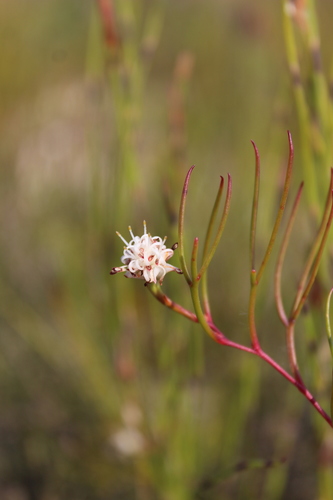
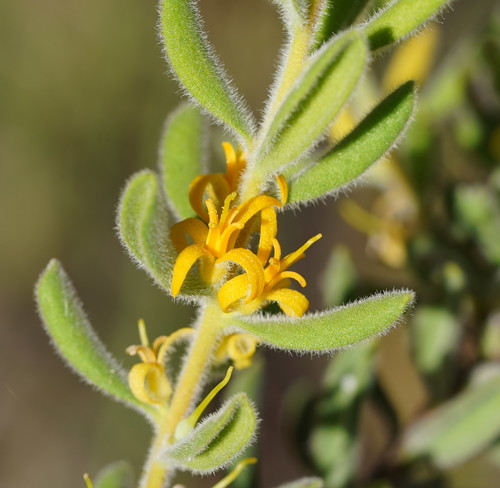
Persoonia rigida (common name rigid geebung) is an erect to low-lying shrub that usually grows between 0.15 and 2 metres (5.9 inches to 6 feet 6.7 inches) in height. Young branches and leaves of this plant are covered in hair. Its leaves range from lance-shaped with the narrower end at the base to spatula-shaped, measure 15 to 50 millimetres (0.59 to 1.97 inches) long and 4 to 19 millimetres (0.16 to 0.75 inches) wide, and have edges that curve downwards. Flowers are arranged in groups of up to twenty on a rachis that can reach 90 millimetres (3.5 inches) long, and the rachis continues to grow after flowering finishes. Each flower sits on a 1–3 millimetre (0.039–0.118 inch) long pedicel with a leaf at its base. The tepals are yellow, 10–12 millimetres (0.39–0.47 inches) long, and hairy on the outside, while the ovary is glabrous. Flowering takes place from November to March. Compared to other species in the Persoonia genus, an unusually high proportion of P. rigida flowers go on to develop fruit. This species is found from the Liverpool Range in central New South Wales, southwards into mid-western Victoria. It grows mostly on the inland (north and west) side of the Great Dividing Range, but extends east as far as Springwood in the Lower Blue Mountains, at altitudes between 300 and 1,300 metres (980 and 4,270 feet). It grows in sandstone-based or rocky soils in dry sclerophyll forest or heathland. It is known to hybridise with P. juniperina (prickly geebung) and P. sericea. In Victoria, it is commonly associated with the tree species Eucalyptus macrorhyncha and Eucalyptus polyanthemos. This species was first cultivated in England in 1824, but is now rarely seen in gardens and has little horticultural appeal.