About Persoonia levis (Cav.) Domin
Morphology
Size and Bark
Persoonia levis (Cav.) Domin grows as a tall shrub to small tree, reaching up to 5 metres (16 feet) in height. Its soft, flaky bark is dark grey on the surface, with reddish layers deeper beneath the bark. Epicormic buds located within the bark sprout new growth after bushfires.
Foliage Characteristics
New growth ranges from smooth to slightly hairy. The species has large green leaves that are 6 to 14 cm (2.2–5.5 in) long and 1.3 to 8 cm (0.5–3.2 in) wide, with oblong or sickle-shaped (falcate) forms. This asymmetrical leaf shape distinguishes Persoonia levis from Persoonia lanceolata.
Foliage Appearance
Its bright green foliage, especially new growth, stands out against the more muted colours of surrounding vegetation and the species' own reddish stems.
Flowering Period
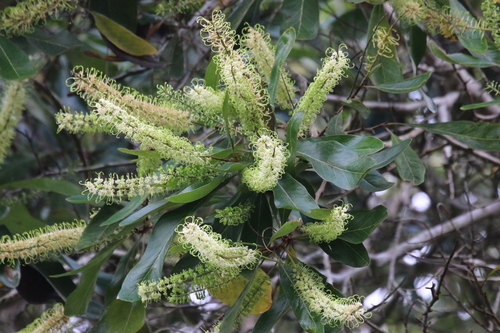
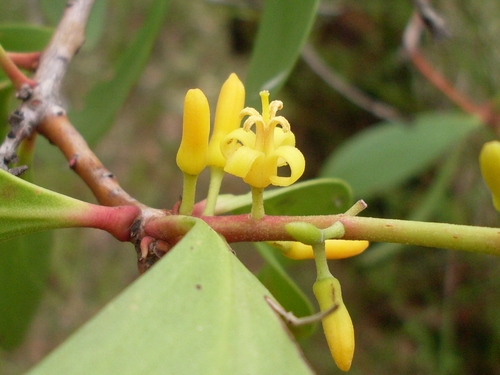
Yellow flowers bloom in summer and autumn, from December to April, with peak flowering occurring between December and February.
Flower Structure
Flowers grow in short axillary racemes along branchlets. Each individual flower has a cylindrical perianth made of tepals fused for most of their length, which encloses both male and female reproductive parts. The central style is surrounded by the anther, which splits into four segments that curl back to resemble a cross when viewed from above.
Pollination Adaptations
These segments act as a landing area for insects visiting the stigma, which sits at the tip of the style.
Fruit Characteristics
The fruit is a smooth, fleshy drupe that is green and roughly round, measuring 1 cm by 0.8 cm in diameter. It contains two seeds, has a spike at one end, and is juicy but stringy when unripe; the seeds and skin of the drupe are inedible.
Distribution and Habitat
Geographic Range
Persoonia levis is distributed from the Macleay River catchment on the mid north coast of New South Wales south to the Cann River in far eastern Victoria.
Soil and Altitude
It grows in dry sclerophyll forest on sandstone-based nutrient-deficient soils, ranging from sea level up to 1000 m (3500 ft) in altitude.
Associated Vegetation
In this habitat, it grows in sunny or lightly shaded areas of open woodland, associated with tree species including Eucalyptus piperita, E. sieberi, E. sclerophylla, E. radiata, E. smithii, Angophora costata, and Corymbia gummifera; it is also found alongside shrub species including Conospermum longifolium, Grevillea buxifolia, G. phylicoides, Hakea laevipes, Symphionema montanum, Telopea speciosissima, Persoonia hirsuta, and P. mollis.
Population Variation
Coastal populations of the species are smaller and have broader leaves than inland populations.
Rainfall Requirements
In the Sydney Basin, the annual rainfall of areas where Persoonia levis occurs ranges from 900–1400 mm (35–55 in).
Conservation Status
The species is considered adequately protected in the Sydney region, and occurs in Georges River, Cattai, Wollemi, Bouddi, Brisbane Water, Marramarra, Ku-ring-gai Chase, Garigal, Lane Cove, Sydney Harbour, Botany Bay, and Budderoo National Parks.
Ecology
Fire Adaptations
Persoonia levis is one of several Persoonia species that regenerates by resprouting from the trunk after bushfire, an adaptation to the fire-prone habitat it grows in. Its thick papery bark protects the underlying epicormic buds from fire damage.
Seed Regeneration
The species also regenerates via seedlings that grow from a soil-stored seedbank after fire, though germination can take up to 12 months. One study of sclerophyll forest that had remained unburnt for 30 years found that Persoonia levis populations had declined over that period.
Lifespan
Individual Persoonia levis plants can live for over 60 years, and their individual leaves have a lifespan of up to 6 years.
Mycorrhizal Association
Vescles indicating a mycorrhizal association have been found on the roots of this species; Proteaceae were not previously recorded forming mycorrhizal associations.
Pathogens
Infection by the fungus Anthracostroma persooniae causes leaf spot disease in Persoonia levis.
Herbivores
The species is a food plant for larvae of the weevil Eurhynchus laevior.
Pollinators
Colletid bees in the genus Leioproctus, subgenus Cladocerapis, exclusively forage on and pollinate the flowers of many Persoonia species. Bees of the subgenus Filiglossa, which are also in the genus Leioproctus and also specialise in feeding on Persoonia flowers, do not appear to be effective pollinators. The specific bee species Leioproctus carinatifrons, a longtongue bee, has been recorded visiting Persoonia levis.
Seed Dispersal
The fruit, which weighs 1700 mg (0.60 oz), is adapted to be eaten by vertebrates including kangaroos, possums, currawongs, and other large birds.
Reproductive System
The flowers of Persoonia levis are self-incompatible, meaning they cannot fertilise themselves and require outcrossing with another individual plant.
Cultivation
Propagation Challenges
Persoonia levis is rarely found in cultivation, mostly due to propagation difficulties: seed germination is unpredictable, and rooting cuttings has been nearly impossible.
Horticultural Appeal
Even so, its colourful bark and foliage are attractive for horticultural use.
Growing Conditions
In garden settings, the species requires well-drained sandy soil in a location with sun or part shade. Once established, it tolerates moderate frosts and dry periods, and grows fairly readily (albeit slowly) in suitable conditions.
Cultivation History
Plantsmen in England had already germinated seed of this species as early as 1795.