About Grevillea lanigera A.Cunn. ex R.Br.
Growth Habit
Grevillea lanigera (A.Cunn. ex R.Br.), commonly known as woolly grevillea, is most often a spreading shrub that usually grows 20 to 50 cm (7.9 to 19.7 in) tall. It sometimes grows as a dense rounded shrub that reaches up to 2 m (6 ft 7 in) in height.
Leaf Characteristics
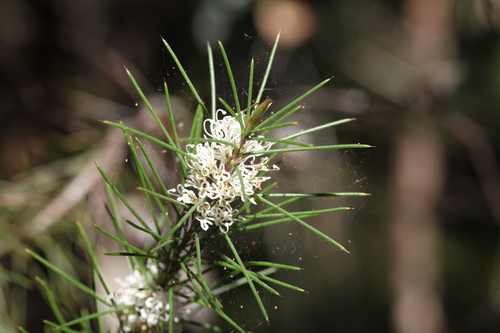
Its leaves are shaped from narrowly oblong to roughly linear, measuring 5 to 40 mm (0.20 to 1.57 in) long and 0.7 to 5 mm (0.028 to 0.197 in) wide, with edges that are curved downward or rolled under. The lower surface of the leaves is covered in shaggy hairs.
Flower Structure
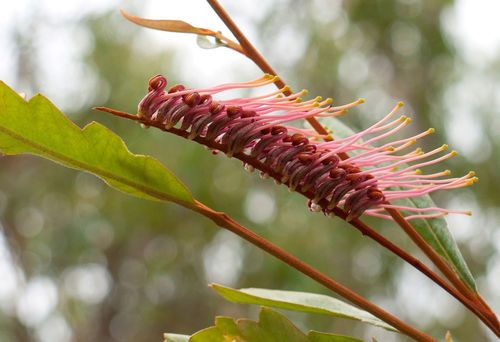
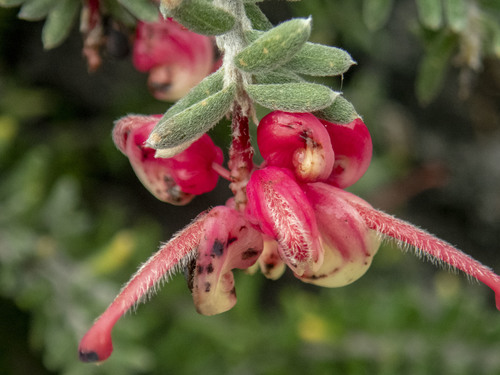
The flowers are arranged in clusters of 2 to 10 on a 2.5 to 10 mm (0.098 to 0.394 in) long rachis, and are colored pale pink to red with cream accents. The style is covered in shaggy or woolly hairs except near its tip; the pistil is 13.5 to 19.5 mm (0.53 to 0.77 in) long and hairy on the inside.
Flowering Period
Flowering occurs mainly from July to December, though flowers may sometimes be present in other months.
Fruit Features
The fruit is a shaggy-hairy, elliptic to oblong follicle that is 10 to 15 mm (0.39 to 0.59 in) long.
Habitat
Woolly grevillea grows in moist, rocky locations within scrub, woodland, and forest.
Distribution Range
It occurs south from near Dubbo and east of the Riverina in New South Wales, extending mainly along the coast and tablelands through the Australian Capital Territory into eastern Victoria.
Species Variability and Hybrids
This species varies in growth habit, leaf features, and flower abundance, and forms hybrids with G. rosmarinifolia, G. polybractea, and G. floribunda.
Cultivation Propagation
This grevillea is popular in cultivation, and can be grown from seed or cuttings.
Growing Conditions
It is hardy across a range of climate and soil conditions, tolerant of both drought and frost, though it prefers a sunny position in the garden.