About Perilla frutescens (L.) Britton
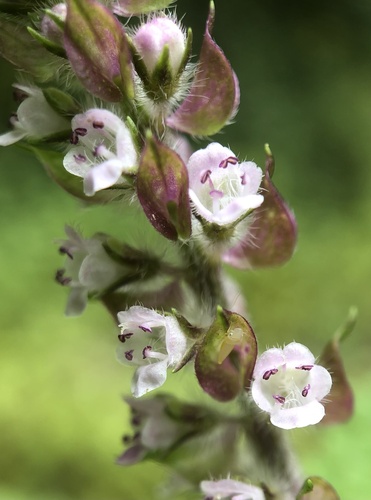
Perilla frutescens (L.) Britton, commonly called perilla, is an annual plant that grows 60–90 cm (24–35 in) tall, with hairy, square stalks. Its leaves are arranged oppositely, measure 7–12 cm (3–4+1⁄2 in) long and 5–8 cm (2–3 in) wide, have a broad oval shape with pointed tips, serrated (saw-toothed) edges, and long leafstalks. The leaves are green, and occasionally have purple tints on their undersides. Perilla produces flowers in racemes at the ends of branches and the main stalk in late summer. Its calyx is 3–4 mm (1⁄8–5⁄32 in) long, made up of three upper sepals and two hairy lower sepals. The corolla is 4–5 mm (5⁄32–3⁄16 in) long, with a lower lip longer than the upper lip. Of its four stamens, two are long. The fruit is a schizocarp 2 mm (1⁄16 in) in diameter, with a reticulate (net-like) pattern on its outer surface. Perilla seeds are globular, can be soft or hard, and range in color from white, grey, and brown to dark brown. 1000 perilla seeds weigh approximately 4 g (1⁄8 oz), and seeds contain 38 to 45 percent lipid by content. This plant is native to Bangladesh; India, specifically the Eastern and Western Himalayas and Northeast India; Nepal; Myanmar; China, specifically South Central China and Southeast China; Thailand; Laos; Vietnam; Java; Taiwan; Japan; Korea; and Russia, specifically Primorsky Krai and Khabarovsk Krai. It has been introduced to other regions including Inner Mongolia, Cambodia, parts of Europe (Germany, Romania, Ukraine, and South European Russia), several U.S. states, and the Canadian province of Ontario. After spreading across the United States, P. frutescens has been classified as a weed there. While perilla is widely grown as an edible plant for humans, it is toxic to cattle, other ruminants, and horses. In grazing cattle, plant ketones from perilla cause acute respiratory distress syndrome, also known as "panting disease". People handling perilla leaves or oil may develop contact dermatitis. Consumption of large quantities of perilla seeds has caused cases of anaphylaxis.