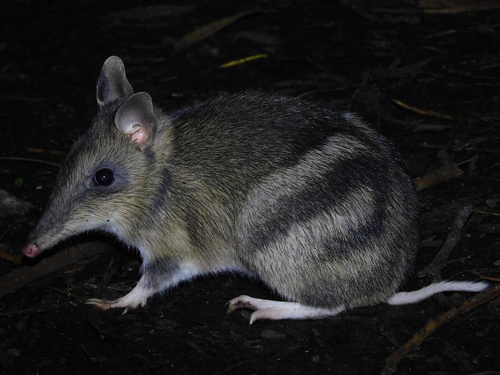
About Perameles gunnii Gray, 1838
Scientific Name and Weight
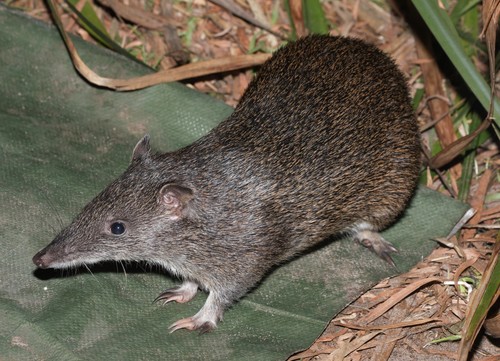
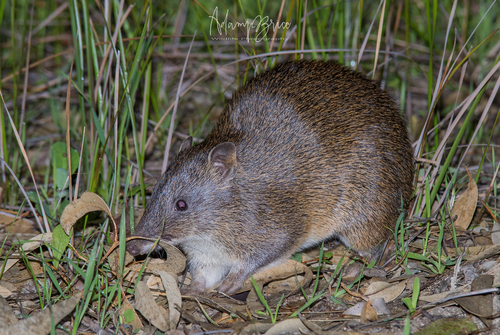
The eastern barred bandicoot, scientifically named Perameles gunnii Gray, 1838, weighs less than 2 kg (4.4 lb).
Distinctive Markings
It has a short tail and three to four whitish bars across its rump.
Population Distribution
This species has two geographically separated populations: one on mainland Australia and one on the island of Tasmania.
Regional Size Differences
The Tasmanian form is somewhat larger than the mainland form, with an average adult mass of 750 g (26 oz) for individuals in Victoria, and 1,000 g (35 oz) for individuals in Tasmania.
Lifespan and Social Behavior
Eastern barred bandicoots live only two to three years and are not gregarious.
Home Range and Mating
Males occupy larger home ranges than females, and only associate with females for mating.
Activity Pattern
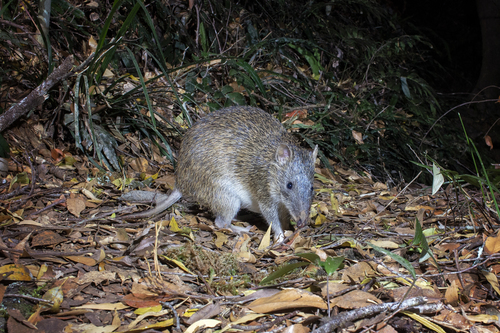
This is a nocturnal species.
Foraging Habits
It emerges from its nest at dusk to forage for a variety of invertebrates, including crickets, beetles and earthworms.
Daytime Resting Behavior
During the day it rests in a grass-lined nest.
Foraging Adaptations
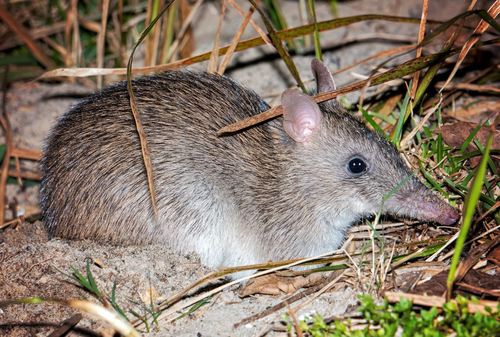
When foraging, it uses its long nose to probe deep into the soil, then digs eagerly once it locates food.
Reproductive Traits
Females have 8 nipples and can produce a maximum of 5 young in one litter, with an average of 2 to 3 young per litter.
Gestation Period
Gestation lasts just 12 days, which is one of the shortest gestation periods of any mammal.
Juvenile Development
Young are weaned at 55 days, and newly emerged juveniles remain dependent on their mothers and forage with them until they reach 86 days old.
Breeding Frequency
In ideal conditions, females can produce up to five litters per year, though reproduction slows during the summer and stops entirely during droughts.
Historical Distribution
Historically, the eastern barred bandicoot was distributed across the basalt plains of southwest Victoria and across Tasmania.
Threats to Mainland Population
Due to predation by introduced foxes and cats, combined with land-clearing for farming, the Victorian subspecies is critically endangered.
Reintroduction Sites Establishment
Since 1989, eight reintroduction sites have been established across the bandicoot's former range.
Conservation Dependencies
Conservation of the eastern barred bandicoot in Victoria now depends on the success of captive breeding and reintroduction programs.
Conservation Plan Elements
Key elements of this conservation plan include maintaining an insurance population in captivity, conducting research to improve breeding and reintroduction success, and increasing community awareness and support for this rare marsupial.
Initial Reintroduction Recommendation
A management plan first developed in 1987 and revised in 1989 recommended the first reintroduction of the eastern barred bandicoot in Victoria at Woodlands Historic Park, 20 km (12 mi) northwest of Melbourne.
Captive Breeding Establishment
In 1988, animals were translocated from the last remaining free-ranging mainland population in Hamilton, western Victoria to captive breeding facilities at Woodlands to establish a new population there.
Fenced Reserve Reintroduction
Captive-bred offspring formed the basis for reintroductions into the Back Paddock Nature Reserve, a 400-ha section of the park surrounded by a predator-resistant fence built to exclude feral predators.
Current Site Population Statuses
Currently, populations at four sites (Floating Islands Nature Reserve, Lanark, Cobra Killuc Wildlife Reserve and Lake Goldsmith Nature Reserve) are extinct, the population at Woodlands Historic Park is functionally extinct, the population at Mooramong is declining, and populations at Hamilton Community Parklands and Mount Rothwell are increasing.
Wild Population Extinction
The last remaining wild population, which was once found along the Grange Burn creek in Hamilton, has also been declared extinct.
2008 Population Estimate
The estimated population size for the Victorian eastern barred bandicoot in 2008 was 150 individuals.
Island Release Successes
Eastern barred bandicoots have been successfully released on Phillip Island, French Island and Churchill Island in Victoria's Westernport.
2021 Conservation Status Update
On 15 September 2021, Victoria's Environment Minister Lily D'Ambrosio announced that the conservation status of the Victorian subspecies has changed from "extinct in the wild" to "endangered", as its population had increased from 150 to 1,500 over thirteen years.
Conservation Status Milestone
This marked the first time such a change in conservation status had occurred in Australia's history.
Tasmanian Subspecies Status
The Tasmanian subspecies, P. g. gunni, is classified as vulnerable to extinction.
Tasmanian Subspecies Range Reason
This subspecies has a larger range than its mainland relative because Tasmania has large areas of suitable habitat and lacks the bandicoot's main predator, the red fox.