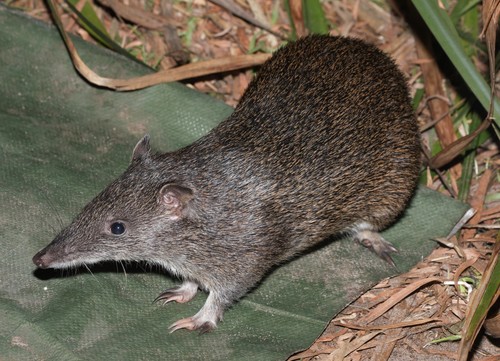
About Isoodon obesulus (Shaw, 1797)
Scientific Naming & Core Body Traits
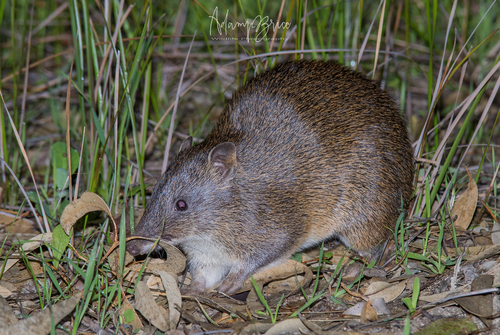
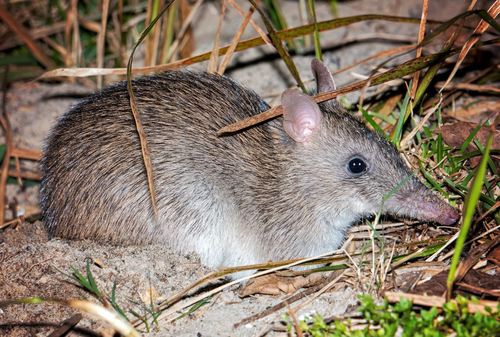
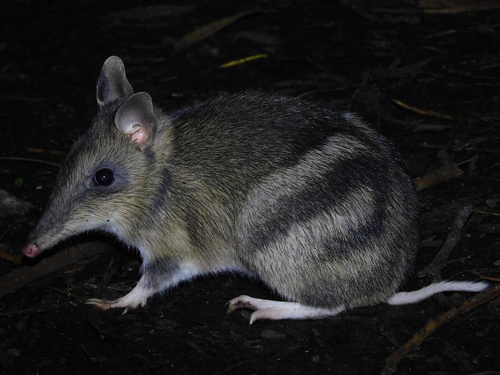
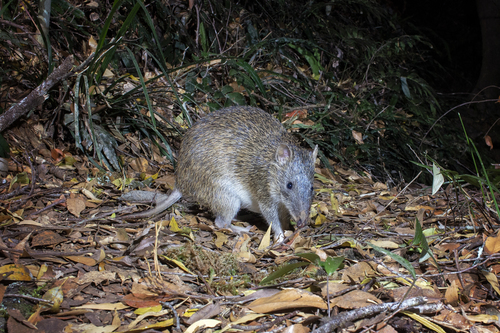
The southern brown bandicoot, scientifically named Isoodon obesulus (Shaw, 1797), has a stocky body, a short snout, and short rounded ears. This species displays sexual dimorphism, with females smaller than males.
Size Measurements
On average, males reach a total length of 50 cm (20 in) and weigh up to 1.2 kg (2.6 lb), while females measure 40 cm (16 in) and weigh no more than 1 kg (2.2 lb). Their fur is coarse and bristly, with a grizzled texture and color ranging from dark greyish to yellowish brown; their undersides are creamy-white or yellowish grey.
Tail Characteristics
Their tail is relatively short, at around 13 cm (5.1 in) long, and is brown on the upper side and white on the underside. Each foot has five toes.
Foot Structure
Like many other marsupials, southern brown bandicoots have syndactylous feet: the second and third toes of the hind foot are fused along almost their entire length. All toes end in sturdy claws, except the first digits of the forefeet and the fifth digits of the hindfeet, which are tiny and vestigial.
Female Pouch Traits
In females, the pouch opens toward the rear, and contains eight teats arranged in a partial circle. Once widespread across much of coastal Australia, southern brown bandicoots now have a much more limited distribution.
Core Distribution Range
An isolated population lives in the northeastern part of Cape York Peninsula, Queensland; all other surviving individuals are found in the southern half of Australia. In New South Wales, the species is considered rare, and is mostly restricted to the extreme southeast of the state and two national parks north of Sydney.
Victoria Distribution
In Victoria, it is more common, found along the entire length of the coast and up to 1,000 m (3,300 ft) in the Grampian and Dandenong mountains. In South Australia, it inhabits the Eyre and Fleurieu peninsulas, the extreme southeast, and Kangaroo Island.
Western & Tasmanian Distribution
Isolated, increasingly restricted populations are found in southwestern Western Australia. The species is most common in Tasmania, where it occurs across almost the entire island.
Tasmanian Island Presence
It is also currently present on Inner Sister Island, but has been extirpated from many other small Tasmanian islands where it once lived. Across its range, the southern brown bandicoot inhabits open forest, scrub, and heathland, particularly in areas with extensive ground cover from shrubs or mat-rushes.
Subspecies Habitat Preference
The subspecies I. o. obesulus prefers the margins of artificial waterways over drier habitats.