About Penstemon whippleanus A.Gray
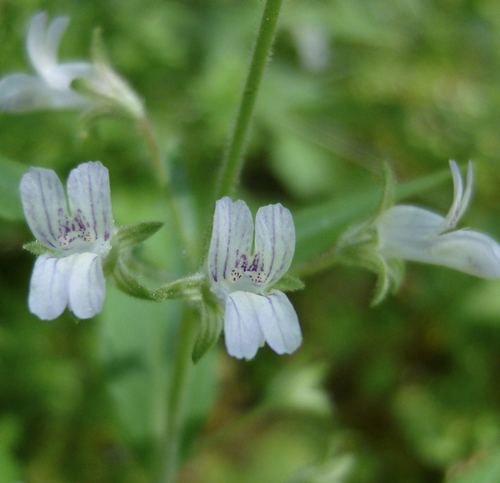
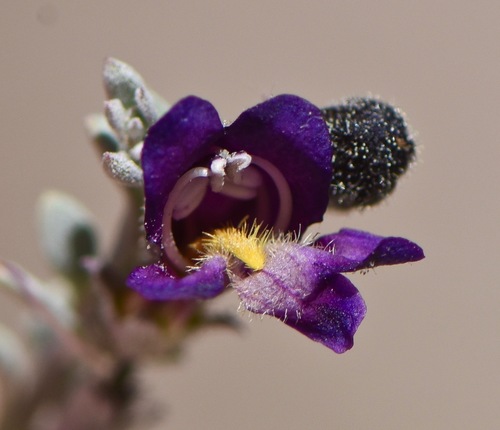
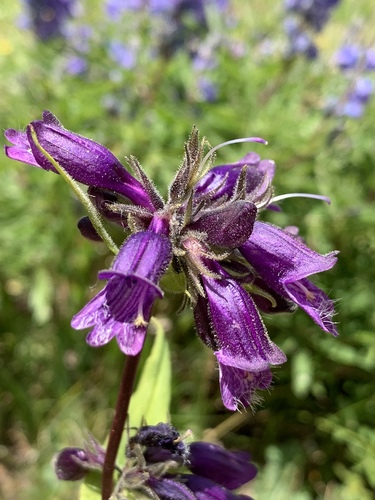
Dusky penstemon, scientifically named Penstemon whippleanus A.Gray, is easily recognizable by its unique combination of large flowers, striking dark or pale blooms, and the height of its flowering stems. Flowering stems are typically 20 to 65 centimeters tall, though they may occasionally reach as short as 8 cm or as tall as 1 meter. Like most species in the Penstemon genus, Penstemon whippleanus is an evergreen perennial plant. It produces both basal leaves growing from the base of the plant, and stem leaves arranged in opposite pairs along its flowering stems. Basal leaves grow on short stalks, are hairless and smooth, and not leathery. Each basal leaf measures roughly 40–90 mm long and 10–30 mm wide, with a blade shape that is generally ovate to lanceolate. Leaves on the flowering stems are typically narrower and shorter, measuring 25–60 mm long and 3–15 mm wide, with a blade shape of lanceolate to oblanceolate. The tall, generally straight flowering stems hold multiple flower clusters at nodes just above each pair of leaves. Flowering stems grow indeterminately, and are smooth (glabrous) on the lower portion, and glandular and hairy on the upper portion. Each flower cluster is a cyme made of two groupings, holding 2-4 flowers per grouping for a total of 4-8 flowers per cluster. The bracts near the point of flower attachment are lanceolate. The flowers are large, usually 20–27 mm long and occasionally reaching up to 30 mm in length, with a width of 8–10 mm at the flower mouth. Flowers are most commonly a deep gothic black-purple, but can also be violet, blue, or creamy white. The creamy white flower form is found mostly in the mountains of the Great Basin and on Colorado's Grand Mesa, and has no intermediate forms with darker-flowered specimens. The inside of the flower mouth has fine lines that act as nectar guides: these lines are white or lavender on dark-flowered forms, and purple on light-colored forms. The lower lip of the flower tube also has distinct long white hairs. Seed capsules are rounded with four lobes, each lobe tapering to a sharp tip at the top. When split open, each capsule holds numerous seeds. Seeds require 6 to 12 weeks of cold stratification for successful germination. Penstemon whippleanus is widely distributed across the central Rocky Mountains of North America. The USDA Natural Resources Conservation Service PLANTS database records it growing in New Mexico, Arizona, Colorado, Utah, Wyoming, Idaho, and Montana, though no county-level distribution records for Montana exist in the database. It grows primarily in the subalpine or subarctic biome at elevations from 2500–3600 meters, with occasional populations found above the timberline or in foothills as low as 1825 meters. It is most often found on open slopes, meadows, rocky ledges, mountain tundra, and woodland openings. It also readily colonizes the gravelly edges of roads and highways, and has a documented preference for rocky soils. Alongside other mountain species such as rosy paintbrush (Castilleja rhexiifolia) and scarlet paintbrush (Castilleja miniata), dusky penstemon acts as a host plant for the geranium plume moth (Amblyptilia pica). When offered both leaves and flowers of dusky penstemon, geranium plume moth caterpillars only feed on the flowers. Flowers of the species contain significant amounts of the alkaloid boschniakine, while leaves only contain trace amounts. Flowers also contain the pyridine compound pedicularine and 4-noractinidine. The 1983 detection of alkaloids in this species was the first detection of alkaloids in any penstemon; prior to this, iridoids were much better known in the genus. Dusky penstemon is planted as an ornamental in gardens for its large, striking flowers, which bloom in summer at high elevations, or as early as April at low elevations. It is very winter hardy, recorded as surviving in USDA hardiness zones 4-8, and UK hardiness rating H4. In garden conditions, it grows in neutral to acid soils, spreads rapidly, and tolerates propagation by division. Like most penstemons, it is drought tolerant but intolerant of poorly draining or waterlogged soils, though it is more tolerant of moisture than most other species in the genus. It does not require rich soils or fertilization, but produces more flowers when grown in richer soil. Due to its native mountain habitat, P. whippleanus is particularly well suited for higher elevation gardens. It grows in full sun or partial shade, but remains healthier in warmer climates when given afternoon shade. It is resistant to deer browsing, but young garden-grown plants are often damaged by cutworms, slugs, or snails. In garden settings, it is also vulnerable to powdery mildew, rust, leaf spots, and Southern blight. For good germination rates, seeds need three months of cold, moist stratification, or can be planted outdoors over winter to receive a similar period of cold conditions.