About Penstemon virgatus A.Gray
Scientific Classification and Plant Type
The wandbloom penstemon, scientifically named Penstemon virgatus A.Gray, is a short-lived perennial herbaceous plant.
Mature Plant Height
Mature plants reach 12 to 90 centimeters (5 to 35 inches) tall, and more commonly grow between 20 and 60 cm (8 to 24 inches) tall.
Flowering Stem Count
Plants produce one or more flowering stems.
Stem Texture
Stems may be puberulent, covered in fine downy hairs, or smooth, but they are never waxy.
Leaf Type and Position
All plants have cauline leaves, which are leaves attached directly to stems; plants sometimes also produce basal leaves, which grow directly from the base of the plant.
Leaf and Stem Hair Correlation
When stems are hairless, leaves are also hairless; when stems have fine hairs, leaves are usually covered in similar fine hairs.
Leaf Glaucous Trait
Rarely, leaves may be slightly glaucous, meaning covered in blue-gray waxes.
Basal and Lower Stem Leaf Length
The lowest stem leaves and any present basal leaves measure 2 to 11.4 centimeters long, and are usually more than 6 cm long.
Basal and Lower Stem Leaf Width
These leaves are much narrower than they are long, most often 1.2 to 2.1 cm wide, though they may be as narrow as 3 millimeters.
Basal and Lower Stem Leaf Shape
They are commonly lanceolate (shaped like a spear head) or oblanceolate (reverse spear-head shape), and rarely linear, resembling a blade of grass.
Upper Leaf Arrangement
Stems bear five to eleven pairs of sessile leaves arranged opposite one another on the stem.
Upper Stem Leaf Dimensions and Shape
Upper stem leaves are 4 to 11.8 cm long and 3 to 17 mm wide, and are also lanceolate in shape.
Flowering Stem Structure
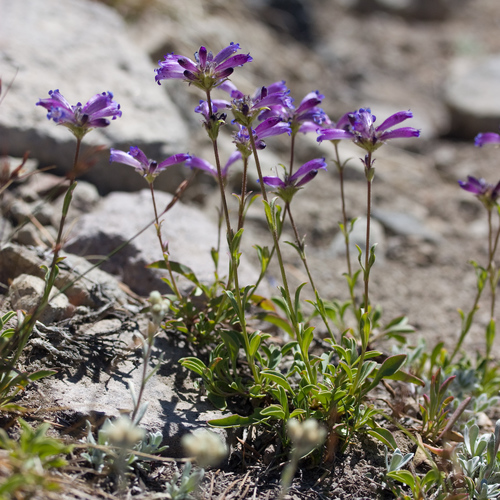
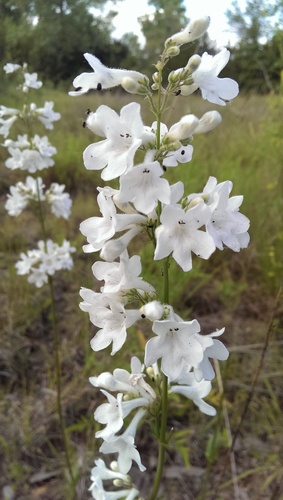
The flowering stem is long and wand-like, with flowers arranged secund, meaning all flowers face one direction.
Inflorescence Length
The inflorescence is usually 6 to 40 centimeters (2 to 16 inches) long, but occasionally may be just 3 cm long at the top of the stem.
Inflorescence Flower Grouping
It holds between 3 and 14 groups of flowers called cymes, with two to five flowers per cyme.
Flower Lip Structure
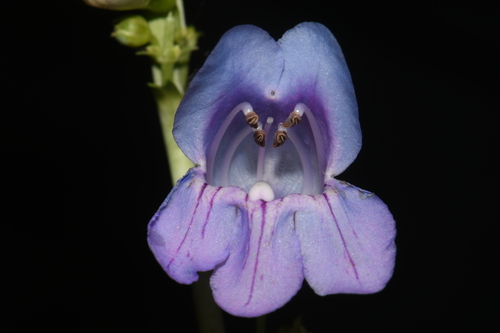
Flowers are two-lipped, with three rounded lobes on the lower lip and two lobes on the upper lip; lower lobes may bend backwards.
Flower Color Range
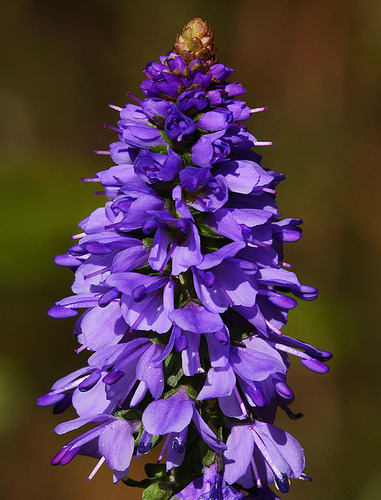
Flower colors range across pallid white, pink, blue, faded lavender, and purple.
Flower Nectar Guides
Dark purple-red nectar guide lines mark the lower lip of the flower.
Similar Species Distinction
Penstemon virgatus is very similar to Penstemon secundiflorus, which also grows in the southern Rocky Mountains, but the staminode of Penstemon virgatus is hairless, while the staminode of P. secundiflorus is hairy.
Native Continent Distribution
Penstemon virgatus is native to North America, growing in both the United States and Mexico.
United States Range
In the United States, it grows in Wyoming, Colorado, New Mexico, and Arizona.
Mexico Range
In Mexico, its range is widely separated from the United States population, occurring in two discontiguous areas: Colima and Jalisco in southwestern Mexico, and San Luis Potosí in northeastern Mexico.
Preferred Soil Drainage
This species favors well-draining locations such as rocky or gravelly hillsides.
Soil Tolerance
However, it is noted for its tolerance of heavier soils and of soil saturation during the spring, as long as the soil is dry at other times of year.
Habitat Plant Associations
It grows in association with openings in scrub oak woodlands and pine forests, as well as in higher altitude grasslands.
Caterpillar Host Role
It is a host species for the caterpillars of the arachne checkerspot butterfly (Poladryas arachne) and the variable checkerspot (Euphydryas chalcedona).
Cultivation Garden Use
In cultivation, wandbloom penstemon is particularly noted for use in high altitude gardens.
Cultivation Range Expansion
It is easy to grow, and has been planted far outside of its natural range within the United States.
Seed Germination Requirements
Its seeds do not require cold stratification to sprout.