About Penstemon virens Pennell ex Rydb.
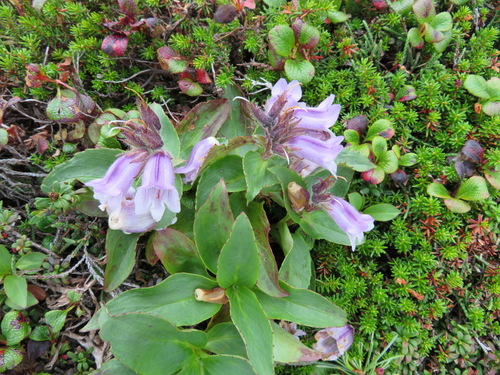
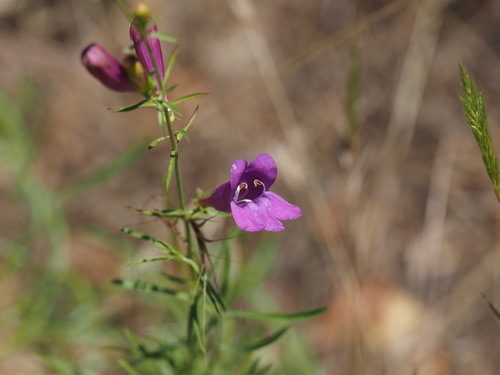
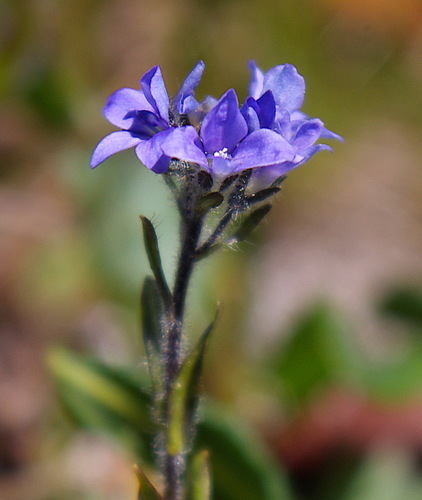
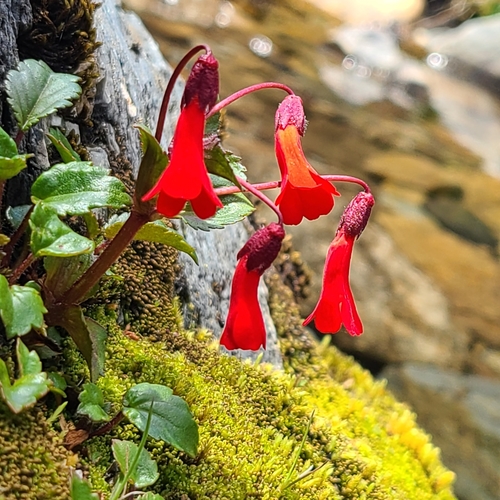
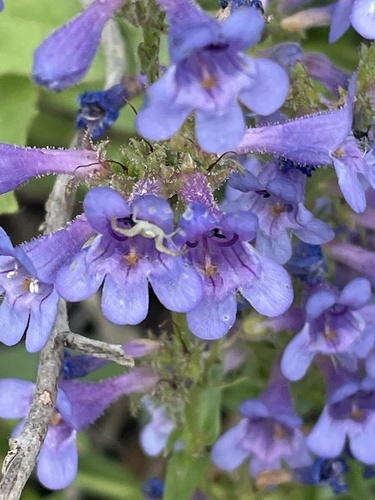
Penstemon virens, scientifically named Penstemon virens Pennell ex Rydb., has upright flowering stems that typically grow 10–40 cm tall with very little curvature. Stems are covered in extremely fine, short hairs that become glandular and hairy closer to the flower buds and blooms, and are rarely almost or completely hairless. Most of its leaves grow at the base of the plant and are relatively short, measuring 2–10.2 cm long. These basal leaves are bright green, smooth, shiny, and have smooth or very finely toothed (denticulate) margins. Though smooth, the leaves are not leathery or thick; they are oblanceolate to spatulate with a tapered base, 4–15 mm wide, and their tips are mildly pointed, ranging from obtuse to acute. Leaves attached to the flowering stems are hairless, have smooth edges, are lanceolate to slightly ovate in shape, and are shorter than basal leaves, measuring 1.8–5 cm in length and 3–14 mm in width. This plant grows as a low, spreading mat that expands each year, and its leaves generally persist over winter in most locations. Its flowering structure is an indeterminate thyrse, which stops growing due to environmental conditions rather than genetic programming. It typically bears 3 to 6 clusters of flowers positioned just above each pair of leaves. When closely examined, these flower clusters are actually paired verticillasters that grow on opposite sides of the stem, and they face in all directions. At the base of each flower are five green, glandular-pubescent sepals that are ovate to lanceolate, 2–4.5 mm long, and 1.5–2.5 mm wide at their base; each sepal has a distinct red edge. The flower itself is a tapered funnel 10–16 mm long, colored pale sky blue to light purple or violet. It opens into five rounded petals at its mouth, with purple-blue to reddish-purple nectar guides running from the center of each petal down into the flower. The outside of the flower is glandular-pubescent, while the inside has a moderate covering of fine white fuzz. The inner diameter of the flower tube throat measures 3–5 mm, with an outer diameter of about 4–5 mm. The lower lip and the area just inside the tube bear a few longer white hairs. The infertile fifth stamen, the staminode that gives the Penstemon genus its name, is covered in golden-brown hairs, 8–10 mm long, and almost reaches the opening of the flower tube. The four fertile stamens are arranged in upper pairs, curving inwards and upwards, and are purple to pink-white. The style is 8–11 mm long. The seed capsules are small teardrop-shaped, about 5–7 mm long and 2–3 mm wide, and ripen by late July or early August at lower elevations. Penstemon virens is most commonly found growing on rocky slopes, rock outcrops, forest openings, along road cuts, and in other disturbed areas, growing at elevations between 1600 and 3000 meters. It is common within its native habitat, but has a limited distribution. Its range extends from the Medicine Bow Range in southeastern Wyoming south to the Culebra Range in southeastern Colorado; it is common in the mountains and foothills of the Front Range between these two areas, and also grows on the Palmer Divide in Colorado. The USDA Natural Resources Conservation Service PLANTS database records county-level occurrences only in Colorado and Wyoming. NatureServe assessed Penstemon virens as globally vulnerable (G3) in 1993; the organization did not assess Colorado state populations, and rated Wyoming populations as imperiled (S2). Ecologically, Penstemon virens tends to grow in large groups rather than alone or scattered across the landscape, and populations almost always contain at least 10 individual plants. Most flower visitors that enter the blooms are bees. The most frequent visitors are species in the genus Lasioglossum, but species from the genera Osmia, Bombus, and honeybees also visit frequently. Specific species that have been observed visiting include Apis mellifera, Augochlorella aurata, Bombus huntii, Bombus rufocinctus, Bombus centralis, Halictus tripartitus, Hoplitis truncata, Lasioglossum sisymbrii, and Lasioglossum trizonatum. This species is also occasionally visited by beeflies (Bombyliidae) and butterflies, but these visitors have not been observed contacting the plant's reproductive parts, and are thought to be nectar robbers. Though hummingbirds are present within its range, they have not been scientifically observed visiting Penstemon virens. A study of plant responses to wildfire found that Penstemon virens occurs in similar areas at similar population levels before wildfire and five years after fire recovery. While it does recover from fire, an earlier study found that Penstemon virens is significantly associated with areas of historic low-intensity fires in ponderosa pine forests. When tested as a potential host for the partially parasitic plant Castilleja integra, researchers found that Penstemon virens can only support Castilleja integra for a few weeks at most. In cultivation, this species (often called blue mist penstemon) is recommended as a garden plant by local governments, water providers, and extension services for areas in and near Colorado's Front Range. It is valued for its low water requirements, adaptation to local climates, attractive blooms, long lifespan, and ease of cultivation. It is drought tolerant once established, but is not adapted to constantly dry conditions. In garden settings, it grows well in full sun to partial shade in the western United States, and requires full sun in the eastern United States. It is highly adaptable to a range of garden soil conditions, but like all penstemons, it stays healthier when grown with good drainage. Dr. Dale Lindgren of the University of Nebraska notes that Penstemon virens seeds require six weeks of cold moist stratification at 4.5 °C to achieve good germination rates, or can be planted outdoors over winter to meet this requirement. However, experiments by Dr. Norman C. Deno indicate that a six-month period of dry warm storage at around 21 °C (70 °F) before cool moist stratification is critical for germination. Deno's research also showed that seeds left inside dried stems after ripening naturally achieve this required dry warm period in the wild. The coldest USDA hardiness zone where this plant is known to survive is zone 4.