About Penstemon secundiflorus Benth.
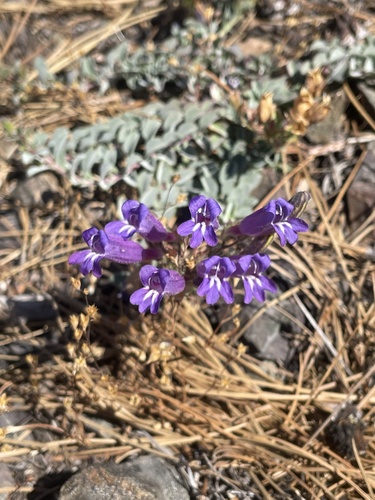
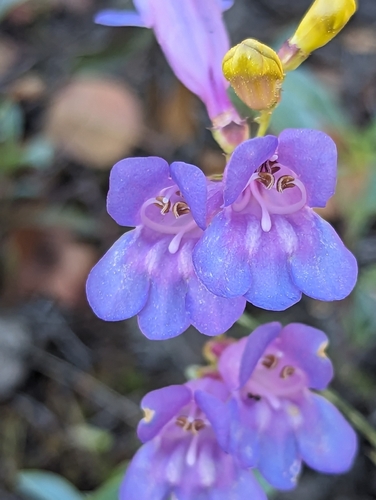
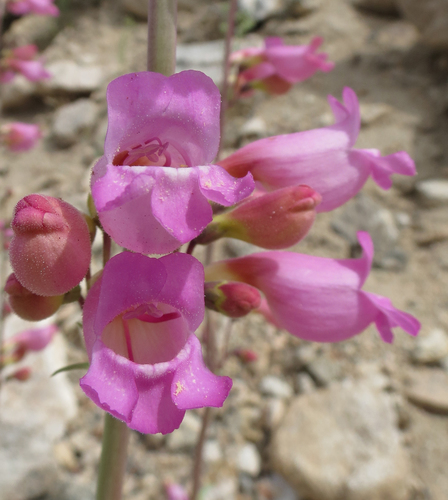
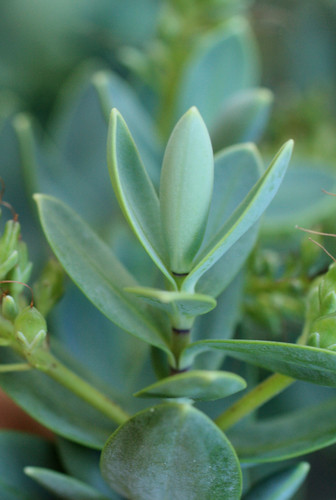
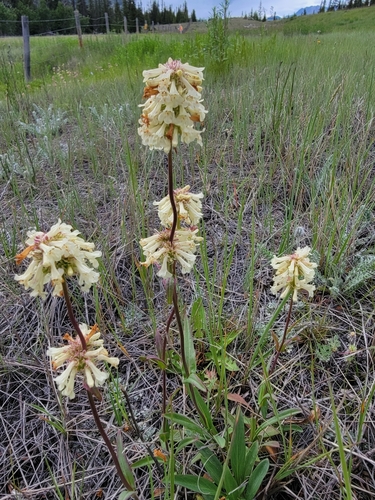
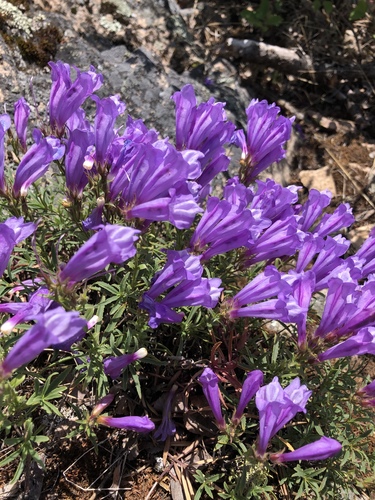
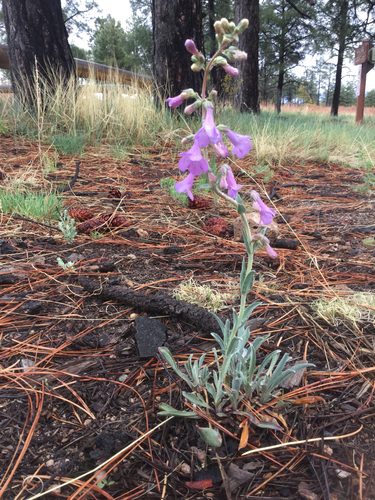
Sidebells penstemon (Penstemon secundiflorus Benth.) is a mostly herbaceous, relatively long-lived plant. It typically dies back completely each year, but may retain some leaves through winter, or grow a slightly woody above-ground stem called a caudex that it re-sprouts from in spring. Its basal leaves range in shape from lanceolate to spatulate. They are usually 20–80 mm long and 2–25 mm wide, though they can occasionally grow as long as 102 mm. The leaves are completely smooth, hairless, and somewhat glaucous, with a gray-green color from natural waxes that protect the plant from drying out. Leaf tips are usually between obtuse and acute (slightly more or less than a right angle rounded point), but occasionally end in a mucronate, a sharp protruding point. Leaf edges are smooth, with no teeth or lobes. Leaves on the flowering stem are arranged in pairs. Lower stem leaves are very similar in size, color, and shape to basal leaves, but are more often lanceolate to egg-shaped. Leaf bases are tapered, and do not have a stalk attaching them to the stem or base of the plant. There are 4–6 pairs of leaves on the lower portion of the flowering stalk, with each leaf base clasping the stem to having a slight projection extending to either side of the stem, which is described as cordate-clasping. This species is commonly found growing in rocky, gravelly, and sandy loam soils. It most often grows in decomposed granite soils, but is occasionally found on soils from limestone or sandstone. It mainly grows in scrubby and open forests, including Pinon-Juniper-Oak woodlands, Juniper savanna, and open ponderosa-oak woodlands. It also commonly grows in sagebrush grasslands at higher elevations and in openings within montane forests. In some areas, its populations extend out onto plains within mixed-grass prairie. P. secundiflorus tends to be scattered across its habitat, growing with only two or three plants per location, rather than forming continuous stands or dense colonies. It is frequently found growing in roadcuts within its range. This species is distributed across three U.S. states and two Mexican states. Most of its population is found east of the Continental Divide in the Rocky Mountains of Wyoming and Colorado, but it has also been reported in several western counties of Colorado. In New Mexico, populations are found in the northern part of the state both east and west of the mountains. Population locations within Mexico are not precisely recorded, but Plants of the World Online (POWO) reports it grows in the Mexican states of Sonora and Chihuahua. Sidebells penstemon has some adaptations to disturbance and wildfire. Seed germination experiments show a 1.9 times greater germination rate when seeds are exposed to smoke. Populations were found in similar numbers both before and five years after the 2002 Hayman Fire in Colorado. As expected for a plant with relatively large, brightly colored flowers, P. secundiflorus attracts many nectar-feeding visitors. Three specific butterfly species are known to visit it: Atlantis fritillaries (Speyeria atlantis), Rocky Mountain apollos (Parnassius smintheus), and Pahaska skippers (Hesperia pahaska); swallowtails are also known to visit the flowers. Most visitors are bees, including Andrena medionitens, Anthophora terminalis, Anthophora ursina, Bombus bifarius, Bombus melanopygus, Bombus centralis, Bombus occidentalis, Osmia bruneri, Osmia pentstemonis, Hylaeus basalis, Lasioglossum sisymbri, and Lasioglossum trizonatum. The specialist bee Osmia brevis, an oligolege that only visits Penstemon flowers, has been observed visiting P. secundiflorus by Frank and Carol Crosswhite. In one field study, bees of the genus Lasioglossum were the most frequent flower visitors, but the exact species was not determined in that study. A hoverfly (false bee), Syrphus opinator, is also known to visit the flowers. The broad-tailed hummingbird, Selasphorus platycercus, also visits P. secundiflorus. As part of its chemical defenses, Penstemon secundiflorus contains the iridoid glycoside 10-hydroxy-(5αH)-6-epidihydrocornin. Despite this chemical defense, new green leaves are eaten by the caterpillars of the dotted checkerspot (Poladryas minuta subspecies arachne). In cultivation, sidebells penstemon has a reputation for being easy to grow, with showy flowers and attractive leaf rosettes. It is also valued for attracting many bees and swallowtail butterflies to gardens. In garden settings, it forms long-lived, many-stemmed clumps. Its seeds germinate easily after six weeks of cold, moist stratification. Sidebells penstemon requires full sun exposure and well-draining soils; Colorado State Extension recommends rocky or gravelly soils, though it can be grown in somewhat clay soils in dry areas. The plant prefers soils that have not been enriched with fertilizers or organic matter, which is a common trait among penstemons. Though well adapted to dry conditions, it struggles when grown tightly packed with other plants. It is used in rock gardens, xeric plantings, meadow gardens, and other naturalistic garden types. In cultivation, it can be grown in areas as cold as USDA Hardiness Zone 4, which experiences minimum temperatures of −34 to −29 °C (−30 to −20 °F), and as warm as USDA Hardiness Zone 7, which has minimum temperatures of −18 to −12 °C (0 to 10 °F).