About Penstemon azureus Benth.
Penstemon azureus Benth. is a perennial subshrub, meaning it is mostly herbaceous but partially woody. It produces numerous thin, hairless branches that are woody at the base.
Size
Plants most often grow 13 to 50 centimeters (5 to 20 inches) tall, and may occasionally reach 70 centimeters (2.3 feet) in height.
Leaf Color and Type
The leaves of Penstemon azureus are blue-green. This species produces both basal leaves (growing directly from the plant's base) and cauline leaves (growing attached to stems), though plants sometimes have almost no basal leaves.
Basal and Lower Leaf Dimensions
When present, basal leaves and lower stem leaves measure 15 to 60 millimeters long, and usually 2 to 10 millimeters wide, occasionally reaching 20 millimeters in width.
Basal and Lower Leaf Shape
These leaves vary in shape: they may be obovate (teardrop-shaped, with the widest portion toward the tip), oblanceolate (shaped like a reversed spear head), or linear (narrow like a blade of grass).
Stem Leaf Arrangement
Each stem bears between three and twenty pairs of leaves attached on opposite sides of the stem. Leaves growing higher on the stem are typically widest at the base and clasp the stem.
Upper Leaf Dimensions and Shape
Upper stem leaves have a broader size range, measuring 10 to 90 millimeters long and 2 to 20 millimeters wide, and may be elliptic, ovate, lanceolate, or linear in shape.
Inflorescence Structure
The inflorescence produces three to ten verticillasters, which are groups of flowers with paired bracts below their attachment points. Each verticillaster has two attachment points, holding one to four buds or hairless tubular flowers.
Flower Appearance
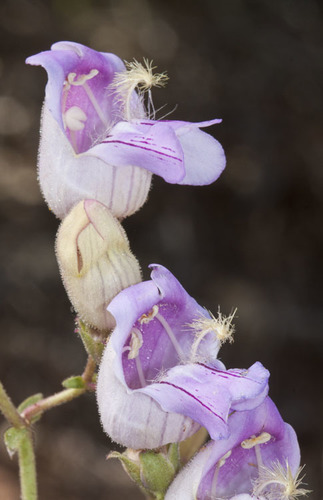
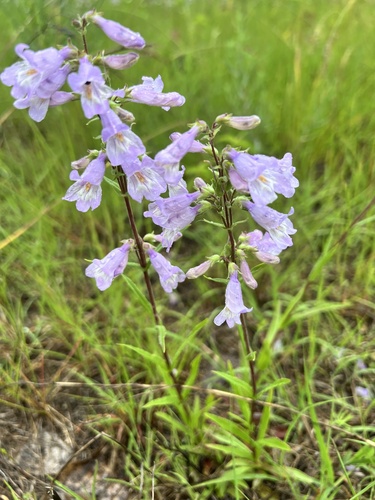
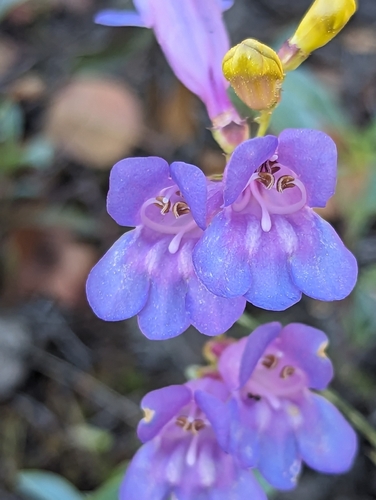
The buds are yellow, and mature flowers are usually blue, though they may occasionally be lavender or violet. Each flower measures 18 to 35 millimeters long.
Overall Native Range
This species is native to the United States, with the majority of its range located in California and a smaller portion extending into southern Oregon.
California Distribution
In California, it grows as far south as Tulare County, where it is native to the Sierra Nevada foothills and high mountains. Its range extends north into the Cascade Range, and it also grows from northern California's north coast up into the North Coast Ranges.
Oregon Distribution
In Oregon, it occurs in four counties: Curry, Josephine, Jackson, and Douglas.
Variety angustissimus Habitat
The variety angustissimus grows in moist woodlands or forests at elevations of 300 to 700 meters (980 to 2,300 feet).
Variety azureus Habitat
The variety azureus grows at higher elevations, from 500 meters (1,640 feet) up to 2,500 meters (8,200 feet), and is found in association with oak, pine, or juniper woodlands.