About Penstemon rydbergii A.Nelson
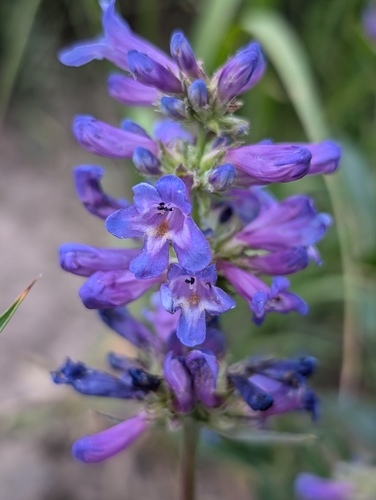
Penstemon rydbergii A.Nelson, commonly known as meadow penstemon, typically grows two types of stems: short leaf-only stems and taller stems that terminate in an inflorescence. All of its herbaceous stems grow from a branching, woody caudex, which is usually positioned above a taproot. Flowering stems are most often 20 to 70 centimeters (8 to 27.5 inches) tall, but can occasionally reach up to 1.2 meters (3 feet 11 inches). Stems may grow straight upward, grow outward before curving upward, or grow along the ground. All stems can be either hairy or hairless; sometimes hairs are only present in lines on the stems below leaf attachment points. Very often, stems become progressively more red toward the top. Most of the plant's leaves are basal, growing at the base of the plant and attached to the non-flowering stems. Basal leaves and the lowest leaves on flowering stems are 2.5 to 15 centimeters (1 to 6 inches) long, most commonly 3.5 to 7 centimeters (1.5 to 3 inches) long. They are 0.5 to 2.2 centimeters wide, most commonly 1 to 1.5 centimeters wide. Their shape ranges from oblanceolate to elliptic, with tapered bases and a narrow to broadly angled tip, and they are very rarely mucronate. Leaves attached to flowering stems grow in three to six opposite pairs, and are 2.5 to 11 centimeters (1 to 4 inches) long, usually shorter than 7 centimeters. They are 0.3 to 2.4 centimeters wide, and shaped lanceolate to elliptic or oblong. The inflorescence sits at the top of the stem and holds one to seven widely spaced groups of flowers called verticillasters; most stems have at least two of these flower groups. Flowers face all directions outward from two cymes, which are branches from a single attachment point, each holding three to eleven flowers. The spreading lobes of the flower are bright to deep blue or purple, while the flower tube is violet to blue-purple, and the flower never has colored guide lines. The flower is hairless everywhere except the lower lip, which has a white or golden beard. Flowers are usually 10 to 16 millimeters long, but can sometimes grow up to 20 millimeters long. The longest pair of the four stamens reaches or extends past the opening of the flower, and the staminode is 6 to 7 millimeters long, reaching just to the flower mouth. Its fruits are hairless capsules that measure 4 to 5 millimeters long by 3 to 4 millimeters wide, and contain numerous small seeds 0.6 to 1 millimeter in size. Meadow penstemon is native to the western United States, ranging from the Rocky Mountains to the Pacific states. In New Mexico, it is only found in the northern mountainous areas of the state. In Colorado, it is only found in the western mountainous portion of the state. In Wyoming, it is only recorded from Carbon and Fremont counties. In Montana, it is only recorded from four of the state's southwestern counties. It is found across almost all of the Great Basin, but does not occur in eastern Nevada. It grows in southern Idaho, and is not found in the northern Idaho panhandle. It generally does not grow west of the Cascade Mountains in Washington and Oregon. In California, it grows in the northern Coast Ranges, the Klamath Mountains, and the higher elevations of the central Sierra Nevada. While most penstemon species prefer dry habitats, meadow penstemon is usually found in moist places such as near streams or in wet meadows. Experimental evidence shows that meadow penstemon becomes more abundant in areas where northern pocket gophers (Thomomys talpoides) are active, and it often grows more densely along the edges of areas disturbed by these gophers. This species contains four iridoids bound as glycosides: euphroside, plantarenaloside, aucubin, and geniposidic acid. Although it produces small flowers, it is sometimes grown in gardens, particularly by gardeners in regions with moist climates. It is propagated by seed, and requires twelve weeks of cold-moist stratification to achieve good germination rates.