About Penstemon palmeri A.Gray
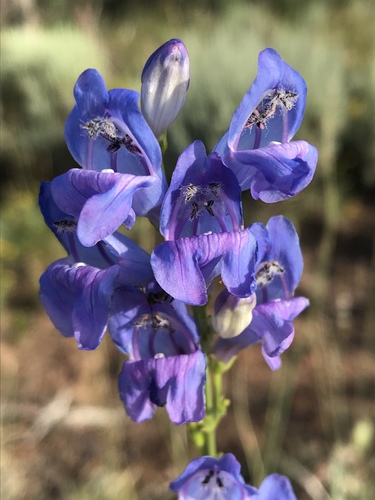
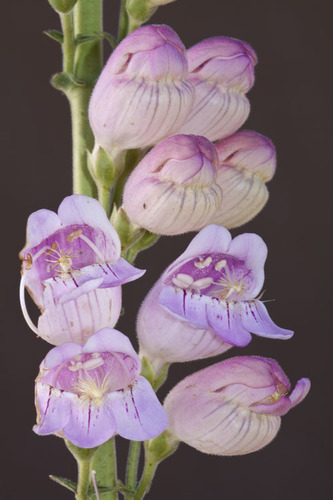
Penstemon palmeri, commonly known as Palmer's penstemon, is an erect perennial that can grow up to 2 meters (6.6 feet) tall. Its leaves are generally oppositely arranged with toothed margins. The inflorescence forms a panicle or raceme that bears small bracts. Each flower has a five-lobed calyx made of sepals, and a cylindrical corolla that may have an expanded throat. The plant's staminode is partially hairy. The showy, rounded flowers have large pink, violet, or blue-purple petals, and carry a fragrance that sets this species apart from other similar-looking penstemons. Occasional individual plants produce red, yellow, or white flowers instead. Penstemon palmeri is native to desert mountain ranges ranging from the eastern Mojave Desert in California, through eastern Nevada, northeastern Arizona, and New Mexico, and extending north through parts of Utah, Colorado, Wyoming, Idaho, and eastern Washington. This drought-tolerant evergreen prefers well-draining drier soils, and grows in washes, bajadas, roadsides, canyon floors, creosote bush scrub, and juniper woodlands at elevations between 1,100 and 2,300 meters (3,600 to 7,500 feet). Ecologically, it acts as a larval host plant for both the Arachne checkerspot and the variable checkerspot butterflies.