About Penstemon gracilis Nutt.
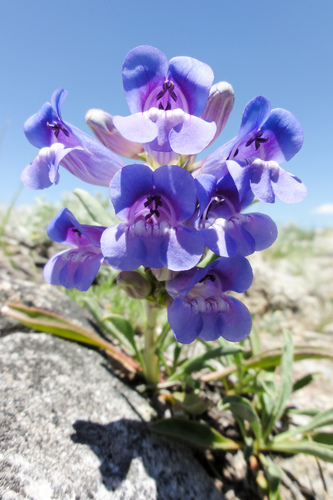
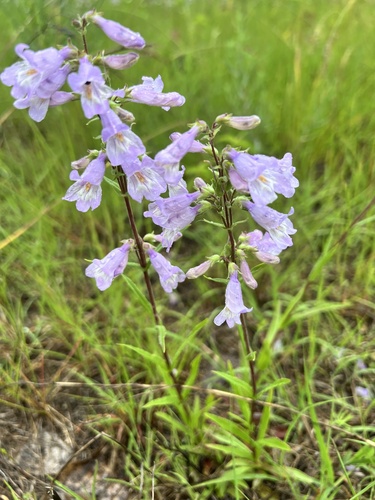
Penstemon gracilis Nutt., commonly known as slender penstemon, is a perennial herbaceous plant. Fully grown individuals are typically 20 to 50 centimeters (8 to 20 inches) tall, though occasional specimens reach only 15 cm (6 in). Most plants produce one to four stems, but some can grow as many as six. Stems may grow straight upward, or grow outward first before curving upward. The upper portion of stems is commonly reddish, and is glandular-pubescent (covered in gland-tipped hairs that exude plant chemicals) near the flower cluster; the base of the stem has non-glandular backward-facing hairs. Stems grow from a short, slender herbaceous (non-woody) caudex that sits atop a taproot. Slender penstemon has both basal leaves (growing directly from the plant base) and cauline leaves (growing attached to stems). Leaves are never leathery; they are usually hairless, but some populations or individual plants may have sparse to dense hair covering. Populations with short, fine leaf hairs are most often found in Wisconsin's Driftless Area, while hairy and hairless plants grow mixed together in North Dakota. Leaf edges range from nearly smooth to serrate, with asymmetrical forward-pointing teeth. Basal leaves and the lowest stem leaves are 2.5 to 7.5 centimeters long and 4 to 15 millimeters wide, with shapes ranging from ovate to oblanceolate to lanceolate. Each stem bears four to seven pairs of leaves. Upper leaves attach directly to the stem, measuring 2 to 9 cm long by 2 to 15 mm wide, and are shaped lanceolate to linear (narrow like a grass blade). Each stem holds two to seven flower clusters attached at two points along the stem, with four to twelve flowers per cluster. The blooms are less showy than those of many other Penstemon species. Flowers are small with a narrow throat, colored pale blue-violet to lavender that darkens to wine color at the base. They are tubular, with fused petals measuring 1.4 to 2.2 centimeters long. The flower's upper lip is smaller than the lower lip, and often bends backwards, while the lower lip projects outward and may have white hairs. The inside of the flower is lighter in color than the outer surface, and has mauve or purple floral guides. The staminode reaches the flower opening or extends just barely beyond it, and is thickly covered in golden-yellow hairs. The fruit is a seed capsule 6–8 mm long and 3–4 mm wide. Seeds are dark brown, rounded to angular, and measure 0.6–0.8 mm. Slender penstemon is native to central and western Canada, the north-central United States, and the eastern edge of the Rocky Mountains extending south to northern New Mexico. In Canada, its range extends from the southwesternmost part of Ontario west to Alberta and northeastern British Columbia. In the United States, isolated populations have been recorded in Lake County, Indiana and Kane County, Illinois; the Flora of North America classifies the Indiana population as a human introduction. A single report of the species from Michigan comes from Dickinson County in the Upper Peninsula. Further west, the species is more common: it is found across roughly the western half of Wisconsin, most of Minnesota, and both North and South Dakota. It only occurs in northwestern Iowa, and is more common in the northern counties of Nebraska. Almost all populations in Montana are in the eastern part of the state, with the only exception being Sanders County in far western Montana. Most of the species' range falls in northeastern Wyoming, and occurrences in Colorado are at lower elevations in the eastern Rocky Mountains. It reaches its southern limit in northeastern northern New Mexico, where it grows occasionally in lower mountains. It can be found at elevations from 300 to 2,100 meters (980 to 6,890 ft). It is primarily a species of the northern Great Plains, growing in tallgrass, mixed grass, and shortgrass prairies. It also grows in the Rocky Mountain foothills and in open woods in Canada, and generally grows in sandy or gravelly soils. In a study of how climate change affects bloom dates across more than 120 northern Great Plains plant species, Penstemon gracilis (noted as lilac penstemon in the study) was one of just ten species that maintained a largely consistent flowering date despite warmer temperatures; overall, it bloomed an average of only two days earlier in 2007–2010 than it did on average between 1910–1961. Within its native range, it is grown as a xeriscape garden plant, and is winter hardy in USDA Zones 3 to 6.